Mobile Fire-Rescue Welcomes First New Recruit Class Since 2013
Mobile Fire-Rescue welcomed 30 new recruits this week, its first new hiring class in more than two years, citing cost savings and staffing needs.
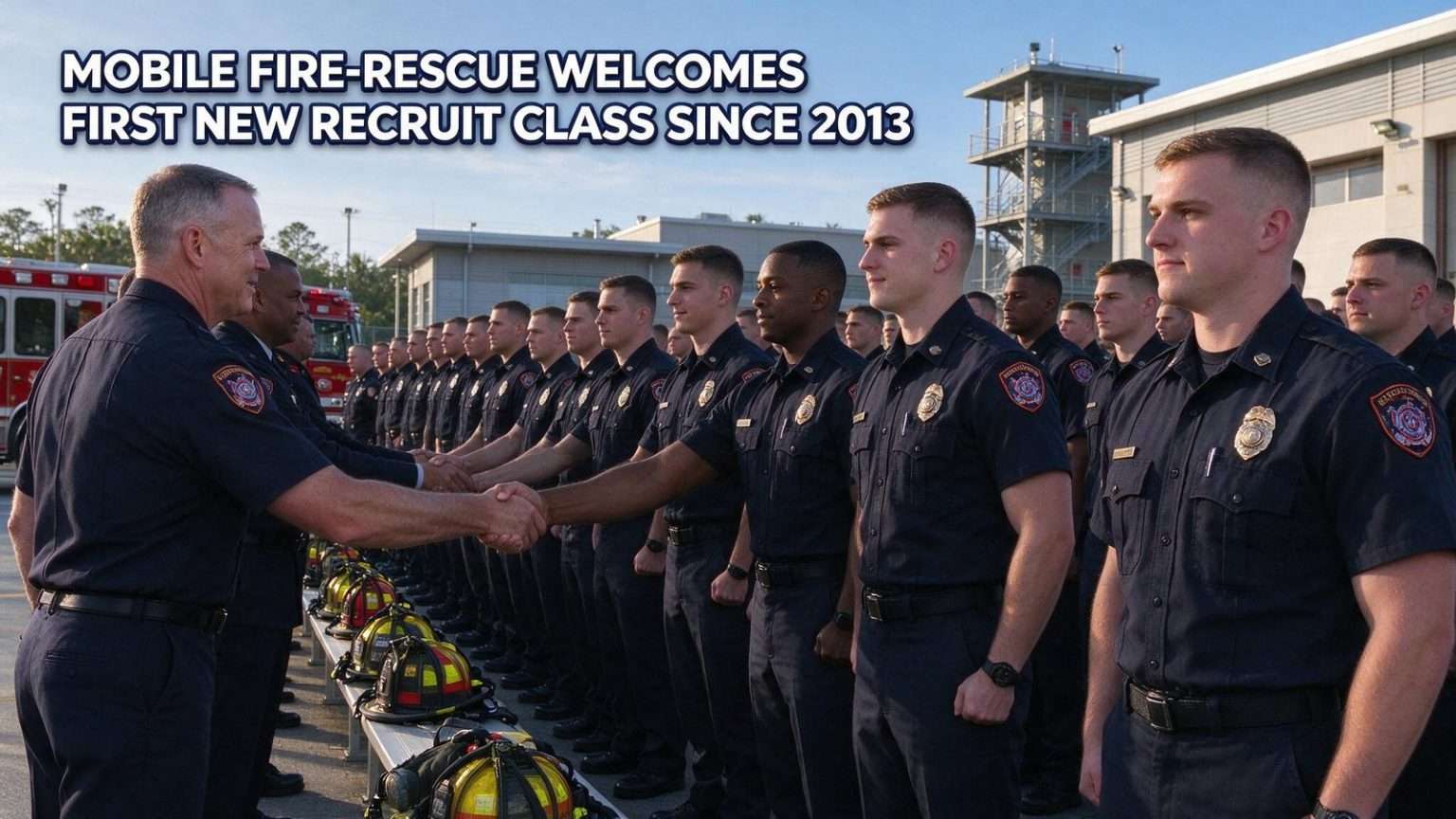
Mobile Fire-Rescue Department is growing its ranks for the first time since 2013, welcoming a class of 30 new recruits this week outside its training academy on Owens Street. The milestone ends a years-long hiring drought for the department and begins a rebuilding of the staffing levels that city and fire officials have described as overdue.
Mayor Sandy Stimpson greeted the group Monday morning, describing the recruits as a highly qualified and diverse class chosen from roughly 90 applicants. Every recruit selected already held at least a basic medic certification, and all but a handful arrived already certified to fight fires, a qualification profile that sets this class apart from a typical hiring cycle.
Officials say those existing certifications will save the city hundreds of thousands of dollars in training costs, since the recruits won’t need the full training timeline required for applicants starting from scratch. That savings, city leaders say, could make it possible to bring on a second recruit class later this year, something that would help address long-standing understaffing concerns within the department.
A mayor’s welcome and a chief’s assessment
The mayor’s presence at the Monday morning welcome carried its own message. Stimpson’s administration has made public safety staffing a recurring theme of its budget requests, and appearing in person to greet the first recruit class in years signaled the priority the city places on the department’s recovery. Fire Chief Billy Pappas called the new class a significant boost for the department’s staffing levels.
The selection of 30 from roughly 90 applicants reflects both the competitiveness of the hiring and the standards involved. Requiring a basic medic certification as a condition of hire narrows the applicant pool dramatically, but it changes what the department gets for its training dollar: instead of spending months teaching candidates emergency medical care from the ground up, the academy can focus on the fire-side skills that complete a recruit’s preparation.
The medical certification requirement tracks the reality of modern firefighting. Across American cities, the majority of calls that fire departments answer are medical emergencies rather than fires, and Mobile is no exception. A department whose firefighters all arrive as certified medics can staff ambulances and engine companies interchangeably, a flexibility that directly affects response coverage across the city’s stations.
The accreditation change behind the savings
Part of the cost savings traces back to a change in how the department’s training academy is accredited. About a year and a half ago, the academy gained approval to hold classes locally rather than sending recruits to train in Tuscaloosa, cutting costs tied to travel, lodging and meals for months-long training stints.
The shift matters more than its administrative framing suggests. For years, Mobile’s recruits traveled to the Alabama Fire College in Tuscaloosa for portions of their certification, a arrangement that consumed weeks of per-diem, mileage and hotel costs for every class, all while the city’s own academy on Owens Street sat available. Winning approval to host the certification courses locally turned that recurring expense into savings that compound with every class the city runs.
Local training also shortens the pipeline. Recruits who train in their home city can move between the classroom and the drill field without travel logistics, and the department can integrate field experience into the curriculum, pairing classroom weeks with ride-alongs and station time in ways that a distant program cannot. City officials have pointed to the accreditation change as the kind of structural fix that makes recurring hiring sustainable rather than episodic.
What the recruits are learning
A department spokesman said the recruits are learning far more than firefighting fundamentals. Training includes operating in full protective gear with limited oxygen supply, a physically demanding element of the job that takes weeks to master. The drills simulate the conditions of an interior fire attack, where self-contained breathing apparatus restricts visibility, communication and air supply, and where a firefighter’s conditioning determines how long they can work before needing relief.
That physical preparation is among the most demanding components of recruit training anywhere. Firefighters train in heavy turnout gear that adds substantial weight, in heat, while managing an air cylinder that imposes a hard limit on how long they can remain inside a structure. Building that capacity takes repetition over weeks, which is why the academy’s timeline matters to how quickly a class can reach the field.
Recruits who had already completed portions of their training were expected to be assigned to fire trucks within 30 days, officials said, which should help relieve reliance on overtime staffing to fill gaps in coverage. Getting certified personnel onto apparatus that quickly is the fastest way a city can convert a hiring class into relief for its working firefighters, who have shouldered mandatory and voluntary overtime through the hiring gap.
The overtime problem the class addresses
City officials have previously pointed to budget constraints as a driver of MFRD’s staffing challenges, noting the fire department has ranked among city departments with the highest overtime costs in recent years. Overtime in a fire department is not a discretionary expense; minimum staffing levels mean that every vacancy, vacation and sick day must be filled by someone working extra, and when hiring stalls, the overtime bill grows automatically.
The costs compound in ways that go beyond money. Extended overtime loads wear on the workforce, contributing to fatigue and attrition, and the cycle becomes self-reinforcing as departures create more vacancies for remaining personnel to cover. Breaking that cycle requires exactly what this week’s class represents: new hires reaching the field in numbers large enough to relieve the pressure.
Officials plan to hold similar recruit classes roughly every 18 months going forward, depending on staffing needs and interest from applicants. The cadence acknowledges both the math of attrition, as retirements and resignations steadily drain the roster, and the practical timeline of training, since a class that graduates every year and a half can hold staffing near its target if the applicant pool holds up.
What the first class since 2013 means
For a department that had not held a recruit class since 2013, the week carries symbolic weight alongside the operational one. The firefighters reporting to Owens Street are the first new faces in years, and their arrival marks the beginning of the long process of restoring the department to the staffing levels that a city of Mobile’s size expects from its fire service.
The qualification profile of this class also points to the department’s recruiting future. By targeting candidates who arrive already certified as medics and, in most cases, as firefighters, Mobile is drawing on the region’s community colleges and certification programs, which have steadily expanded fire science and EMS training along the Gulf Coast. That pipeline, paired with the locally accredited academy, gives the city a repeatable model for the classes officials say will follow.
For now, the 30 recruits have their marching orders: master the gear, master the air supply, and be ready to ride within weeks for those already far enough along. The city’s leaders, from the mayor who greeted them to the chief who will train them, have framed the class as the first installment of a rebuilt department, with a second class possibly later this year and a recurring cadence planned for the years ahead.
The decade-long gap since the last class is worth situating in the department’s recent history. A fire department that hires in regular cycles maintains a balance of experience, with veterans mentoring each wave of new hires and institutional knowledge passing down naturally. When hiring pauses for years, that balance tilts, and the workforce ages toward retirement together, creating the risk of a sudden wave of departures with no one trained to replace them. Breaking the drought restores the demographic ladder that every fire department needs.
Recruit classes also carry the culture of a department forward. The academy is where the values of the service are transmitted, from the chain of command to the habits of station life, and a class that trains together forms bonds that persist through entire careers. For Mobile Fire-Rescue, this week’s 30 recruits will be the cohort that anchors the department’s next generation of drivers, engineers, lieutenants and, eventually, chiefs.
The economics of the medic-first hiring strategy deserve a closer look. Basic medic certification, the emergency medical qualification that every recruit in this class carries, represents hundreds of hours of training that the city did not have to provide. Multiplied across 30 hires, the avoided instruction time is where the hundreds of thousands of dollars in savings come from, and it is the difference between a department that can afford annual classes and one that cannot.
The 30-day deployment timeline for the most advanced recruits compresses the payoff even further. Rather than waiting the full academy cycle for help on the trucks, the department can place certified firefighters on apparatus within a month, restoring coverage on the shifts that have been running short. Each recruit who reaches an engine or ambulance displaces overtime hours that the city would otherwise pay at premium rates.
Mobile’s approach mirrors what departments across the Gulf Coast have adopted as competition for certified firefighters has intensified. Regional fire services in Baldwin County, the Florida Panhandle and the Mississippi coast recruit from the same certification programs, and cities that offer a fast path from certification to employment hold the advantage. The Stimpson administration’s embrace of the strategy positions Mobile to compete for the Gulf Coast’s candidate pool rather than cede it to faster-hiring neighbors.
Applicant interest will determine whether the every-18-months plan holds. Fire careers remain a stable draw in coastal Alabama, offering pension-backed employment, a clear advancement ladder and a job with inherent meaning, and departments that publicize successful classes tend to see applicant numbers climb with each cycle. The roughly 90 applicants for 30 spots suggests a healthy ratio, one that a second class later this year would test.
The recruits’ first assignment is the academy’s crucible: weeks of drills in full protective gear, learning to work inside a self-contained breathing apparatus’s limited air supply until the limitation becomes second nature. From Owens Street they will spread to stations across the city, the first reinforcements Mobile’s fire stations have received in more than a decade, and the vanguard of the hiring rhythm city officials say will carry the department forward.