Most Mobile Residents Want City Executives Living Inside City Limits
A large majority of local readers say top Mobile city officials should be required to actually live within the city they help run.
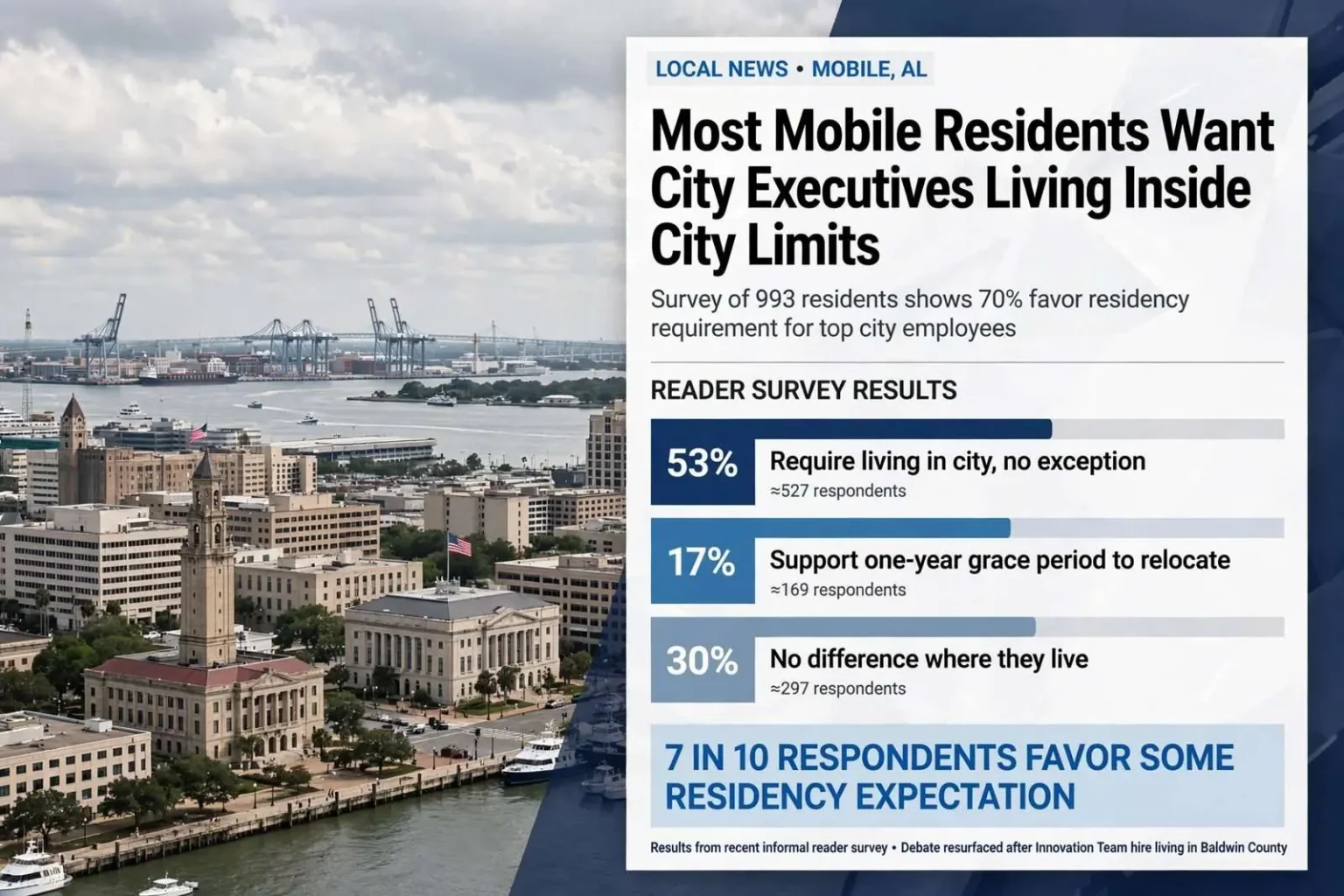
A clear majority of Mobile-area residents believe the city’s highest-ranking employees should be required to live within the city limits they serve, according to results from a recent informal reader survey that drew nearly a thousand responses. The results gave a numerical shape to a debate that has surfaced periodically around city hall for years — and that returned with new energy after a high-profile hire put a Baldwin County address at the center of the question.
Of the 993 people who took part, about 53 percent said all executive-level city of Mobile employees should have to live inside the city without exception. Another 17 percent said they would support giving new hires a one-year grace period to relocate into the city before enforcing a residency requirement. The remaining roughly 30 percent said it makes no real difference to them where high-ranking employees choose to live. In other words, seven in ten respondents favored some form of residency expectation, whether immediate or eventual — a margin that surprised even some observers of Mobile politics.
The debate resurfaced after Mobile Mayor Sandy Stimpson hired Joan Dunlap, a Mobile native who currently lives in Baldwin County, to lead the city’s newly formed Innovation Team, an initiative funded through a grant from Bloomberg Philanthropies aimed at improving city government efficiency and services. The team, part of a national program that has placed innovation officers in cities across the country, was billed as a way to bring data-driven problem-solving to municipal operations — but its first hire revived the oldest question in local government hiring: can someone who pays taxes across the bay really lead Mobile’s government from the inside?
The Numbers Behind the Dispute
Colby Cooper, Stimpson’s chief of staff, confirmed that Dunlap’s appointment means roughly one-third of the mayor’s twelve-member executive staff currently lives in Baldwin County rather than Mobile County. Cooper also noted that the residency question extends well beyond the mayor’s inner circle: more than 800 city employees, or about a third of Mobile’s total municipal payroll, live outside Mobile County altogether. Those figures reframed the debate from a question about one appointment into a portrait of a city government whose workforce is, in significant part, suburban and even exurban.
The pattern is a familiar one in metro areas across the country. City employees — including police officers, firefighters, engineers and administrators — frequently choose to live in neighboring jurisdictions where housing costs, schools or space better fit their families, while working inside the city limits every day. Mobile’s situation is sharpened by its geography: the city limits sit within a larger metro whose growth since the mid-twentieth century has flowed steadily across Mobile Bay and down the Western Shore corridors, leaving a city whose daytime population and tax base depend on people whose mailing addresses may be Daphne, Spanish Fort, Fairhope or Satsuma.
Supporters of residency requirements argue the stakes are about more than optics. When top administrators live in the city, they argue, their daily experience — the potholes, the trash pickup, the school zones — is the same one residents are having, and municipal decisions get made by people with skin in the game. Dollars matter too: salaries paid from Mobile’s budget spent in Mobile’s economy, and homes owned by city leaders generating Mobile’s property tax, are visible ways leadership shares the burden it manages.
The Case for Flexibility
Critics of a hard residency rule counter that it can shrink the pool of qualified applicants, particularly for specialized roles. The Innovation Team hire is a case study in that tension: the position demanded a particular set of skills in data analysis and government process improvement, and Bloomberg Philanthropies’ program was designed to let cities recruit the best person available, not the best person within the city limits. Restricting such hires to current city residents, the argument goes, trades quality for symbolism — and residents pay the price in worse services.
The critics’ argument extends across the municipal workforce. A police department or public works division that must compete with county governments, private employers and neighboring states for talent cannot necessarily afford to filter candidates by address, and enforcement raises practical questions: who monitors compliance, what counts as a residence, and whether forcing an employee to sell a home to keep a job is a reasonable condition of public employment. Courts in some states have struck down or limited residency rules, and even where they are legal, they are difficult to administer fairly.
There is also the matter of what the survey itself represented. Informal reader surveys measure the engagement of a news audience rather than the city as a whole — respondents skew toward people who follow local news closely enough to answer — but the near-unanimity of the engaged response, with 70 percent favoring some residency expectation, still told city officials something about the climate they operate in.
The Mayor’s Position
City officials have not announced plans to change hiring policy in response to the survey or the controversy, and the Stimpson administration has defended Dunlap’s appointment on merit grounds while acknowledging the optics. The mayor’s office has framed the Innovation Team as an investment in making city government work better for every resident, wherever the team’s members happen to sleep, and Cooper’s candor about the numbers suggested the administration preferred transparency to quiet on the subject.
Whether that position holds may depend on how the broader conversation develops. Residency requirements have been debated in Mobile before, and they carry political weight in a city where the boundary between Mobile and Baldwin counties is both a bridge and a rivalry. Proponents of a requirement could press the city council to take up an ordinance, though any such rule would apply prospectively and would likely include exemptions for specialized hires like the Innovation Team positions — the very carve-out that makes critics of strict residency rules shrug.
What Residents Said
The survey’s middle option — a one-year grace period for new hires — drew the smallest share of support at 17 percent, suggesting that respondents saw the question less as a logistical problem to be managed than a matter of principle: either the city’s leaders should live in the city, or it should not matter at all. That binary framing mirrors the national debate over residency rules, where compromise positions tend to satisfy neither side.
What is not in dispute is the underlying fact pattern: a mayor’s executive staff one-third rooted across the bay, a municipal payroll one-third living outside the county, and a public that — at least among the nearly thousand who answered — wants its city run by people who live in it. The Innovation Team’s work will proceed with its director commuting from Baldwin County, and the residency question will wait, as it always has, for the next appointment that puts it back on the front page.
The Mobile-Baldwin Divide
Any discussion of residency in Mobile eventually runs into the reality of the two-county metro. Mobile and Baldwin counties are linked by the Jubilee Parkway on I-10 and the Cochrane-Africatown USA Bridge on the Blakeley Highway, and the daily commute across Mobile Bay runs in both directions — Mobile workers living in Baldwin’s fast-growing suburbs, and Baldwin workers commuting into the Port City. The Eastern Shore’s population growth over the past three decades has made the cross-bay commute one of the metro’s defining patterns, and city employment is woven into it.
For Mobile’s municipal budget, the pattern has real consequences. Salaries funded by Mobile taxpayers are spent, in part, in communities whose governments never contribute to the city’s revenues, and property owned by city employees is taxed by the cities where it sits. Residency advocates treat that arithmetic as an argument; opponents respond that workers are free to live where they choose and that public employment should not come with a housing mandate that private employment never imposes.
The divide also carries a racial and historical dimension that the survey results don’t capture. Mobile’s city limits contain most of the metro’s Black population, while Baldwin County is overwhelmingly white, and residency debates in Southern cities have long intersected with questions about who counts as the city’s stakeholders and who benefits from its government jobs. How the conversation proceeds — and whether it stays focused on services and taxes or picks up that deeper history — may shape how much traction a formal requirement ever gains at city hall.
How Other Cities Have Handled It
Residency requirements run the gamut nationwide. Some cities require all employees to live within limits; many require it only for safety personnel or department heads; others have abandoned rules entirely after recruitment struggles. The trend over recent decades has been toward loosening, driven by the same forces Mobile’s critics cite: competitive hiring markets, dual-income households and the recognition that a talented administrator living ten miles outside the limits delivers more value than a mediocre one inside them.
The Bloomberg Philanthropies model that funded Mobile’s Innovation Team generally leaves staffing choices to each city, but its premise — that innovation leaders should be recruited on talent — sits uneasily with strict residency rules, which is why several program cities have granted their innovation hires exemptions. Mobile’s experience with Dunlap’s appointment fits that pattern exactly: a position created to bring outside-best practices colliding with a community’s preference for insiders.
For now, the survey stands as a snapshot of resident sentiment — 53 percent for a strict rule, 17 percent for a grace period, 30 percent indifferent — and as a data point the administration cannot entirely ignore. If the city ever formalizes a residency policy, the numbers from this debate will be cited as evidence that the public wanted action; if it does not, they will be cited as evidence of a public preference that went unheeded. Either way, the question of where Mobile’s leaders lay their heads at night has been squarely asked, and it is not going away.