Mobile Mayor Lays Out Timeline for Civic Center’s Eventual Closure
Mobile Mayor Sandy Stimpson has outlined a tentative schedule that could lead to the Civic Center's closure by April 2016 for redevelopment.
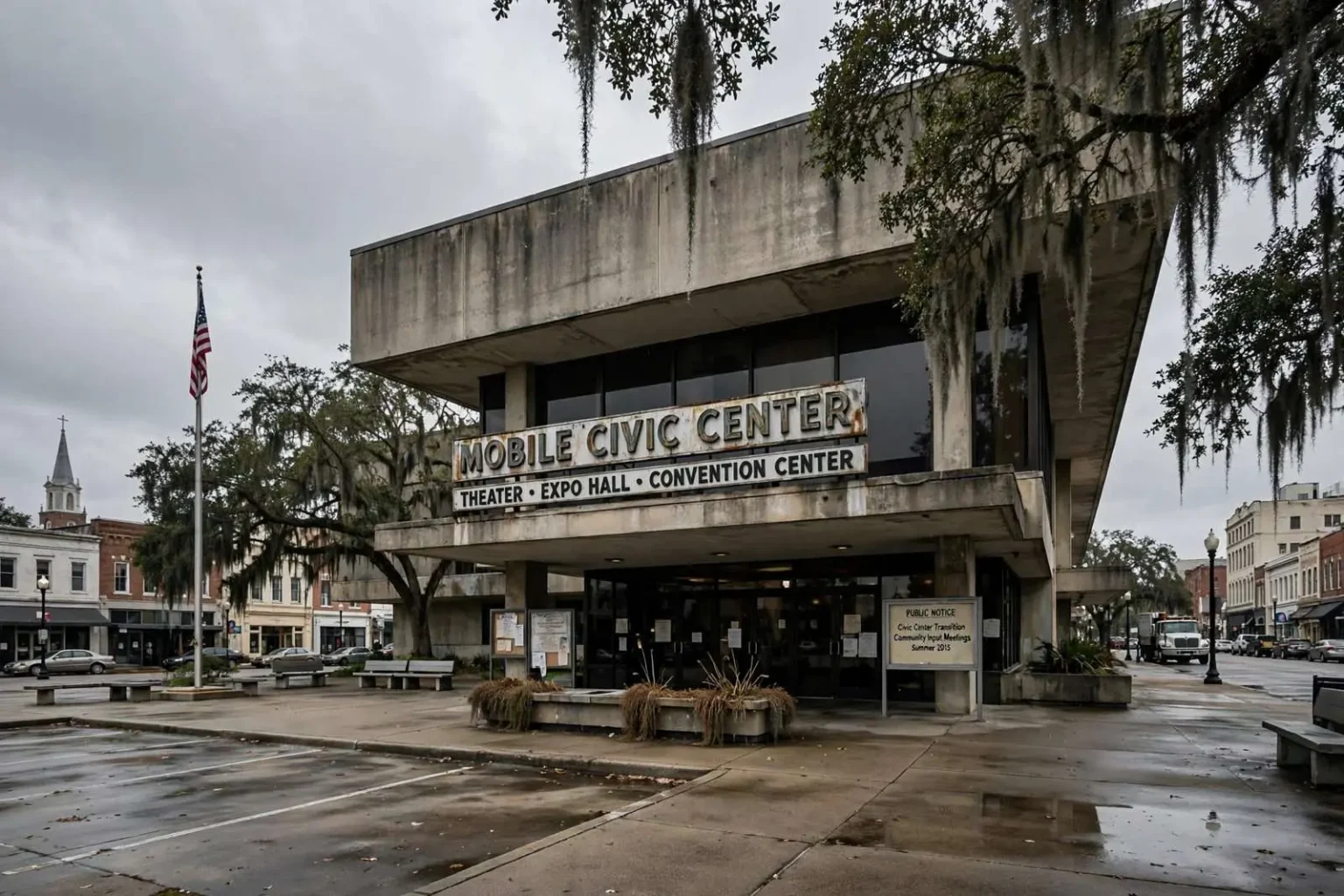
MOBILE, Alabama — Mobile Mayor Sandy Stimpson has outlined a tentative timeline that could lead to the closure of the aging Mobile Civic Center complex by April 2016, part of a broader push to find a public-private partnership to redevelop the downtown site. The announcement sets in motion one of the most consequential downtown redevelopment questions the city has faced in decades, with the fate of a venue that anchors Mobile’s cultural calendar now tied to a schedule that begins within months.
In a statement, Stimpson said keeping the civic center running currently costs the city roughly $2 million a year, while bringing the facility and its connected theater and expo hall into compliance with the Americans with Disabilities Act would cost about $20 million — and double that to bring the aging complex up to modern standards. Those figures frame the administration’s argument: the complex is not merely old but costly, and the price of keeping it useful keeps climbing.
“Organizations can maintain their use of the Civic Center complex until April 24, 2016,” Stimpson said. The date gives resident organizations and event promoters a fixed horizon for planning, and it anchors every other step in the transition the mayor’s office has sketched out.
A spokesman for the mayor’s office said the target closure date followed a review of the venue’s 2016 event bookings. The review determined that April 24 fell at a point where the complex’s remaining commitments could be honored while leaving most of the following year free for whatever the redevelopment process produces.
The Road To A Decision
Stimpson’s office released a rough sequence for the transition: soliciting expressions of interest from developers in spring 2015, hosting community conversations over the summer, issuing a formal request for proposals later in the year, and awarding a redevelopment contract by winter or spring of 2016 ahead of the facility’s closure. The pace is aggressive by municipal standards, compressing solicitation, public input and contract award into roughly a year.
Each step builds public involvement into the schedule deliberately. The community conversations planned for the summer are positioned as the point where residents, event organizers and downtown stakeholders can shape what the city seeks in a redevelopment partner, before the request for proposals locks in the requirements.
The public-private partnership model is the linchpin. City officials have not detailed what might replace the civic center, saying only that a strong public-private partnership would be needed to limit the financial burden on Mobile taxpayers while unlocking new possibilities for the downtown property.
The Organizations That Call It Home
The mayor acknowledged the civic center complex remains home to organizations woven into Mobile’s cultural life, including several Mardi Gras societies, the Mobile Opera, the Mobile Ballet, Distinguished Young Women and the Mobile International Festival. Each of those groups uses the complex differently, and each now faces a question that looms over the transition: where do they go when the doors close.
Mardi Gras societies hold their balls in the civic center during Carnival season, a tradition that makes the venue part of the oldest Mardi Gras celebration in the country. Mobile Opera and Mobile Ballet mount their seasons on its stages, and the expo hall’s flexible floor space hosts everything from the Mobile International Festival’s cultural showcases to the Distinguished Young Women program that brings contestants from across the country downtown each year.
He said the city intends to work with those groups to ease the transition even as it pursues redevelopment of the site. What that assistance looks like — alternate venues, scheduling help, financial support for relocations — will become clearer as the timeline advances, but the organizations’ seasons do not pause while the city plans.
Decades Of Events
The civic center has served as a multipurpose venue for Mobile for decades, hosting everything from concerts and conventions to graduation ceremonies, and its potential closure has stirred discussion among residents who have marked milestones there for generations. Its theater and expo hall have held touring acts, trade shows, political events and civic gatherings, giving the complex a place in the memory of nearly every Mobile household.
That familiarity cuts both ways. The complex is beloved as a setting but criticized as a facility: aging systems, accessibility gaps and maintenance costs that have grown faster than the bookings that offset them. The $2 million annual operating cost represents money that cannot fund streets, parks or public safety, and the compliance bill of roughly $20 million — with modernization running twice that — would be the largest single investment the venue has ever required.
What Downtown Has At Stake
The civic center site occupies a significant footprint in downtown Mobile, and its redevelopment is viewed at city hall as a chance to reshape a block that has been dominated by a single aging facility. Cities across the country have faced the same calculus with their postwar civic centers: the venues that anchored downtown life in the 1960s and 1970s no longer compete with modern arenas and convention spaces, and their upkeep outpaces their revenue.
The administration’s public-private framework reflects what those other cities have learned. A redevelopment that relies on the city’s budget alone would compete with every other capital need for years, while a partnership structure spreads the cost and brings private management discipline to whatever replaces the complex. The trade-off, which the community conversations are expected to explore, is determining how much of the site’s future the public shapes and how much a private partner directs.
For the organizations that perform there, the transition timeline creates both urgency and opportunity. Mardi Gras societies planning future balls, the Opera and Ballet mapping seasons, and event organizers booking conventions all need answers within the year, and the city’s schedule anticipates those needs moving through 2015 into the spring 2016 closure.
The closure date of April 24, 2016, remains tentative, tied to the redevelopment sequence holding its schedule. What is not tentative is the arithmetic behind the decision: roughly $2 million a year to operate, about $20 million to reach federal accessibility compliance, and double that to modernize — a trajectory that made the question not whether Mobile could afford to redevelop its civic center, but whether it could afford not to.
The Americans with Disabilities Act compliance figure deserves attention on its own. Federal accessibility law requires public facilities to provide accessible seating, entrances, restrooms and circulation, and retrofitting a 1960s-era complex — with its theater, expo hall and connected spaces — means touching nearly every part of the building. The $20 million estimate covers only compliance, not the roof systems, mechanical plants, audio-visual infrastructure and backstage facilities that modern touring acts and conventions now expect.
That gap is what city officials mean by modern standards. A venue that is merely accessible but not competitive loses bookings to newer facilities in the region, and Mobile’s civic center has increasingly competed for events against venues with larger floors, more loading capacity and updated sound and staging systems. The mayor’s figures describe a building that would require tens of millions in investment simply to keep doing what it does now, with no guarantee of a growing event calendar afterward.
The annual operating loss compounds the problem. A venue that costs $2 million a year to keep open represents a recurring commitment that repeats whether or not the building hosts a strong calendar of events, and those annual costs would continue alongside any capital spending on renovations.
The spring 2015 solicitation for expressions of interest is the formal start of the process, but city hall has been signaling the direction for months. Expressions of interest let developers, operators and investment groups describe what they might build or run on the site without the formality of a bid, giving the city a map of realistic possibilities before it writes its request for proposals.
Downtown Mobile’s revitalization adds context to the timing. The city’s central business district and historic districts have seen sustained reinvestment in recent years, from restaurants and nightlife around Dauphin Street to residential conversions and the continued growth of the port and aerospace economy. A redeveloped civic center site — or a replacement venue — would plug into a downtown that is more active than at any point in a generation.
The mayor’s office has kept its description of the end result deliberately open, but the categories of possibility are familiar from peer cities: a modern event venue operated with private capital, a mixed-use development that incorporates civic space, or a hybrid that keeps performance halls while adding private revenue-producing uses. Each path carries different implications for the organizations that depend on the current complex, which is why the city has promised to work with them through the transition.
Mobile’s Mardi Gras obligations weigh heavily in that discussion. Carnival season places unique demands on a venue — ballroom capacity, staging, security and a schedule concentrated in the weeks before Lent — and any future plan that fails to accommodate the societies’ traditions would face immediate resistance in a city where Mardi Gras is a civic institution. The community conversations scheduled for the summer of 2015 are the venues where those priorities will be argued.
The transition, in short, is a years-long question compressed into a one-year schedule. The city has set the dates: expressions of interest in spring, community input in summer, a formal request for proposals in the fall, and a contract by the following winter or spring, with the current complex closing April 24, 2016.