State Grants to Fund Domestic Violence, Sexual Assault Services in Baldwin County
Alabama awarded more than $231,000 in grants to the Baldwin County Violence Project to fund shelter, counseling and advocacy for abuse victims.
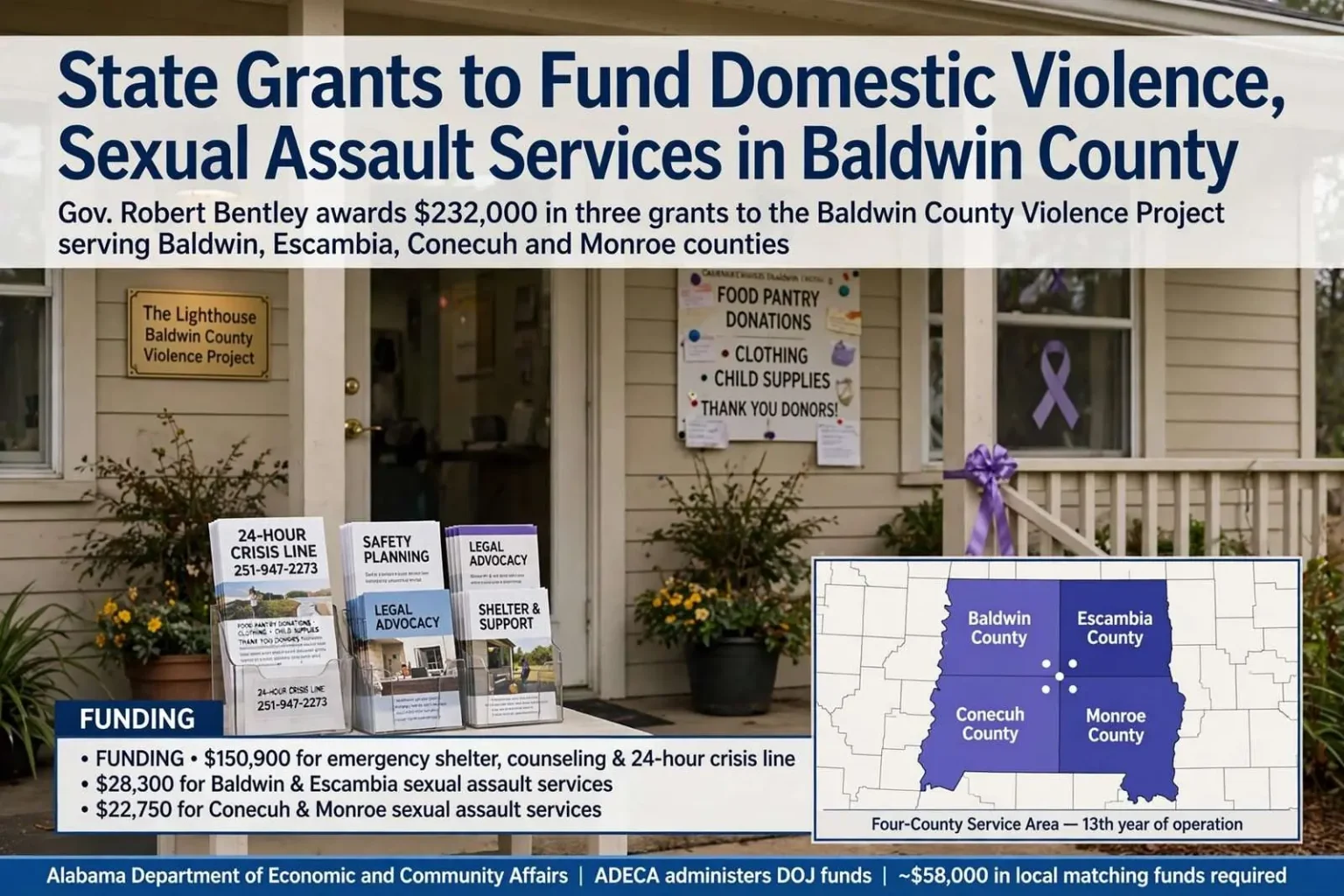
An Alabama nonprofit that serves victims of domestic violence and sexual assault across four South Alabama counties received a major infusion of state funding, with Gov. Robert Bentley awarding three separate grants totaling roughly $232,000 to the Baldwin County Violence Project.
The organization provides services across Baldwin, Escambia, Conecuh and Monroe counties, and the largest portion of the funding, about $150,900, will go toward emergency shelter, a 24-hour crisis line, counseling and advocacy for domestic violence victims across all four counties. A second grant of roughly $28,300 will extend sexual assault services specifically to victims in Baldwin and Escambia counties, while a third award of about $22,750 directs sexual assault services to Conecuh and Monroe counties.
The three-grant structure reflects how victim services actually reach people across a rural-urban service area. Baldwin County’s population centers support a different service delivery model than Escambia, Conecuh and Monroe, where victims may live an hour’s drive from the nearest counselor or shelter bed. Splitting the awards by county pair allows the organization to tailor outreach, staffing and response to the geography each grant covers rather than stretching a single program across four counties with very different needs.
Where the Money Comes From
The Alabama Department of Economic and Community Affairs, known as ADECA, is administering the grants using funds made available through the U.S. Department of Justice. The state agency oversees a wide range of programs beyond victim services, including law enforcement support, infrastructure, water resource management and workforce development, but officials highlighted the violence prevention funding as a priority given rising demand for these services regionally.
ADECA functions as Alabama’s clearinghouse for federal pass-through funding, channeling Justice Department money to local organizations that deliver services directly. That structure puts the burden of grant writing, reporting and compliance on organizations like the Baldwin County Violence Project, but it also allows local providers — who know their communities — to compete for dollars that might otherwise never leave the state capitol. The grants will be supplemented by roughly $58,000 in matching funds.
Match requirements are standard in federal victim services funding, and they require nonprofits to raise local dollars simply to unlock the federal ones. For a organization funded heavily by private donations, every fundraising campaign carries a double purpose: it sustains services and it preserves eligibility for the grants that anchor the budget.
The Work the Grants Sustain
Joanne Sheils, executive director of The Lighthouse, the organization that runs the Baldwin County Violence Project, said the state funding is essential to keeping the programs running at all. She described a collaborative approach that draws on multiple community partners to serve both men and women affected by abuse, rather than operating in isolation from other local systems.
The collaborative model matters because no single agency can meet a victim’s full range of needs. A typical case can pass through a hospital emergency room, a law enforcement report, a prosecutor’s office, a shelter intake and a civil court fight over protective orders — and victims who must navigate those systems alone often give up before reaching safety. Advocates who coordinate across those institutions function as the connective tissue, which is why grant funding for advocacy positions translates directly into cases that stay open and victims who stay reached.
Sheils noted that reports of sexual assault in Baldwin County tend to climb during the summer months, a pattern she attributed partly to more residents being out and about as the weather warms. Seasonal patterns shape staffing for victim services the way they shape beach patrols: summer brings more visitors, more social activity, more late-night gatherings — and more demand on crisis lines and advocates’ time.
The organization, now in its 13th year of operation, pairs advocates with victims to assess immediate needs and connect them with additional community resources when necessary, whether that means medical care, legal assistance or longer-term housing support.
Thirteen years has given the organization institutional knowledge that funding cycles alone cannot replace. Advocates who have served a community for years know which clinics handle forensic exams with trained staff, which judges hear protective order petitions promptly, which landlords work with victims who need emergency transfers, and which congregations will quietly help a family relocate. That knowledge is what turns a grant award into a functioning safety net.
The Four-County Service Area
Serving Baldwin, Escambia, Conecuh and Monroe counties means covering some of the longest distances in South Alabama’s service landscape. Baldwin County alone stretches from the Mobile Bay shore to the Florida line, while the three rural counties to its northeast are among the least densely populated in the state. Rural victims face barriers their urban counterparts rarely consider: no public transportation, fewer neighbors within earshot, longer response times and the privacy impossible in a small town where everyone knows everyone.
A 24-hour crisis line narrows some of that distance. For a victim in Monroe County, a phone call may be the first — and sometimes the only — contact with the service network, which makes the line’s staffing and training as important as any shelter facility. Advocates who answer those calls screen for immediate danger, explain options and arrange the next step, whether that is a shelter bed, a hospital accompaniment or simply a safety plan for a victim who is not ready to leave.
Funding the Safety Net
Beyond state and federal grant dollars, the Baldwin County Violence Project relies heavily on private donations to keep its full range of services free for victims who seek help. The free-services model is standard among victim services organizations, and it is deliberate: charging a victim for shelter, counseling or advocacy would put the cost of someone else’s violence on the person who suffered it.
That model, however, means the organization competes year-round for the charitable dollars that pay what grants do not. Community fundraisers, donor campaigns and partner contributions carry real programs — food for shelter residents, transportation to court dates, school supplies for children who arrive with their mothers at the shelter door. When demand rises, those are the budgets that stretch first and snap first.
Organizers say that combination of public funding and community support has allowed the program to expand its reach across the four-county service area even as demand for shelter and crisis intervention services has grown. Victim services providers across Alabama report sustained increases in demand, driven by both greater awareness and outreach that reaches victims who once suffered in silence — a sign of progress that also carries a price.
How Victims and Neighbors Can Reach Help
Anyone in Baldwin, Escambia, Conecuh or Monroe counties who needs assistance related to domestic violence or sexual assault can reach the organization’s crisis line, which operates around the clock to connect callers with local shelter, counseling and advocacy resources.
The 24-hour line serves not only victims but the people around them. Friends, family members, clergy and employers who suspect abuse can call for guidance on how to help, what to say and which local resources exist. Advocates field those calls with the same training they bring to crisis response, because a well-advised third party often determines whether a victim ever makes the call for themselves.
Grant awards like the three announced by Gov. Bentley are the quiet infrastructure behind that availability. Crisis lines, shelter beds and court advocates do not appear by accident; they exist because state agencies, federal funders and local donors each fund a piece of the system, and because organizations like The Lighthouse assemble those pieces into a service that answers the phone at 3 a.m. in four counties at once.
The grant announcements also serve a public function beyond the money. When a governor’s office highlights domestic violence funding, it signals to victims in the smallest towns of Conecuh and Monroe counties that help exists near them — a message that victim services providers say reaches people no hotline list ever will. Publicized funding rounds prompt calls, and calls are where every shelter stay, protective order and counseling relationship begins.
For the organization entering its 13th year, the roughly $232,000 in new awards represents continuity — the resources to keep advocates in the field, the shelter open and the crisis line staffed across another year of rising demand in South Alabama. The matching funds the grants require will come from the same community donors who have carried the program since its founding, completing the loop between public commitment and the local support that makes it work.
Thirteen years of operation has also built institutional knowledge that funding cycles alone cannot replace. Advocates who have served the community for years know which clinics handle forensic exams with trained staff, which landlords work with victims who need emergency transfers, and which resources in each of the four counties respond fastest when a family’s safety depends on hours rather than days. That accumulated experience is part of what each round of grant funding sustains, and part of why officials describe the program as an essential thread in the region’s safety net.