University of South Alabama Baldwin County
How Mobile and Baldwin Counties Marked Martin Luther King Jr. Day in 2015
Churches, colleges and civic groups across Mobile and Baldwin counties held marches, breakfasts and services honoring Dr. King in January 2015.
MOBILE, Alabama — Communities across Mobile and Baldwin counties came together in January 2015 for a series of marches, church services, breakfasts and educational programs honoring the legacy of the Rev. Dr. Martin Luther King Jr., continuing decades-old local traditions tied to the federal holiday.
The observances stretched across a full week on both sides of the bay, from breakfasts that filled church and campus halls at sunrise to evening services that packed pews, and from the long-established marches in Mobile and Prichard to community walks in Baldwin County towns that have kept their own versions of the tradition alive.
Mobile: ‘The Dream Alive’ at Bishop State
In Mobile, Bishop State Community College hosted “The Dream Alive,” a tribute presentation featuring guest speaker the Rev. Robert R.A. Turner of St. Paul A.M.E. Church in Tuscaloosa. The program connected the King legacy to a new generation of students and community members gathered on the downtown campus.
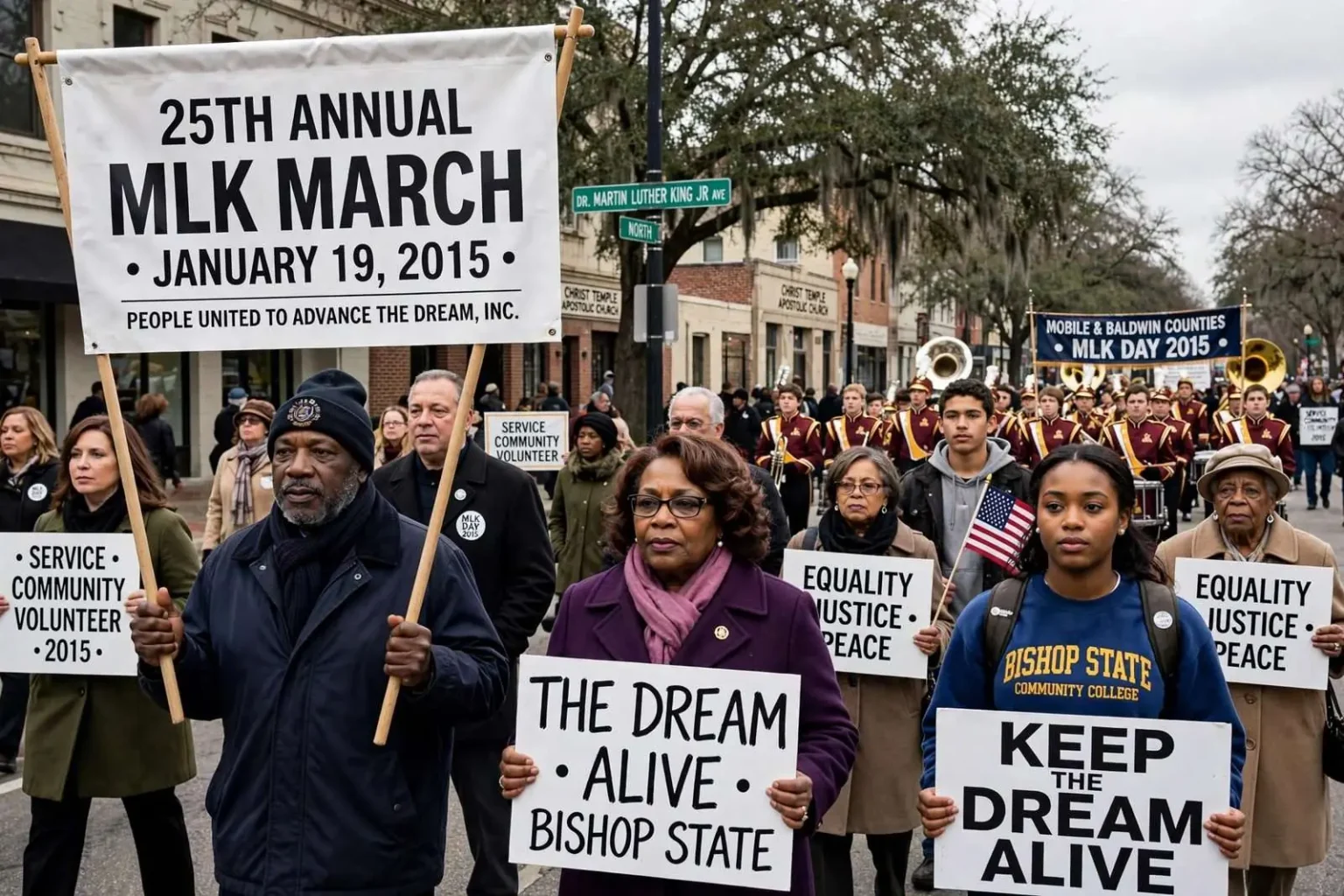
The organization People United to Advance the Dream, Inc. organized several events that week, including a fellowship dinner at Christ Temple Apostolic Church, an ecumenical service at Mount Hebron Ministries, and the 25th annual Martin Luther King march, which began at Bishop State’s campus, proceeded down Dr. Martin Luther King Jr. Avenue and ended with a rally at Lyons Park.
The march route itself tells the history of the neighborhood it honors. Dr. Martin Luther King Jr. Avenue runs through one of Mobile’s most historically significant Black communities, and the annual walk down the avenue bearing his name — now a quarter century old by 2015 — had become the anchor event of the city’s holiday calendar, drawing participants from churches, schools, civic groups and neighborhood associations across the city.
Marches of that age accumulate their own customs: the banners carried year after year, the families who claim their place near the front, the marching bands and church groups that fill out the line. Regulars know the route by heart, and each January’s crowd is measured against the ones before it.
The rally at Lyons Park gave the march its destination and its voice, with community speakers and an audience that stayed long after the walking was done. For many families, the full arc — dinner, service, march, rally — represented a week of commitments kept year after year.
Prichard: A March and Rally of Its Own
Prichard held its own march and rally that year, starting near the Bill Clark Center and ending at the A.J. Cooper Municipal Complex, with former Mobile Mayor Sam Jones serving as guest speaker. The event was sponsored in part by a local funeral home and the Prichard Housing Authority.
Prichard’s observance carried its own weight in the region’s civil rights history. The city, one of the first incorporated Black cities in the nation, has long marked the King holiday with events organized by and for its own community, and the march from the Bill Clark Center to the municipal complex put the city’s institutions — its schools, its churches, its housing authority, its businesses — at the center of the day.
The involvement of the Prichard Housing Authority and local businesses reflected how the holiday is observed across the Gulf Coast: not as a single city-run parade but as a patchwork of events funded and organized by the institutions that anchor each neighborhood.
South Alabama: Service and Breakfasts
Separately, the University of South Alabama organized an MLK Day of Service for students and campus organizations through its Center for Academic Service-Learning and Civic Engagement. The day of service sent students into the community in the holiday’s modern spirit — a day on, not a day off — with volunteer projects across Mobile.
The Port City Chapter of Blacks in Government hosted its 26th annual Martin Luther King Jr. Memorial Breakfast at Bishop State, featuring then-U.S. Attorney Kenyen Brown as guest speaker. The breakfast, a quarter-century tradition by 2015, brought together public employees, elected officials and community leaders for a morning of reflection on King’s legacy in public life.
Brown, who served as U.S. Attorney for the Southern District of Alabama, was a fitting choice for the chapter’s program, linking the federal justice system’s presence in Mobile to the civil rights movement whose landmark legal victories the holiday commemorates.
Baldwin County: Bay Minette, Daphne and Loxley
In Baldwin County, the Baldwin County Martin Luther King Celebration Committee organized a memorial program at a Bay Minette church, followed by the county’s 29th annual memorial march beginning at Daphne City Hall and ending at the Daphne Civic Center, where a Bay Minette city councilman delivered the keynote address.
The Baldwin observance was among the longest-running in the region — 29 years of marches by 2015 — and its geography told the story of the county’s Black communities, with the program opening in Bay Minette, the county seat, before the march moved through the streets of Daphne, home to one of Baldwin’s most established Black neighborhoods along the eastern shore of Mobile Bay.
Loxley residents held a separate community march along Highway 59, adding a third Baldwin County observance to the day. The march along the highway that serves as the town’s main artery gave Loxley’s observance a public face, passing the businesses and homes of the community it represented.
Together, the Baldwin County events showed how the holiday had taken root well beyond the urban core of Mobile — in smaller communities where church congregations, fraternal organizations and local committees carried the tradition with modest budgets but deep commitment.
What the 2015 Observances Meant
Taken together, the slate of 2015 observances reflected how deeply the King legacy runs through the civic life of Mobile and Baldwin counties. The events were not the product of a single organization or city hall; they were staged by community groups, churches, colleges, a university, a federal government employee organization and housing authorities, each with its own tradition reaching back decades.
The variety also reflected the many meanings the holiday holds: the breakfasts emphasized leadership and public service, the church services emphasized faith and memory, the marches emphasized community and visibility, and the university’s day of service emphasized the call to action that King’s work demands of each generation.
Weather and timing rarely dampen the tradition. The holiday falls in mid-January, when a Mobile morning can be mild or surprisingly cold, and the marches have gone forward through both. Organizers plan the routes with the weather in mind, keeping distances walkable for participants of all ages, and the rallies at the end give those who skip the walk a place to join the gathering.
Traditions Decades in the Making
By 2015, Mobile’s march was in its 25th year, Baldwin County’s in its 29th, and the Port City breakfast in its 26th — numbers that show how early and how firmly the Gulf Coast embraced the King holiday, which became a federal observance in 1986 after years of national debate.
The anniversaries also point to the organizers who built the traditions: pastors and community leaders who mapped the first routes, secured the first speakers and made the phone calls each January that keep the events on the calendar. By the time a march reaches its 25th year, it has outlived its founders’ involvement and become an inheritance that each new group of organizers takes up in turn.
The local traditions have typically paired the commemorative with the communal. A march is also a family reunion for the neighborhoods it passes through; a memorial breakfast is also a networking event for the officials and professionals it gathers; a church service is also a moment for a community to take stock of the year behind it and the work ahead.
The 2015 calendar carried that double purpose throughout. Bishop State, whose campus hosted both the tribute presentation and the memorial breakfast, has long stood at the intersection of education and community life in downtown Mobile, and its role in the week underscored how the observances pass the legacy from one generation to the next — from the pulpits and podiums to the students and children marching along the avenue.
A Legacy That Keeps Its Local Accent
The national holiday looks much the same everywhere on the calendar, but its observance is always local, and in south Alabama it carries a particular accent: the avenue named for King in Mobile, the first incorporated Black cities of Prichard, the established Black communities of Baldwin’s eastern shore, and the small towns along Highway 59 that march in their own names.
The January 2015 observances across Mobile and Baldwin counties honored that legacy the way it has been honored here for decades — in march steps and sermons, in breakfasts and volunteer shifts, and in the quiet repetition of traditions that began before many of their participants were born and will continue long after, as long as communities keep showing up for the dream they commemorate.