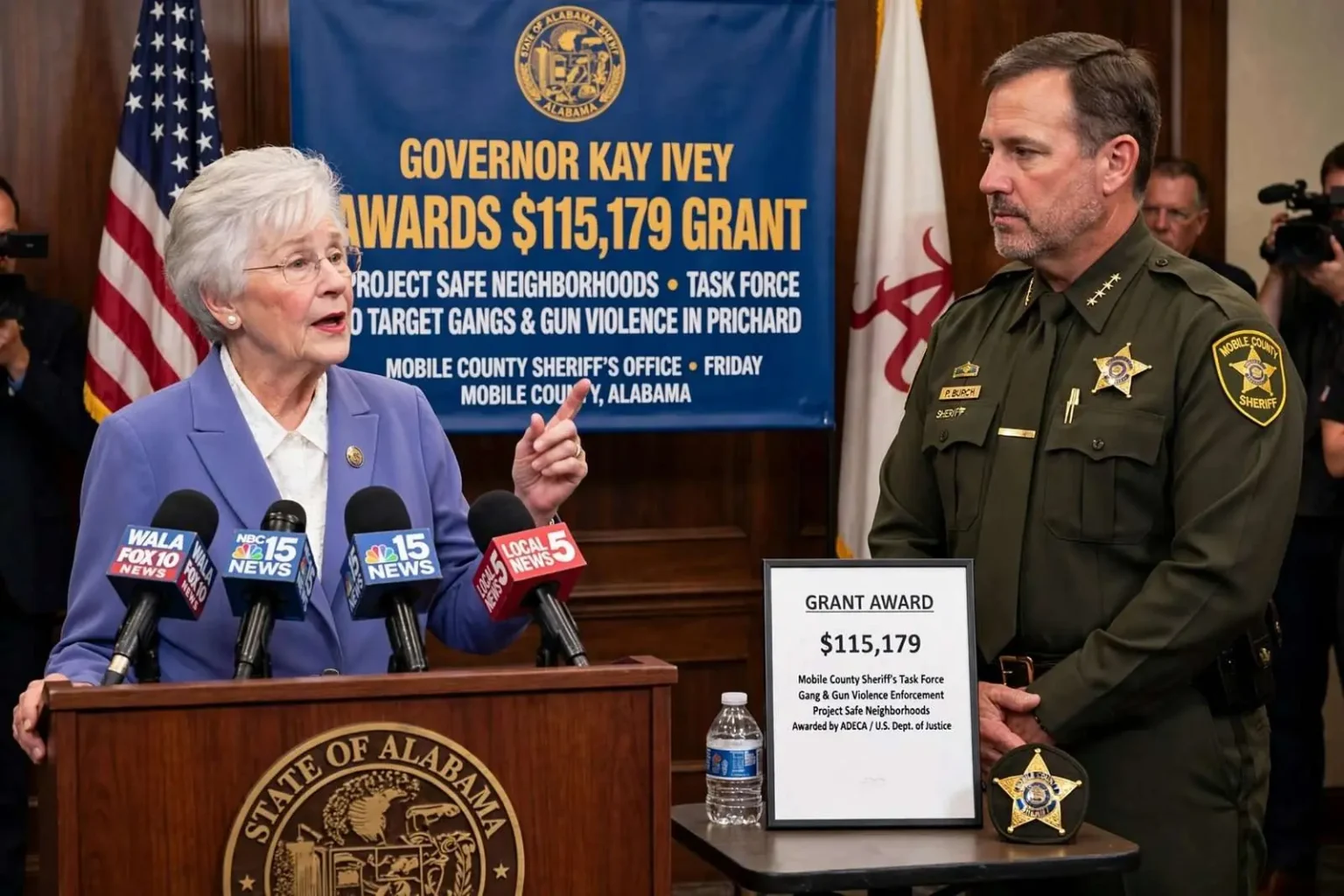
MOBILE COUNTY, Ala. — Gov. Kay Ivey announced Friday that Alabama is awarding $115,179 to Mobile County to support a task force targeting gang activity and gun violence in Prichard. The grant will help the Mobile County Sheriff’s Office establish a specialized unit to address major crimes and emergency operations in the city, adding manpower and investigative capacity at a moment when the county is already carrying an unusual share of Prichard’s policing burden. Funding originates with the U.S. Department of Justice’s Project Safe Neighborhoods program and is administered in Alabama by the Alabama Department of Economic and Community Affairs.
The award is modest by the standards of a big-city police budget, but it is aimed at a specific and expensive kind of work: focused enforcement against violent offenders, built on coordination between deputies, investigators and prosecutors. Grants of this type typically cover overtime, equipment and dedicated personnel hours rather than routine patrol costs, which makes them a tool for concentrating effort on the small number of offenders who drive most of a community’s gun violence.
Why the Sheriff’s Office Is Doing This Work
The Mobile County Sheriff’s Office has handled most police calls in Prichard since mid-June, when local and federal agencies announced the arrest of a Prichard Police Department officer as part of an ongoing corruption investigation. Several additional officers have been arrested since, including former Chief Walter Knight. The arrests upended the leadership of the city’s own department and left the county to fill the gap, with sheriff’s deputies answering the majority of calls for service in the city while questions about the police department’s future remained open.
That arrangement has placed a considerable operational load on the county. Sheriff Paul Burch has said the office is pursuing grants to offset the cost of the effort, while acknowledging that a long-term solution is still needed. Every deputy shifted into Prichard is one unavailable for patrol or investigations elsewhere in the county, a strain that shows up in response times and caseloads across the sheriff’s jurisdiction. Grant funding of this scale addresses a specific project rather than the underlying structural question of who polices Prichard and how it is paid for, a question that remains unresolved between the city and the county.
Prichard, a city of roughly 20,000 residents just north of Mobile, has struggled for years with tight municipal finances and the challenges that come with them. The city’s difficulties keeping a fully functioning police department have made the county’s involvement essential, and state officials have watched the situation closely as the corruption investigation has continued to unfold.
What Officials Said
“This initiative will strengthen public safety in Prichard and help secure convictions in criminal cases,” Ivey said. “I commend the Mobile County Sheriff’s Office for its dedication to serve communities and keep residents safe.” The governor’s announcement placed the grant within her administration’s broader emphasis on supporting law enforcement agencies that have taken on added responsibilities without added budgets, particularly in communities where local departments have been disrupted.
ADECA Director Kenneth Boswell added: “ADECA joins with Gov. Ivey in supporting law enforcement in their efforts to reduce crime and create a safer community for residents to call home.” ADECA, which administers federal public safety dollars passed through to Alabama communities, has long served as the conduit for programs like this one, reviewing applications from local agencies and distributing awards across the state.
What Project Safe Neighborhoods Funds
Project Safe Neighborhoods is a long-running federal program designed to reduce violent crime by coordinating federal, state and local law enforcement with prosecutors around specific, locally identified problems. Created by the Justice Department in 2001, the program operates on a simple premise: that the most effective way to cut gun violence is to identify the small networks responsible for it, build prosecutable cases against them, and deliver a message to the community that violence will draw certain consequences. Grants flow to district attorney offices, sheriff’s departments, police agencies and community partners who take part in that coordinated effort.
The emphasis on securing convictions reflects the program’s structure: it funds not only enforcement activity but the case-building work that determines whether arrests result in prosecutions that hold. For Prichard, where an evidence-handling scandal has already contributed to at least one case dismissal, that emphasis on prosecutable casework carries particular relevance. Cases that collapse in court because of questions about how evidence was collected or stored represent wasted enforcement effort and lost accountability, which is why the grant’s focus on building cases that can survive a trial matters as much as the arrests themselves.
What the Task Force Will Do
The specialized unit the grant supports is expected to concentrate on major crimes and emergency operations within Prichard, supplementing the sheriff’s office’s existing coverage of the city. Task forces of this kind typically pair experienced investigators with crime analysts, giving the agency a capacity to work cases longitudinally rather than reacting call by call. In practice, that means following gang-related shootings and gun crimes across jurisdictional lines, coordinating with Mobile Police, federal partners and prosecutors to build cases, and freeing patrol deputies to handle the daily volume of calls while the targeted work proceeds.
The grant was announced Friday by the governor’s office, and the money is expected to begin flowing to the county as the task force is stood up. Agencies receiving Project Safe Neighborhoods funds generally report back on arrests, cases referred for prosecution and community outreach, so the effect of the $115,179 will be measured not just in enforcement statistics but in whether the cases built by the unit hold up in Mobile County’s courtrooms.
The Road Ahead for Prichard
For Prichard residents, the grant does not answer the larger question hanging over the city: what its own police department will look like once the corruption investigation has run its course, and how the city will pay for policing in the years ahead. Sheriff Burch has been candid that county coverage of the city is not a permanent arrangement, and state-level grants, while helpful, cannot substitute for a stable local structure. In the meantime, the task force represents an attempt to keep violent crime in check while the city works through its institutional crisis.
The award also signals state confidence that the sheriff’s office can build cases that last. With the evidence-handling problems of the city’s former department still echoing through local prosecutions, the unit’s work will be judged by a demanding standard. If the task force succeeds, it will provide not just arrests but convictions, the measure by which Ivey’s announcement said the initiative should be known, and a foundation for whatever arrangement Mobile County and Prichard work out once the county’s extraordinary role in the city eventually comes to an end.
How the Grant Money Works
Award sizes like this one are typical of Project Safe Neighborhoods’ local allocations, which are designed to fund targeted initiatives rather than general operations. The money administered through ADECA generally reimburses the agency for the specific costs of the funded project, and unspent funds or costs outside the grant’s scope remain the county’s responsibility. Sheriff’s offices that receive such grants usually assign existing personnel to the funded unit and use the award to cover their overtime, training and equipment, stretching the dollars further than a straight salary line would.
The application and administration process also imposes discipline on the receiving agency. Grants carry reporting requirements, spending deadlines and audit trails, and the sheriff’s office will need to document how the task force’s hours and expenses tie back to the funded mission of reducing gang activity and gun violence in Prichard. For an office absorbing an unplanned citywide policing load, that paperwork burden is one more cost of the arrangement, though officials have framed the grant as a way to make the burden sustainable.
Enforcement in Context
Gang and gun violence enforcement in Mobile County has long been a shared project among the sheriff’s office, municipal departments and federal partners, with prosecutors in the Mobile County District Attorney’s Office and the U.S. Attorney’s office taking cases that cross city lines. Prichard’s neighborhoods sit within that larger landscape, and offenders rarely confine their activity to one jurisdiction, which is why the program’s model of coordination matters. A task force with dedicated investigators can follow a shooting from Prichard into Mobile or out into the county and build a case that includes all of it, rather than leaving fragments with different agencies.
The grant also arrives as Mobile County’s population continues to spread northward, with growth in communities around Prichard and along the Highway 45 corridor increasing the number of residents who depend on the sheriff’s office for coverage. That growth adds calls, cases and roads to patrol, and it underscores why county officials have argued since mid-June that covering Prichard’s calls cannot simply be absorbed by the existing force without help. The $115,179 is a down payment on that help, targeted at the most serious end of the workload.
Watching the Results
Residents of Prichard will judge the task force by what they experience: response times when shots are fired, visibility of deputies in the neighborhoods, and whether the arrests that follow lead to lasting accountability in court. Community leaders in the city have long argued that enforcement alone is not enough, and the most effective Project Safe Neighborhoods efforts nationally have paired the enforcement piece with community outreach and services aimed at preventing the next generation of offenders. Whether the local initiative grows to include that broader work will depend on funding and partnerships that extend beyond this award.
For now, the state’s message, delivered through Ivey’s Friday announcement, is that the county’s extraordinary effort in Prichard has been recognized and will be partially supported. The task force has a mandate, a funding stream and a clear measure of success in the governor’s own words: stronger public safety and convictions that hold. How far $115,179 goes toward that goal in a city the size of Prichard will become clear over the months the grant covers, and the results will inform the harder conversations about Prichard’s policing that still lie ahead.