
Nearly Four Decades Later, Family and Detectives Still Seek Answers in 1981 Todd Acres Murder
Brenda Peters was found beaten and stabbed in Mobile's Todd Acres area in 1981. Her brother and a detective vow to keep searching for answers.
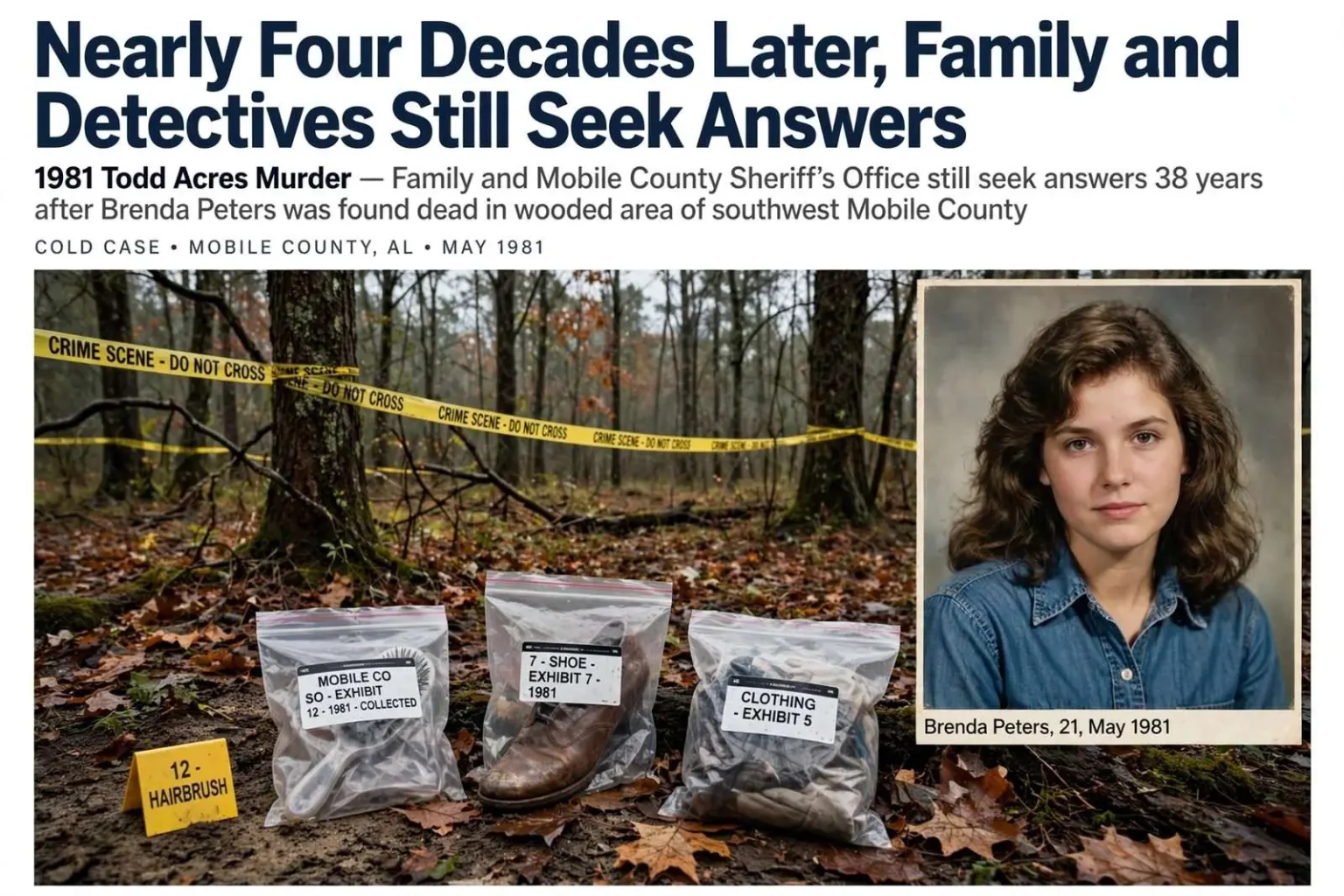
Almost 38 years after 21-year-old Brenda Peters was found dead in a wooded area of the Todd Acres community, her family and the investigators who worked the case say they have not given up hope of learning what happened to her. The case has outlasted sheriffs, investigators, and generations of change in forensics — but not the determination of the people who loved her.
Peters, a mother of three, was discovered in May 1981. She had been beaten and stabbed multiple times in what then-Sheriff Tom Purvis described as a deliberate, intentional attack. The killing shook the Todd Acres community, a rural stretch of southwest Mobile County where families had lived for generations and where a violent death of that kind was, and remains, rare.
Her brother, Ken Harden, was 14 at the time. “It haunts me,” Harden said. “The night the two detectives came and said they had found her body — it just tore my parents apart.”
Harden has carried the case with him ever since — through his teens, his own family, and into his 50s — pushing the Sheriff’s Office for updates and holding onto the belief that someone, somewhere, knows what happened in those woods in May 1981.
Detective J.T. Thornton of the Mobile County Sheriff’s Office, who has stayed with the case for decades, said a person of interest emerged early: Lovey Riddle, a career criminal who produced a confession he later recanted. Some details matched the case; others did not, and Riddle was ruled out at the time.
Last year, Thornton received a series of letters from a federal inmate in north Alabama, Kenneth Hooks, who offered details — some accurate, some not. It later emerged that Hooks had been incarcerated with Riddle, and Riddle told Thornton he had written some of the letters himself.
Thornton believes Riddle may have been trying to attach himself to a notorious case for status in prison. Confessions and near-confessions from inmates are a recurring complication in old cases, as investigators weigh whether a letter reflects knowledge only a killer would have or simply a story borrowed from newspapers and cellblock talk.
A phantom confession
Riddle once claimed to authorities in Maine that he had killed 30 women, a claim determined to be false. His record of recanted claims is one reason investigators discounted his early confession in the Peters case, even though some details appeared to match.
Both Thornton and Harden say they do not believe Riddle killed Peters. Harden suspects Riddle heard something in prison and ran with it. The attention, they say, diverted resources and energy from the harder question — who actually killed Peters — without ever producing an answer.
The letters arrived one after another, each claiming knowledge of the killing, each examined against the facts of the case that only investigators and the killer would know. When details failed to line up, Thornton traced the letters back through the prison system, a detective’s version of following a thread until it unravels. The exercise consumed months but settled a question that had lingered over the file.
For cold case detectives, phantom confessions are an occupational hazard. Notorious unsolved killings attract claimants the way landmarks attract tourists, and investigators develop a discipline for sorting genuine knowledge from borrowed detail: real confessions tend to contain facts never made public, and they survive contradiction. Riddle’s claims, examined against those standards, did not hold.
Thornton plans to resubmit Peters’ clothing, a shoe, and items recovered at the scene — including a hairbrush — for advanced forensic analysis in the hope that new technology may reveal something missed decades ago.
Thornton’s plan is to send the items to a laboratory equipped for the newest generation of testing, where analysts can apply methods that extract usable profiles from samples that older equipment would have discarded as unreadable. It is the same re-examination strategy that has revived cold cases across the country in recent years.
The items have been preserved for decades, and the forensic methods available today — DNA analysis that can produce profiles from samples once considered too small or too degraded to test — bear little resemblance to the techniques available to investigators in 1981. A single touch, a hair, or a trace of biological material on a preserved item can now yield a profile that can be compared against databases that did not exist when the case was new.
A case that refuses to go cold
“Maybe they’ll find something that we missed,” Thornton said. “Maybe they’ll find a drop of blood or something that may have come from the brief struggle that happened between Ms. Peters and her offender.”
Thornton’s persistence reflects a broader shift in how law enforcement approaches cold cases. Advances in DNA technology and investigative genealogy have solved cases across the country that sat unsolved for decades, and agencies that once closed the file on old homicides now routinely revisit them when new methods become available. The Mobile County Sheriff’s Office has seen its own cold cases cleared in recent years as evidence was reanalyzed with tools its original investigators could not have imagined.
For detectives, a case like Peters’ never really closes. Thornton has kept the file active through the tenures of multiple sheriffs, following up on letters, tips, and the slow accumulation of forensic possibility. The resubmission of evidence is the latest step in a process that he and the department describe as a promise made to the family: the case stays open until it is solved.
Todd Acres itself has changed with the decades, but not beyond recognition. The rural roads and woodlots that defined the community in 1981 remain, and some of the families who lived there when Peters was killed still do. Investigators know that in communities like this one, memories run deep and long — and that the answer to a 38-year-old question is more likely to come from a nearby porch than from a stranger far away.
Harden, now in his 50s, remains determined. “I’ll never give up until I take my last breath,” he said. “And then my children will probably carry on after me. I think she deserves a rightful answer. I deserve to know. Our family deserves to know.”
The family’s wait has spanned nearly four decades of milestones that Peters never got to see. Her three children grew up without their mother, and Harden has watched a generation pass in Todd Acres while the question of who killed her sat unanswered. It is the kind of loss that reshapes a family permanently, and the kind of case that investigators say they carry home with them.
Peters was 21 when she died — young enough that nearly everyone who knew her is still living, and old enough that her absence has touched every chapter of her children’s lives. Family members have said over the years that keeping her case in the public eye is deliberate: they believe someone in the community has carried a piece of the answer all along, whether a detail seen on the road that night, a remark made years later, or a truth that has never been told to investigators.
How the public can help
Anyone with information about the 1981 Todd Acres murder is asked to contact the Mobile County Sheriff’s Office. Cold case investigators stress that even fragments of memory can matter in a case this old — a name, a vehicle, a rumor heard decades ago and never reported. Tips can be taken anonymously, and investigators say the passage of time has loosened some tongues that stayed silent in 1981.
The Sheriff’s Office maintains the Peters case among its active cold cases, and Thornton continues to review the file as new information arrives. The resubmission of the preserved evidence for advanced forensic testing represents the most promising avenue in years, and its results — whenever they come — will either open a new chapter in the case or close off one more possibility.
Advances that have broken decades-old cases elsewhere in Alabama and across the country have reshaped what families in Harden’s position can reasonably hope for. Cases that were once resigned to file cabinets have been revived when a preserved item yielded a usable profile, and the reanalysis now underway in the Peters case is exactly the kind of second look that has produced those breakthroughs.
For Harden, the outcome he has waited 38 years for remains simple: an answer. Whether it comes from a laboratory, a witness, or a conscience unburdened after decades, his family’s message to whoever holds that answer has not changed since the two detectives came to their door in May 1981 — they are still listening, and they are not going anywhere.
Until then, the file stays open, the evidence stays preserved, and a brother’s promise holds: the search for what happened to Brenda Peters continues.


