She’s Been Missing Since 2022 and Has a Cognitive Disability That Makes Her Vulnerable to Using a Fake Name. Baldwin County Wants Her Found.
Baldwin County investigators are renewing their appeal for help finding Taylor Elizabeth Gipson, missing since July 2022, whose cognitive disability makes her vulnerable to using a false identity.
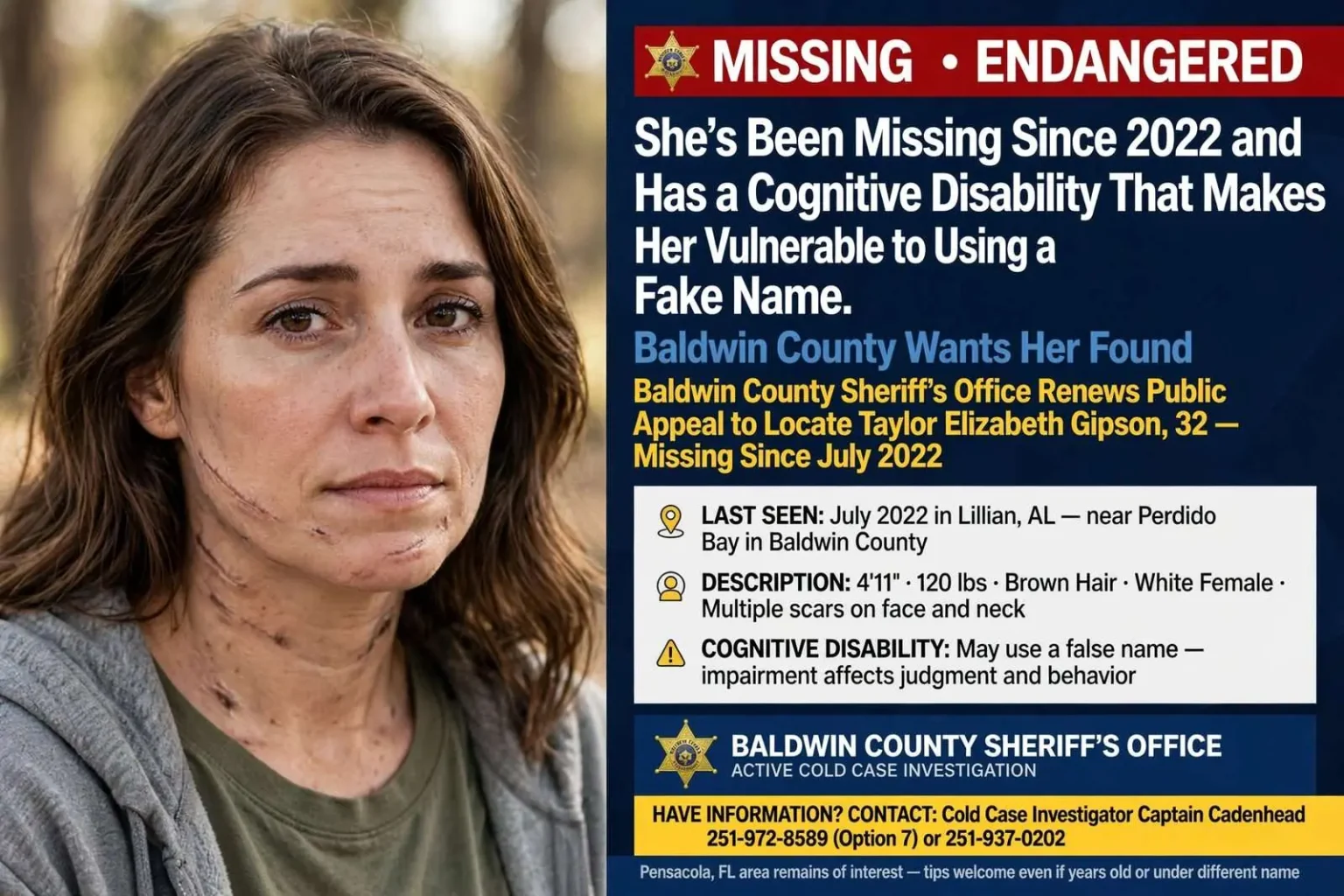
The Baldwin County Sheriff’s Office is once again asking the public for help locating Taylor Elizabeth Gipson, a 32-year-old woman who has been missing since 2022 and whose case is considered both a missing person investigation and an endangered person case because of a cognitive disability that affects her judgment and behavior. Three years after she was first reported missing, investigators say the case remains active and open, and they are hoping a renewed appeal will reach someone who has information that has not yet made its way to law enforcement.
Gipson was reported missing in July 2022. She was last known to be living in the Lillian area of Baldwin County, a small community in the northeastern corner of the county near the Alabama-Florida line. Investigators believe she may have traveled to the Pensacola, Florida, area at some point after her disappearance, a possibility that has shaped the direction of the search and the areas deputies have focused on. With no confirmed sightings in the years since, the case has been classified as a cold case, though the Sheriff’s Office stresses that the classification does not mean the investigation has stopped.
According to the Sheriff’s Office, Gipson is described as a white female standing approximately 4 feet 11 inches tall and weighing around 120 pounds. She has multiple scars visible on her face and neck, details investigators highlight because they can be distinctive in identification. Physical descriptions play an outsize role in cases like this one, where standard identification documents may not lead directly to the person being sought.
A Case Complicated by a Cognitive Disability
Central to the investigation is the fact that Gipson has a cognitive brain injury that the Sheriff’s Office says is unrelated to the circumstances of her disappearance but that significantly complicates the effort to find her. The injury impairs her judgment and behavior, and investigators say she has previously used false names and may attempt to assume a different identity. That tendency matters in practical terms: routine identification checks — a name run through a database, an identification card presented during a traffic stop or an encounter with police, a form filled out at a clinic or shelter — may fail to flag her presence even if she is living openly in a community.
Missing person cases involving adults with cognitive disabilities occupy difficult ground for law enforcement. Adults generally have the right to go where they choose, and police cannot simply treat every adult who has not been heard from as a crime victim. The endangered classification changes that calculus. It signals to other agencies that a person’s disability creates a heightened risk of harm, and it allows information about the case to be shared more widely with neighboring departments, state agencies, and national databases that track missing individuals.
Why Location Matters in This Search
The geography of the case is an important piece of context. Lillian sits on Perdido Bay in the far northeastern reaches of Baldwin County, in one of the most rural and least densely populated parts of a county that is otherwise among the fastest growing in Alabama. The community is connected to the Pensacola area by the US Highway 98 corridor, and the state line is only minutes away. That proximity means the last known point of residence and the area investigators believe Gipson may have traveled to are effectively part of the same regional landscape — a stretch of coastal communities where people move back and forth across the state line routinely for work, family obligations, medical care, and daily errands.
Baldwin County itself presents a significant search challenge. It is the largest county in Alabama by land area, stretching from the Florida line north past Bay Minette and from the shores of Mobile Bay east to the Perdido River. A sheriff’s office covering that much territory depends heavily on tips from residents to develop leads in long-running cases, which is why the agency periodically renews public appeals even years after a person was first reported missing. Each renewed appeal is a fresh attempt to place the case in front of residents who may not have seen the original coverage.
Cold case designations are often misunderstood by the public. Rather than signaling that a file has been closed or shelved, the classification typically means that the initial round of investigative work — interviews, area searches, record checks, and canvassing — has been completed without locating the person, and that the case now depends on new information arriving. Departments routinely re-examine such files, compare them against unidentified person reports from other jurisdictions, and re-publicize them at anniversaries or other milestones in the hope that changed circumstances will prompt someone to come forward.
That is effectively what is happening in the Gipson case. The three-year mark gives investigators a reason to put the case back in front of the public, and the renewed appeal emphasizes that even information that may seem trivial — a possible sighting, a recollection of someone using an unfamiliar name, a detail about where she may have stayed — could be meaningful to the investigation.
How Missing Adults Are Tracked — and Where the Gaps Are
When a person is reported missing, their identifying information is entered into national law enforcement databases so that any subsequent contact with police anywhere in the country can flag the record. But those systems are only as good as the identifying information attached to them, and they rely on names, dates of birth, and physical descriptions that a person using a false identity may not match. In cases where a missing person has a documented pattern of using different names, investigators have to look for corroboration beyond identity documents: physical descriptions, distinguishing marks such as scars, and reports of a person’s circumstances or behavior that fit what is known about the missing individual.
For the families of missing adults with cognitive disabilities, the uncertainty is often compounded by the difficulty of knowing where to look. A person may move between communities, stay temporarily with acquaintances, or interact with social service agencies, hospitals, or shelters under a different name. National databases such as the National Missing and Unidentified Persons System exist in part to address those gaps, allowing agencies and families to maintain records that can be compared against unidentified individuals encountered anywhere in the country. But matching still depends on the quality of the descriptions on both ends of the comparison, which is why agencies in cases like this one stress distinctive physical details such as scars so prominently.
The Sheriff’s Office has not said whether Gipson is believed to still be in the two-state coastal region or whether she may have traveled farther. What investigators have emphasized is that the Pensacola area remains a point of interest, and that anyone who may have encountered a woman matching her description — particularly someone who used a name different from her own — is asked to think back carefully and report what they remember. Encounters that might have seemed unremarkable at the time can take on significance years later when viewed against the full picture of a case.
Cases in which a missing person may be deliberately or habitually concealing her identity present a distinctive investigative problem. Routine database searches, warrant checks, and even routine welfare checks can come back clean if the person is living under another name. Investigators in such cases typically work backward from the person’s known history — places she lived, people she knew, services she might seek — and ask the public in those specific circles to come forward, rather than waiting for a random identification.
Investigators Ask for the Public’s Help
In its renewed appeal, the Sheriff’s Office underscored how much weight it places on small pieces of information from the public. “Even the smallest detail could be the key to moving this investigation forward,” the Sheriff’s Office said. Appeals of this kind are built on a simple premise: in long-running missing person cases, the investigation often advances not through a single dramatic break but through the gradual accumulation of details that, taken together, narrow the search and point investigators toward new people to interview or new places to check.
Anyone with information about Gipson or her whereabouts is asked to contact Cold Case Investigator Captain Cadenhead at 251-972-8589, option 7, or 251-937-0202. Investigators are asking callers to share whatever they can, including possible sightings, information about people she may have been associated with, or details about places she may have stayed — even if the information is years old and even if the person they encountered went by a different name. Tips that seem insignificant in isolation can be the detail that connects two previously separate threads of an investigation.
For residents of Baldwin County and the surrounding coastal region, the case is a reminder of how missing adult investigations work when the person at the center of them is vulnerable. Unlike cases involving young children, which typically generate immediate large-scale searches and widespread alerts, adult cases often proceed more quietly, driven by the steady work of a small number of investigators and by the willingness of ordinary people to report what they have seen. Public appeals remain one of the most effective tools available in those cases, particularly when the passage of time has made it more likely that someone’s memory has been jogged or that their circumstances have changed.
The Sheriff’s Office says the case remains active and open three years after Gipson was first reported missing, and investigators say they will continue to pursue leads as they come in. What they need, the agency says, is the public’s help: someone has information connected to this case, and the renewed appeal is an effort to reach that person and make it as easy as possible for them to come forward.