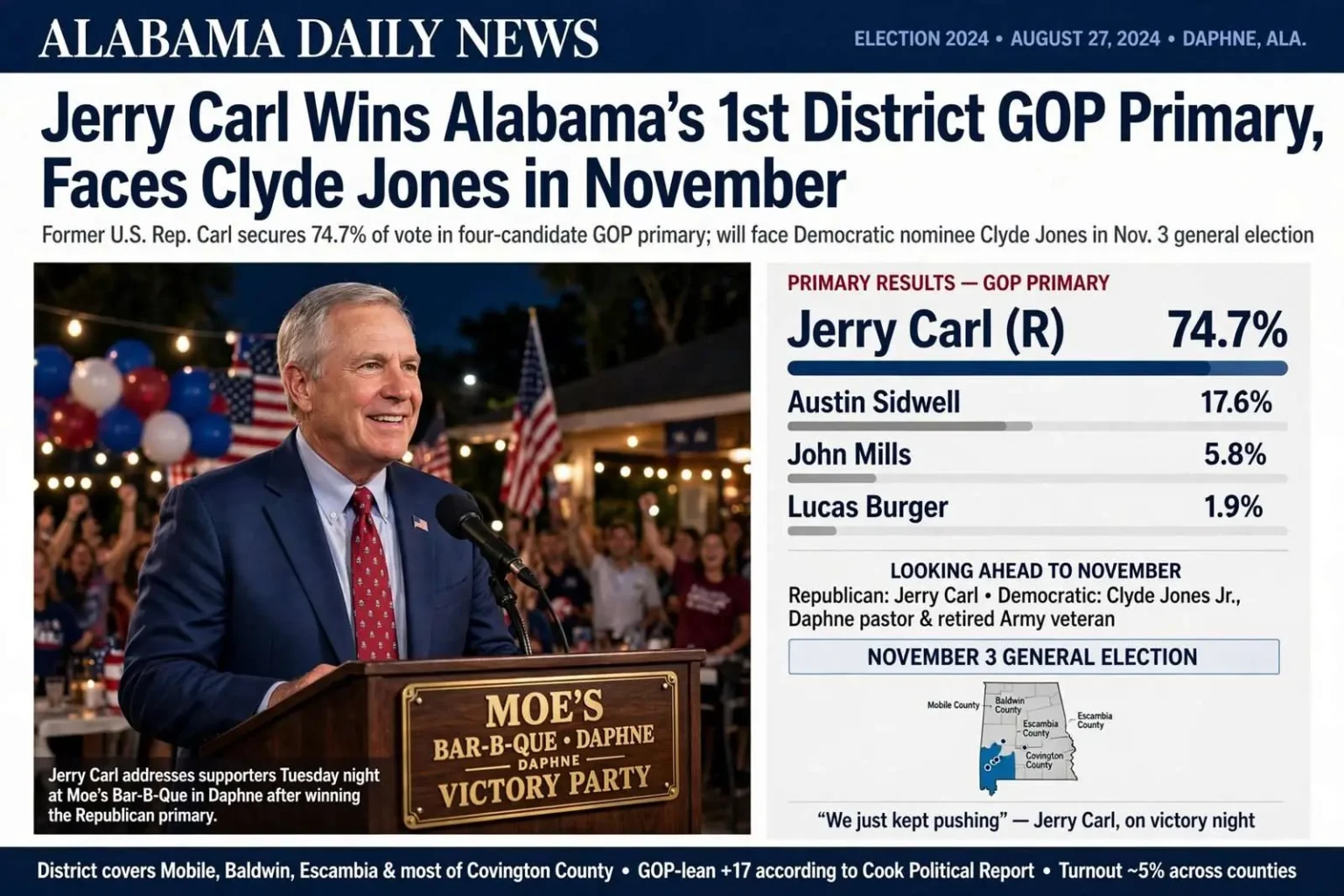
DAPHNE, Ala. – Former U.S. Rep. Jerry Carl took a major step toward reclaiming his old congressional seat Tuesday night, easily winning a four-candidate Republican primary in Alabama’s 1st Congressional District.
According to unofficial returns from the Alabama Secretary of State, Carl won roughly 74.7% of the vote, well ahead of Fairhope businessman Austin Sidwell (17.6%), Navy veteran John Mills (5.8%) and Gulf Shores Realtor Lucas Burger (1.9%). Turnout was sparse across the three-county district: only about 5% of registered voters cast ballots in Mobile County, 6% in Baldwin County and roughly 5% in Escambia County, with Covington County votes still being tallied at the time of Carl’s victory party.
Carl, a Mobile Republican, served on the Mobile County Commission from 2012 to 2020 before representing the 1st District in Congress from 2021 to 2025. He lost the seat in 2024 to Barry Moore after redistricting pushed the district’s boundaries into the Wiregrass; Moore is now the GOP nominee for U.S. Senate. The district’s boundaries were later restored to something closer to their pre-2023 shape following a U.S. Supreme Court ruling this year in Louisiana v. Callais, which cleared the way for Alabama’s Legislature to reinstate the map used in 2020 and for Gov. Kay Ivey to call the special primary.
Speaking to supporters at a victory party at Moe’s Bar-B-Que in Daphne, Carl credited a positive campaign and an endorsement from President Donald Trump and U.S. Sen. Katie Britt. “Failure is giving up,” Carl told the crowd. “You can give out, but you don’t give up, and y’all didn’t give up. You know, when things got kind of bad, things looked kind of bleak, we just kept pushing.” He said the campaign’s focus now shifts to turning out voters for the Nov. 3 general election, where he’ll face Democratic nominee Clyde Jones Jr., a Daphne pastor who was the only Democrat to qualify for the race.
Jones, in a statement, challenged Carl to at least one debate before November. “Let the voters hear from us and make an informed choice when they vote for their representative in November,” Jones said, adding that if elected he wants Congress to “accept its responsibility” on immigration, health care and veterans’ policy.
Election Night Results by the Numbers
The 1st District, which now covers Mobile, Baldwin and Escambia counties and most of Covington County, carries a Republican lean of roughly 17 percentage points, according to the Cook Political Report. State Rep. Rhett Marques of Enterprise had also been running in the race before the district lines shifted back toward their earlier configuration; Marques instead won his own primary Tuesday in the newly reconfigured 2nd Congressional District.
County-by-County Results
Unofficial county-level returns released Tuesday night showed Carl carrying all three fully counted counties by wide margins. In Escambia County, Carl received 1,219 votes (88.91%), followed by Austin Sidwell with 70 votes (5.10%), John Mills with 66 votes (4.81%) and Lucas Burger with 16 votes (1.16%), out of 1,372 total votes cast – about 4.85% of registered voters.
In Baldwin County, with 92% of precincts reporting, Carl had 2,658 votes (64.77%), Sidwell had 1,150 votes (28.02%), Mills had 246 votes (5.99%) and Burger had 50 votes (1.22%), out of 11,771 ballots cast, or roughly 5.55% of registered voters.
In Mobile County, with 49% of precincts reporting, Carl led with 4,991 votes (79.34%), followed by Sidwell with 781 votes (12.41%), Mills with 369 votes (5.87%) and Burger with 150 votes (2.38%), out of 15,504 votes cast, about 5.05% of registered voters. No results had been posted for Covington County on the Secretary of State’s website as of 9 p.m. Tuesday.
Update — Escambia County results: Turnout across the special primary reached roughly 5.24% of registered voters in the 40 counties touched by Tuesday’s elections, with a somewhat lower 4.85% turnout among registered voters in Escambia County specifically.
Carl’s district-wide total was 23,325 votes, ahead of Austin Sidwell, John Mills and Luca Burger. In Escambia County, Carl carried 1,291 votes to Sidwell’s 70, Mills’ 66 and Burger’s 16 – winning every precinct in the county except Dixie, where he received two votes to Sidwell’s four and Mills’ one.
Closest Precincts and Down-Ballot Races
The strongest county turnout came from the Brewton Civic Center precinct, where Carl received 219 votes to Sidwell’s 11, Mills’ seven and Burger’s six. Circuit Clerk John Robert Fountain said his office sent out 22 absentee ballots for the race; all were returned, but one was disqualified, leaving 21 counted.
In other down-ballot congressional primary results Tuesday, Rhett Marques won the Republican nomination for the 2nd Congressional District and will face incumbent Democrat Shomari Figures in November. Democrat Maurice Mercer won the 6th District Democratic nomination and will face Republican Gary Palmer, while Ammie Akin won the GOP nomination for the 7th District seat.
Candidates Look Ahead to November
In the days after his primary win, Carl said he is not taking the general election for granted. “In the state of Alabama, we are so comfortable knowing well, we won’t worry about it; it will be a Republican that will be chosen. We are in a time and an era right now that might not be,” Carl said.
Jones, a retired Army veteran and businessman who has also served as board president of Alabama Arise, is campaigning on a platform that includes improving the health care system, addressing affordability for families and pushing for a livable wage for workers. “I knew it was time to do more, to get back into politics and do more and affect more change,” Jones said.
Carl has pointed to his prior experience in Congress as an asset heading into a second term. “We’ve got four years seniority, so we go back on appropriations, on natural resources, probably pick up some strong committees, which equates into strong stuff for South Alabama,” he said.
Jones has argued that Carl’s record in Washington is a liability rather than a strength. “He’s part of the reason we are in the situation that we are in right now. We are experiencing that experience right now. So, do we need to go back to that?” Jones said.
Carl described his path back to Congress in terms of leadership. “It’s leadership,” he said. “It’s being able to step up.” Jones said he believes he has what it takes to challenge both Carl and Washington. “I think this is a great opportunity to make change here in the state of Alabama,” he said.
Voters will decide the race on Nov. 3.
Background on the Candidates and the Redrawn District
Alabama’s 1st Congressional District, redrawn multiple times over the past decade, has historically covered Mobile and Baldwin counties along with parts of surrounding counties in southwest Alabama. The district lines were significantly altered by a 2023 redistricting pushed by the U.S. Supreme Court’s Alabama voting rights ruling, with the lines later restored closer to their earlier configuration after the Louisiana v. Callais decision.
Clyde Jones Jr., the Democratic nominee in the 1st District race, is a Daphne pastor and retired Army veteran. He has campaigned on issues including health care access, affordability and veterans’ policy, and has called for debates ahead of the November general election.
Daphne, on the eastern shore of Mobile Bay, is one of Baldwin County’s larger cities and has been a focal point of the district’s political activity in recent elections. The city’s location along Interstate 10, just across the bay from Mobile, places it at a key crossroads in southwest Alabama’s political geography.
The Cook Political Report’s partisan voter index, which estimates a district’s partisan lean by comparing recent presidential results to the national average, is widely used to gauge congressional race competitiveness. Districts with double-digit Republican or Democratic leans are typically considered safe for the dominant party.
A Closer Look at the District’s Counties
Covington County, in south-central Alabama, was added to the 1st Congressional District under the redrawn boundaries. The county has historically been more conservative than Mobile and Baldwin counties but has trended strongly Republican in recent election cycles. The redistricting process that shifted the district’s lines was the subject of significant litigation, ultimately resolved by the U.S. Supreme Court’s decision in Louisiana v. Callais.
Baldwin County has grown into one of Alabama’s most politically competitive counties, with significant Republican majorities alongside growing pockets of independent and Democratic voters in communities like Fairhope, Daphne and Gulf Shores. The county’s growth has made it a focal point for both parties in statewide and federal elections. Carl’s strong performance in Baldwin County in the primary reflects the durable Republican lean of the county’s electorate.
Mobile County has historically been the population center of the 1st Congressional District, with the city of Mobile and its suburbs providing the largest share of voters. Baldwin County’s rapid growth has made it an increasingly important part of the district’s political map, particularly in statewide and federal races. The shift in the district’s relative weight has implications for how candidates campaign and how resources are allocated across the district’s geography.
The district’s shift back toward its pre-2023 boundaries came after the U.S. Supreme Court’s ruling in Louisiana v. Callais cleared the way for Alabama’s Legislature to reinstate an earlier congressional map. The redistricting fight played out over multiple election cycles and drew national attention as part of broader debates over the Voting Rights Act and the role of federal courts in setting district boundaries. Gov. Kay Ivey’s decision to call the special primary gave voters in the redrawn district the chance to choose nominees for the November general election.