Alabama PSC Approves Data Center Rules Letting Power Contracts Take Effect Without a Vote
Alabama’s Public Service Commission approved rules letting large Alabama Power data center contracts take effect after 90 days without a vote, drawing criticism from Energy Alabama and the Southern Environmental Law Center.
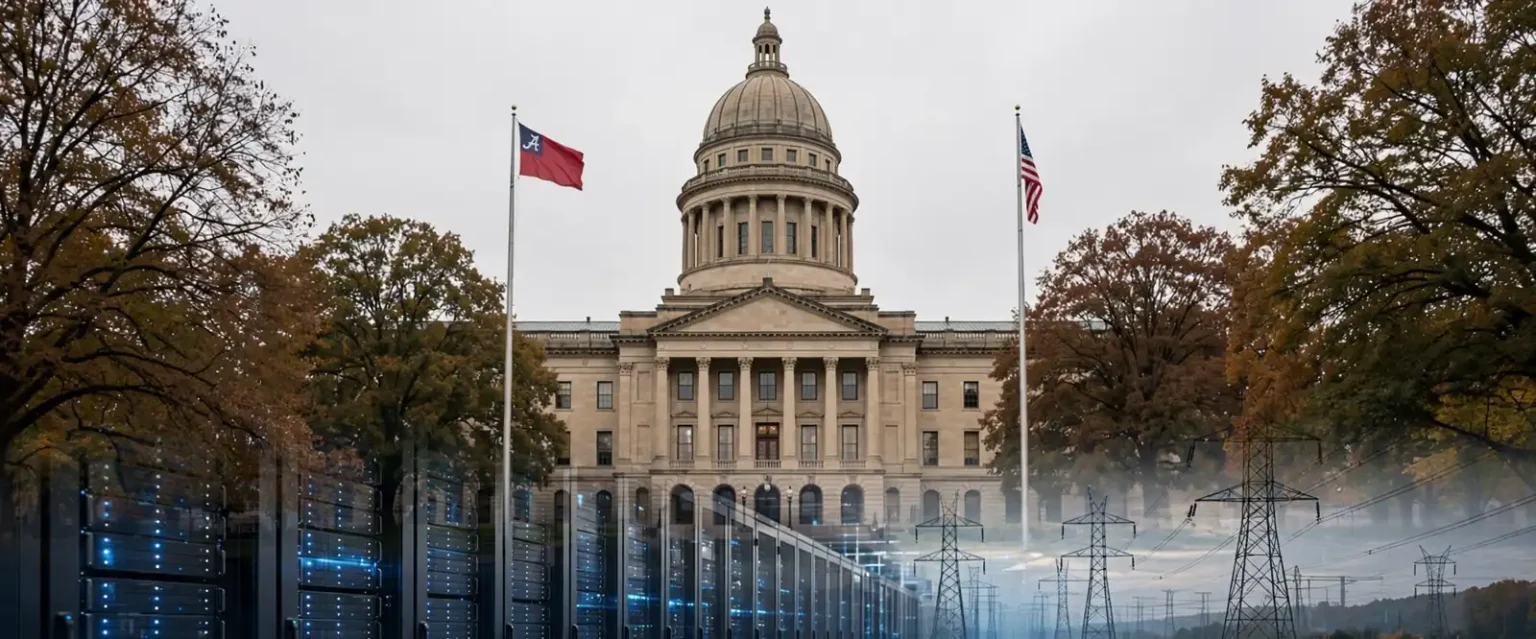
MONTGOMERY, Ala. — Alabama’s utility regulators have approved new data center rules that will let large power contracts between Alabama Power and data center developers take effect without a commission vote, a decision that consumer and environmental advocates say leaves too much of the process behind closed doors.
The Alabama Public Service Commission approved the process Tuesday, Oct. 6, for new data infrastructure expected to use at least 150 megawatts of electricity. Under the rules, Alabama Power must publicly disclose the customer, its parent companies, the project’s location and the maximum power demand under contract. But many other details, including the full contract and the financial analysis behind it, can remain confidential.
The vote comes as data centers have become a flashpoint in Alabama, from the race for governor to a new moratorium in Baldwin County.
What the new rules do
The final rules depart from a Sept. 30 staff recommendation that would have required the three-member commission to vote to approve or reject every qualifying data center contract. Instead, a contract that goes 90 days without a vote approving or denying it will automatically be approved. No public hearing is required before a decision.
Under the process, Alabama Power must file a public petition summarizing each agreement. The complete contract and supporting financial analysis — including projected infrastructure costs, expected revenues and other calculations used to judge whether a deal serves the public interest — will be shared only with commission staff and the Alabama Attorney General’s Office.
The commission also declined to set minimum terms that would apply to every data center agreement and declined to create a large-load tariff, a standardized rate structure for very large customers that advocates have pushed for.
A longer review — but still no required vote
According to Energy Alabama, a nonprofit utility watchdog, the 90-day window is a significant extension of Alabama Power’s longstanding contract process, which previously allowed certain large-load agreements to take effect after just 10 days without commission action.
Daniel Tait, the group’s executive director, said the change is an improvement but does not go far enough.
“For three decades, rules built for manufacturers let contracts take effect without a vote of the Commission. Data centers on this scale are a different animal. Ninety days is better than ten, but silence still counts as yes. A contract this big should never take effect because nobody voted. Alabamians deserve to see their regulators decide, in public.”
— Daniel Tait, Energy Alabama executive director
Tait said his organization believes Alabama Power should be required to publish its full contracts, with redactions where necessary, and that review of data center projects should be fully open to public input. He also noted that Southern Company, Alabama Power’s parent company, places its own minimum requirements on data center projects.
Why a large-load tariff matters
Energy Alabama has argued that a large-load tariff would protect everyday customers if a data center project does not pan out.
“A large load tariff would put minimum contract lengths, minimum monthly bills, collateral, and exit fees in writing for every data center, so other customers are protected if a project shrinks, walks away, or collapses. Other states do this already but the Commission decided against such protections for Alabama.”
— Energy Alabama statement
The concern reflects a broader national debate. Data centers that power cloud computing and artificial intelligence can demand enormous, around-the-clock amounts of electricity, and utilities across the country are planning new power plants, pipelines and transmission lines to serve them. Because utilities generally recover the cost of that infrastructure from customers over many years, regulators must decide how to ensure that households and small businesses are not left paying for capacity built for a single large customer — especially if that customer reduces its demand or leaves before the investment is paid off.
Environmental group: a step, not a solution
The Southern Environmental Law Center also criticized the final rules, though it called them a step in the right direction. The group said the process still falls short of ensuring residential and small business customers are protected from the costs of new generation, pipelines and transmission needed to serve large data centers.
“I am hopeful this is only the beginning of a deeper conversation about how to protect Alabama Power customers from the costs and risks of the data center boom. It’s disappointing the commission would not commit to taking public votes on all contracts. For too long, these negotiations have taken place largely behind closed doors. I hope the commissioners continue this long-overdue move toward letting daylight in on how they regulate Alabama Power.”
— Jaclyn Brass, staff attorney, Southern Environmental Law Center
About the PSC and Alabama Power
The Alabama Public Service Commission is the state agency that regulates investor-owned utilities, including Alabama Power, which serves a large share of the state’s homes and businesses. Its members — a president and two associate commissioners — are elected statewide. The commission sets the rates Alabama Power may charge and reviews agreements that could affect what other customers pay.
Alabama Power, headquartered in Birmingham, is a subsidiary of Atlanta-based Southern Company, one of the nation’s largest utility holding companies. Special contracts with industrial customers have long been part of how the utility serves large manufacturers, and the rules approved Tuesday adapt that framework to the new wave of data center demand.
Data centers on the campaign trail
Tuesday’s decision coincided with a new political ad from U.S. Sen. Tommy Tuberville, the Republican nominee for governor, who promised strict oversight and community consent for any data center project if he is elected.
“For years, politicians offered data centers free money, cheap power, and taxpayer-funded infrastructure. Politicians get the headlines. Big Tech gets the tax break. And working families get stuck with the bill.”
— Tommy Tuberville, in a campaign ad
Tuberville also said Big Tech would pay all expenses, be taxed at the highest rate and not be eligible for tax abatements. Over the summer, he faced backlash after saying Alabama is “going to do data centers” and dismissing concerns about large-scale tech infrastructure as “bull crap.”
It is unclear how Tuberville would empower communities to block projects they do not want. Most Alabama counties do not have zoning regulations, which are the primary tool local governments use to control where large developments can be built.
Democratic nominee Doug Jones, a former U.S. senator, has taken a more restrictive stance, calling for a one-year moratorium on new data centers so the state can develop additional safeguards. Jones’ campaign has accused Tuberville of reversing his earlier support for data center development, noting that Tuberville previously said Alabama should “take all the data centers we can get.”
The two are competing to succeed Gov. Kay Ivey, who is term-limited, in the Nov. 3 general election.
Baldwin County hits pause
Closer to home, the Baldwin County Commission placed a moratorium on all data center projects this week, citing a lack of resources to handle rezoning requests.
Baldwin County is one of the few Alabama counties with zoning laws, but its zoning applies only in unincorporated areas whose residents have voted to come under county jurisdiction. Communities that have not opted in remain largely without land-use rules, which can leave residents with little say when a large project is proposed nearby.
The Stockton community in north Baldwin County approved such a referendum earlier this year amid backlash over a large solar farm project that was abruptly announced for the area. That solar farm will sell renewable energy credits to a major technology company’s data centers being built in Montgomery — an example of how the data center boom can reach well beyond the sites where the buildings themselves rise.
What it means for customers
For Alabama Power customers, the immediate effect of the new rules is more public information than before about who is seeking large data center contracts and where those projects would be located. Each qualifying contract will be summarized in a public petition, and the commission will have 90 days to act.
But unless commissioners choose to vote, contracts can still take effect without a public decision, and the detailed cost projections that would show whether other ratepayers are protected will remain out of public view. Advocates say they will continue to push for public votes, published contracts and a large-load tariff.
What’s next
The first data center contracts filed under the new process will be an early test of how the rules work in practice, including how much detail Alabama Power includes in its public summaries and whether commissioners choose to vote on deals rather than let them take effect automatically.
Residents who want to follow those filings can monitor the Public Service Commission’s docket and public meetings, where petitions are filed and commission actions are recorded. With data centers now a campaign issue and Baldwin County’s moratorium in place, the debate over how — and whether — to welcome large-scale tech infrastructure in Alabama is likely to continue well beyond Election Day.