Mobile Municipal Garage Workers Earn First ‘Pay It Forward’ Bonuses
Seven Mobile Municipal Garage employees became the first recipients of Mayor Sandy Stimpson's employee bonus program.
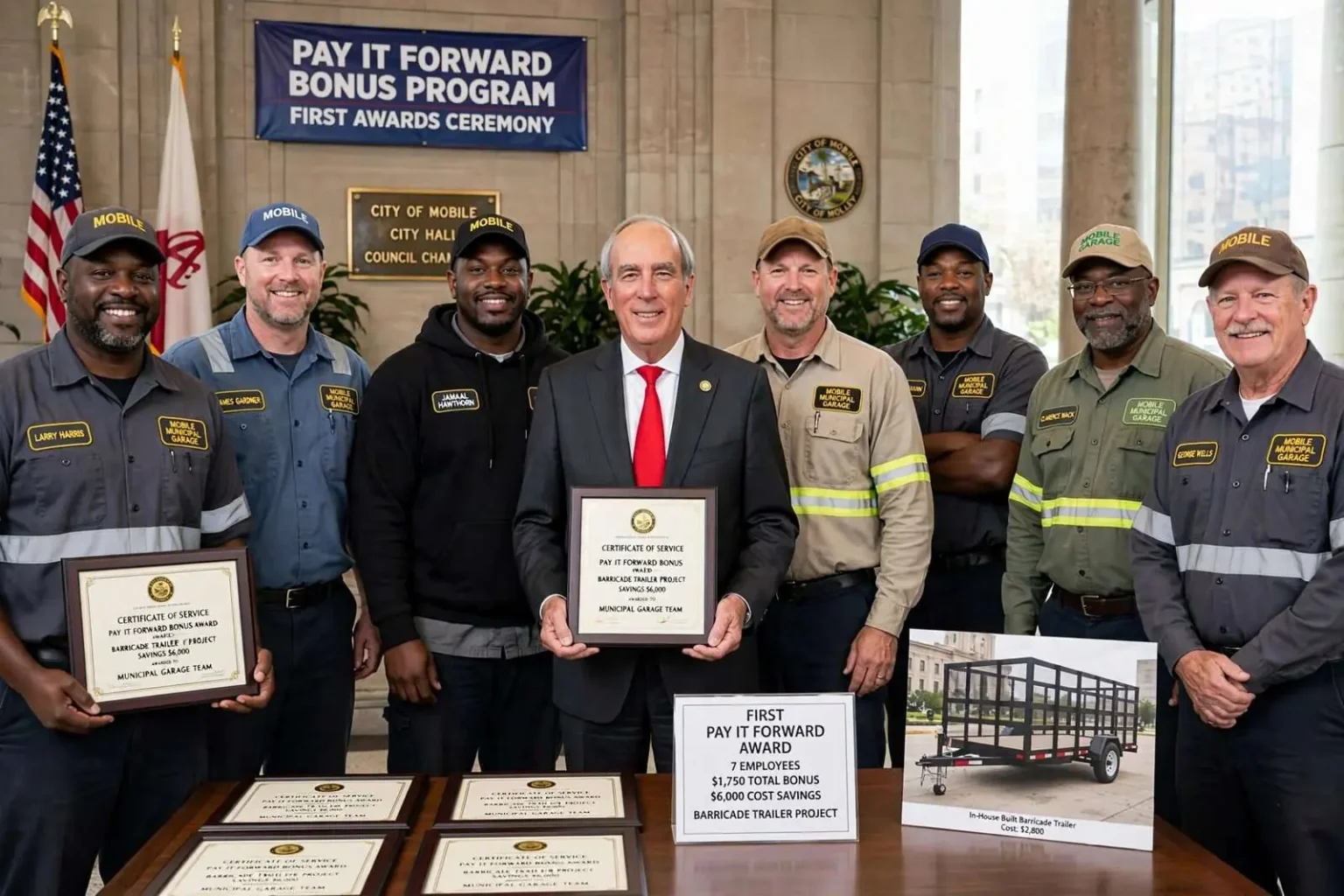
Seven employees of Mobile’s Municipal Garage became the first recipients of Mayor Sandy Stimpson’s new “Pay It Forward” bonus program this week, earning recognition and extra pay for a money-saving project that benefited the city.
The employees, honored during a ceremony at City Hall, were recognized for building a trailer used to transport traffic barricades, a project that saved the city thousands of dollars compared to purchasing the equipment.
Each employee received a certificate of service from Stimpson along with an additional $250 added to their next paycheck, for a combined payout of $1,750.
The ceremony gave City Hall one of its more unusual celebrations: a group of garage employees, not administrators or department heads, standing at the front of the room as the mayor credited them with a better deal for taxpayers than the city could have bought. The moment marked the first time the Pay It Forward program had paid out since Stimpson established it.
How the Program Works
Stimpson said the program is designed to reward employees who find creative, cost-effective solutions to everyday municipal problems. He described the initiative as an extension of his administration’s broader focus on sound financial management and investment in city workers, calling the group’s ingenuity an example for other departments to follow.
The bonus program is funded directly through the mayor’s own salary. As a mayoral candidate, Stimpson pledged to contribute $50,000 annually toward employee bonuses, totaling $200,000 over a four-year term, despite an annual salary of $89,000.
The funding arrangement is what sets Pay It Forward apart from typical municipal recognition programs. Government employee bonus initiatives usually draw on budgeted department funds; this one draws on the mayor’s personal paycheck, making each award a direct personal investment rather than a line item. The pledge also connected the program to a signature theme of Stimpson’s candidacy — running city government more like a business that rewards results.
Under Alabama law, any individual city employee can receive no more than $1,000 in Pay It Forward awards within a single fiscal year, and awards are only approved when a specific, quantifiable cost savings can be documented.
Those guardrails do significant work. The statutory cap prevents any employee from accumulating large bonus payments through a single project, and the documentation requirement means every award must trace back to a real, measurable saving — not a supervisor’s impression of good work. The result is a program where the size of the bonus is anchored to the size of the benefit delivered to the city.
The Trailer Project
In this case, the city’s traffic engineering department had requested a new trailer that would have cost roughly $9,000 to purchase. Instead, a team led by employee Larry Harris built the equipment in-house for less than $3,000 in materials and labor, saving the city approximately $6,000.
The equipment in question was a trailer used to move traffic barricades — the portable barriers that stage work zones, close streets for events and redirect traffic around hazards. Barricade transport is unglamorous but constant work for a city the size of Mobile, where crews deploy and retrieve barricades for everything from repaving projects to festival street closures.
Buying the trailer commercially would have meant a purchase order, delivery time and roughly $9,000 spent. Building it in the Municipal Garage meant city workers designed the unit to their own specifications, used materials the city could source at cost and put the finished product on the street in less time than a purchase cycle would have allowed.
Stimpson praised the quality of the finished trailer and indicated the city may commission additional units built by the same team.
That possibility turns a one-time award into a potential production line: if additional barricade trailers are built in-house at the same savings, the $6,000 saved on the first unit multiplies across the fleet. City officials have long noted that municipal garages — the workshops where city vehicles and equipment are maintained — hold exactly this kind of fabrication capability, waiting for projects like this one to put it to use.
The Employees Honored
The full group honored included Harris, James Gardner, Jamaal Hawthorn, Lee Bush, Tyrone Holley, Clarence Mack and George Wells, all employees of the Municipal Garage.
The seven men represent the behind-the-scenes workforce that keeps a city running — the mechanics, fabricators and equipment operators whose work rarely draws public attention until something goes wrong. Their recognition at City Hall was a deliberate change of scenery for the garage crew, and a message from the administration about whose contributions count.
Group awards of this kind also acknowledge how municipal work actually gets done. A project like the barricade trailer passes through design, welding, electrical work, finishing and inspection, rarely resting with any single employee. Paying out the bonus across the team matched the reward to the collaborative nature of the work.
Stimpson noted that with this first round of awards already reaching $1,750, spending under the Pay It Forward program is likely to exceed his initial $50,000 annual pledge in the coming year as more departments identify similar savings opportunities.
That projection reflects the program’s design intent. Once the first awards demonstrate that documented savings lead directly to paychecks, the expectation inside City Hall shifts: departments begin looking for the projects they can propose, and the pipeline of cost-saving ideas widens. A $50,000 annual fund can leverage far more than $50,000 in savings if each bonus is anchored to a documented benefit several times its size.
For the mayor personally, the projection means his salary contributions may not cover demand, raising questions city officials would have to address if the program’s popularity grows — whether additional funding sources follow or whether the cap on awards throttles participation. For now, the program stands on the mayor’s pledge and the legal limit of $1,000 per employee per fiscal year.
A Culture of Cost-Saving
City officials say the program reflects an effort to build a culture of accountability and innovation among municipal workers, while giving employees a direct financial incentive to look for efficiencies in their daily work.
The idea draws on a principle well established in private industry: frontline workers usually know where the waste is. The crew that maintains barricades knows what a trailer should cost and how one could be built; the mechanics know which repair practices waste parts; the drivers know which routes burn fuel. Programs like Pay It Forward formalize a channel for that knowledge to reach the budget.
Municipal governments across the country have experimented with employee suggestion and incentive programs, with mixed results. The ones that work share common features: clear rules, fast payouts, documented savings and public recognition. Mobile’s version checked each box — statutory limits, a $250 payment attached to the very next paycheck, a $6,000 documented saving and a City Hall ceremony.
For the seven Municipal Garage employees, the week brought an unusual combination of extra pay, mayoral recognition and a certificate bearing the city’s seal. For the city, the transaction cost $1,750 and saved $6,000 — a return the administration can cite every time it describes how Mobile’s government is learning to reward the people who save it money.
The trailer itself will spend the coming years moving barricades around Mobile’s streets, largely unnoticed by the drivers it helps redirect. But the story of its construction — built cheaper and better in a city garage by seven men the mayor singled out by name — now serves as the template the city hopes other departments will follow.
What Comes Next for the Program
The first payout establishes a precedent that City Hall will be watching closely. Every future request for a Pay It Forward award will be measured against the barricade trailer: a documented $6,000 saving, a seven-person team and a bonus of $250 each. Departments with cost-saving ideas now have a concrete example of what qualifying looks like and what it pays.
The program also arrives at a time when Mobile’s budget pressures make every saving meaningful. City budgets fund police and fire protection, road maintenance, parks and sanitation, and each dollar saved in operations is a dollar available elsewhere. Bonuses that trigger documented savings therefore function as a form of self-funding investment, provided the documentation requirement holds up in practice.
There is a staffing dimension as well. Municipal garages and public works departments often struggle to attract skilled fabricators and mechanics, because private industry pays comparable or better wages for the same trades. Recognition programs and performance bonuses are among the few tools available to a city for signaling that skilled tradespeople are valued — a point the mayor’s ceremony made more vividly than any recruitment brochure.
The Mobile Municipal Garage handles the fleet and equipment work behind virtually every city service, from garbage trucks and street sweepers to the vehicles used by inspectors and engineers. A shop of that kind is equipped for welding, machining and fabrication as a matter of routine, which is precisely why a barricade trailer was within its capability. The project succeeded not because workers went beyond their jobs, but because the city finally asked for what the shop was built to do.
Whether the program’s early momentum continues will depend on how quickly other departments produce their own documented savings. But the first round made the mechanics of the program public: an idea, a measurable saving, a mayor’s signature and a bonus check — a sequence Mobile’s city workers now know ends in their own paycheck.