Reward for Orange Beach Dolphin Killer Could Top $10,000
Local groups and Orange Beach officials are pledging thousands in reward money to find whoever shot a dolphin with a hunting arrow.
A wave of outrage over the death of a bottlenose dolphin found with a hunting arrow lodged in its side has prompted Orange Beach officials and several local organizations to pledge reward money aimed at finding those responsible, with the total pot potentially exceeding $10,000. The case has struck a nerve along the Alabama Gulf Coast, where dolphins are a daily sight from the Intracoastal Waterway to the beaches of the Gulf State Park and where residents consider the animals part of the region’s identity as much as its tourism brochures.
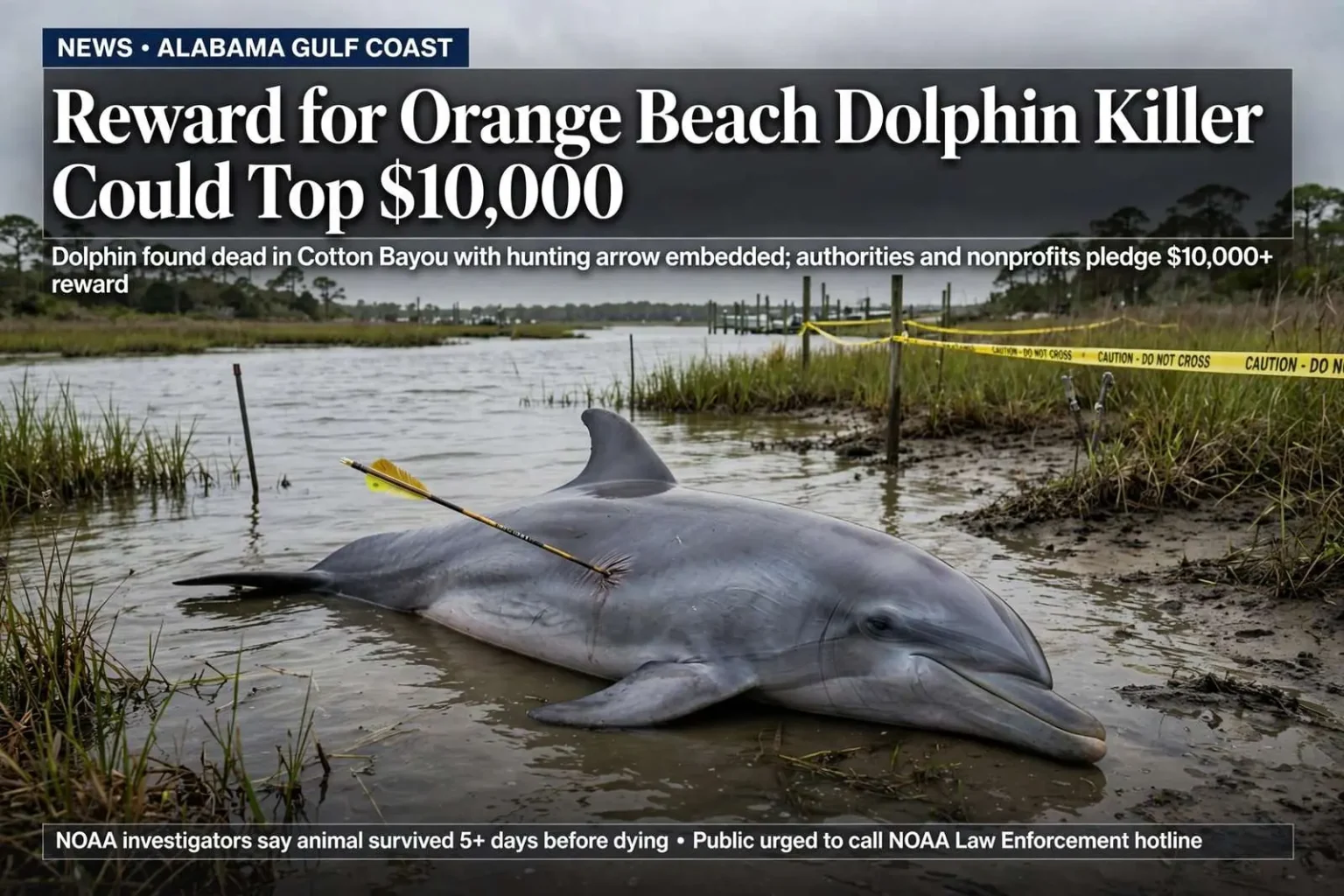
The dolphin was discovered dead and stranded on Cotton Bayou in Orange Beach, with a yellow-feathered hunting arrow still embedded in its body. Cotton Bayou sits at the heart of the city’s beach district, a small waterway that separates public beach accesses and draws swimmers, boaters and paddleboarders all summer — meaning the wounded animal likely spent its final days in some of the most heavily trafficked waters on the Alabama coast, possibly within sight of people who never realized what was happening.
The National Oceanic and Atmospheric Administration said preliminary results from a necropsy indicate the animal survived with the arrow lodged in its side for at least five days before ultimately dying from a secondary infection caused by the wound. The finding transformed the case from a shocking image into something investigators describe as a prolonged act of cruelty, and it gave prosecutors — should anyone be identified — a paper trail of suffering that began well before the carcass washed ashore.
Rewards stack up quickly
Following NOAA’s public appeal for information, the Humane Society of the United States and the Humane Society Wildlife Land Trust announced a combined reward of up to $5,000 for information leading to the identification, arrest and conviction of whoever was responsible. The Humane Society’s wildlife trust arm has built a practice of posting rewards in animal cruelty cases across the country, and its involvement signaled that the case is being treated as a serious wildlife crime rather than a local curiosity.
Orange Beach Mayor Tony Kennon said the city was prepared to add its own $5,000 reward pending approval from the city attorney, calling the act “pretty serious business” and saying he could not fathom why anyone would shoot a dolphin. Kennon, whose city administers Gulf State Park and markets itself to millions of visitors a year on the strength of its clean beaches and abundant marine life, said the reward reflected the city’s view that an attack on the dolphins is an attack on what makes Orange Beach what it is.
Local nonprofits also stepped forward. Vince Lucido, chairman of the Alabama Gulf Coast Reef and Restoration Foundation, said the group’s board was considering a $1,500 contribution, while the Coastal Alabama Business Chamber, which Lucido is set to chair, planned to vote on whether to add another $1,500. Lucido said he hoped the combined local response would inspire additional donors, potentially pushing the total reward toward $20,000 to $30,000 — a figure that would place the case among the most heavily rewarded marine mammal crimes the region has seen.
A second death in two weeks
The Orange Beach case is the second dolphin death reported in the northern Gulf of Mexico within a two-week span, according to NOAA. Days earlier, a pregnant dolphin was found shot with a firearm near Miramar Beach, Florida, prompting the Whale and Dolphin Conservation group to offer a separate $2,500 reward in that case. The back-to-back deaths have alarmed marine mammal researchers, who note that the northern Gulf’s resident bottlenose population — the same animals tourists photograph from charter boats and dolphin cruises — faces enough pressure from disease outbreaks, water quality and boat strikes without deliberate violence.
Investigators have not said whether the two cases are connected, and the weapons involved differ. But the pattern has prompted NOAA’s enforcement arm to publicize both cases together, hoping that the combined attention and reward money shakes loose tips that any single case alone might not. Histories of similar prosecutions along the Gulf Coast show that convictions most often come from someone who saw something — a boat’s behavior, a person on a pier, a piece of equipment — and called it in weeks or months later.
What the law allows
Federal law strictly protects marine mammals along the Gulf Coast. Harassing, harming, killing or feeding wild dolphins is prohibited under the Marine Mammal Protection Act of 1972, with violations punishable by fines up to $100,000 and up to a year in jail per offense, whether prosecuted civilly or criminally. The statute, passed at a time when dolphin populations had been decimated by tuna fishing and other human pressures, makes the United States one of the strictest jurisdictions in the world on marine mammal harm, and federal prosecutors along the Gulf have brought cases ranging from illegal feeding to deliberate shootings.
Anyone with information about either dolphin death is asked to contact NOAA’s Office of Law Enforcement in Niceville, Florida, or the agency’s national enforcement hotline. Investigators say tips from the public remain critical to identifying those responsible for the attacks on the protected animals, and they note that callers may remain anonymous. In a region where fishing guides, charter captains, kayakers and beachgoers share the water with dolphins every day, investigators are betting that someone saw something — and that a reward now exceeding $10,000, and possibly far more, will help them say so.
The dolphins of the northern Gulf
Bottlenose dolphins in the bays, bayous and nearshore waters of the northern Gulf are not passing visitors; they are resident populations that live out their lives in the same sounds and estuaries where they were born. Alabama’s coastal waters support hundreds of them, from Mobile Bay to Perdido Bay, and they occupy a protected ecological niche as apex predators of fish and squid in waters that also anchor a multi-billion-dollar tourism economy. Their visibility is part of their vulnerability: dolphins that approach boats for a free handout from anglers learn behaviors that put them in the path of propellers, fishing gear and, in rare and criminal cases, people who mean them harm.
Federal biologists have spent decades building a picture of those populations, cataloging strandings, tracking unusual mortality events, and responding to the hundreds of reports that pour in each year from the public. The stranding network that handled the Cotton Bayou dolphin is made up of trained responders who can move quickly when a call comes in, but their work is investigative as much as rescue-oriented — every stranded animal is documented, sampled and, where warranted, necropsied to establish exactly what killed it.
That science is what made this case so damning. Establishing that a dolphin survived five days or more with an arrow in its side requires tissue analysis and careful examination of the wound’s condition, and the resulting timeline gives law enforcement a framework for the crime that goes beyond the discovery of the body: an animal that suffered for the better part of a week in waters where residents swim and children play.
Why rewards matter in wildlife cases
Wildlife crimes are notoriously difficult to prosecute. There is rarely a witness willing to come forward against a neighbor or acquaintance, the evidence is often a single carcass, and the perpetrators — in shooting cases, usually someone in a boat or on a pier with a clear shot — leave few traces. Reward money changes that calculus by converting silence into a commodity, and past Gulf Coast cases show it works: tips prompted by rewards have led to convictions in dolphin shooting and bow-hunting cases in the region, including prosecutions that ended in significant federal penalties.
The organizations piling onto the Orange Beach reward represent the cross-section of the coast that cares about the case. The Humane Society brings national investigative reach; the reef and restoration foundation brings the fishing and diving community that shares the water with dolphins daily; the business chamber brings the hospitality industry that would feel the sting if word spread that dolphins were unsafe in Orange Beach’s waters. Together they have signaled that the case will not quietly fade the way so many animal cruelty reports do.
What happens next
For now, investigators are working the tips that have come in since NOAA publicized the necropsy findings, and the reward total may still grow as boards that have promised votes formally act on them. The city attorney’s approval of Kennon’s $5,000 pledge is expected as a formality, and the chamber’s vote could push the advertised total higher within days. Officials caution that rewards are paid only on conviction, a standard designed to keep the money flowing toward real evidence rather than false leads.
Meanwhile, marine mammal advocates along the coast are using the case to remind the public of the rules most residents already know: do not feed dolphins, do not attempt to swim with them, and report any interaction that looks like harassment. The hope in Orange Beach is that the person who loosed the arrow into Cotton Bayou will be identified before the summer’s next tourist season — and that the cost of the act, in dollars and in years, will send a message that the Gulf Coast’s dolphins are watched over.