Orange Beach Raises Dolphin Killing Reward Pool to $23,000
Orange Beach added $3,000 to a reward fund for information on a dolphin killed by a hunting arrow, lifting the total offered in the case to $23,000.
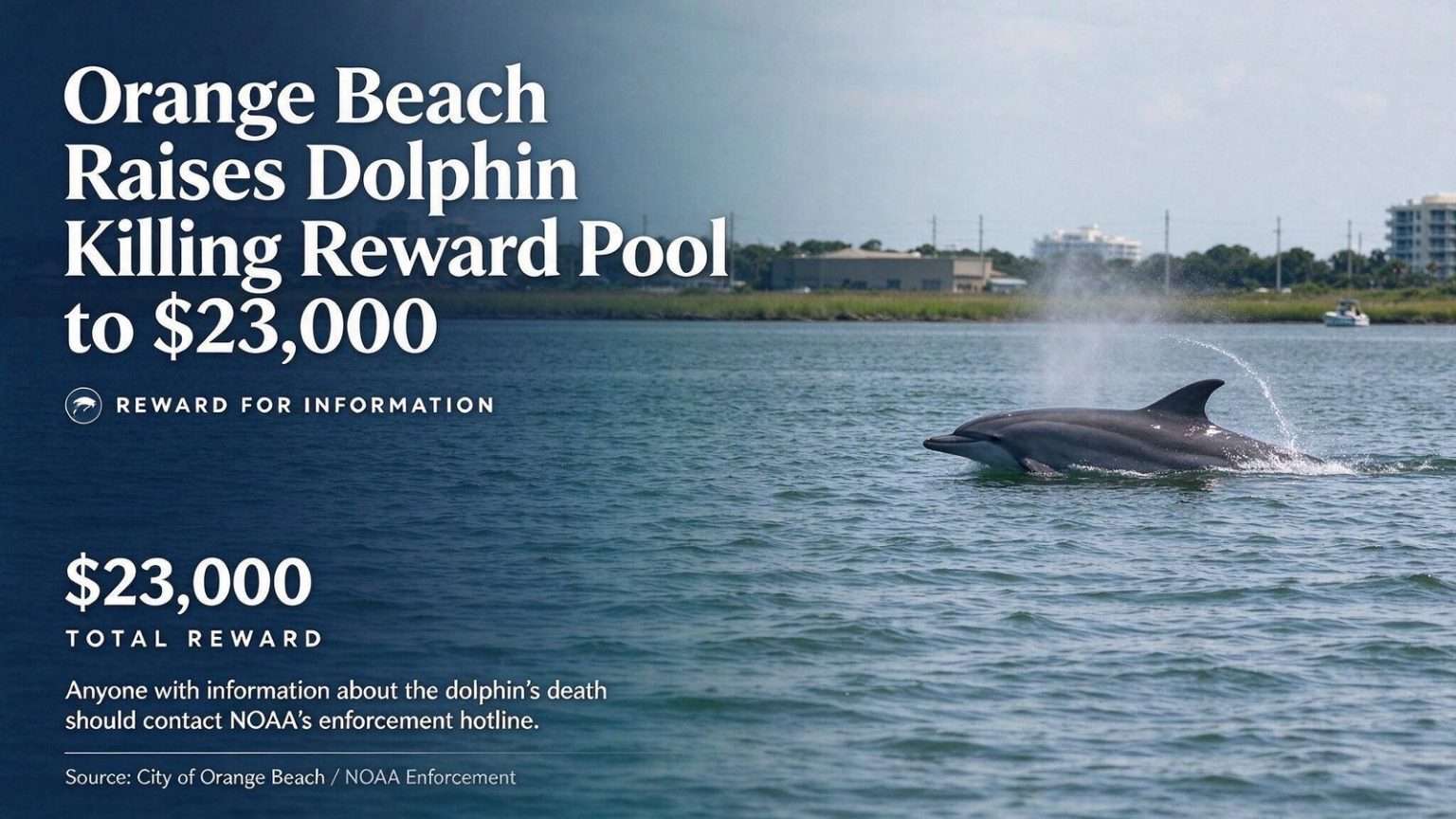
Outrage over the killing of a dolphin along the Alabama coast grew this month as the city of Orange Beach added money to a fast-climbing reward fund, pushing the total offered for information in the case to $23,000. The City Council voted unanimously to contribute $3,000, joining a long list of local agencies, businesses and national organizations that had already pledged support. City officials said they had hoped to put up more but were capped by state law.
“I wish it could be more but that’s all the law will allow,” Mayor Tony Kennon said before the vote. “So hopefully it will do some good to finding the culprit.”
The bottlenose dolphin was found dead on Dec. 6 along the shoreline of Cotton Bayou, a back-bay area of the city. According to the National Oceanic and Atmospheric Administration, preliminary results from a necropsy — the animal equivalent of an autopsy — suggested the dolphin had lived with a yellow-feathered hunting arrow lodged in its body for at least five days before dying from a secondary infection caused by the wound.
A slow, painful death for a protected animal
The necropsy findings transformed the case from a routine stranding into something investigators describe as an intentional killing of an exceptionally cruel kind. A dolphin struck by an arrow does not die immediately; the animal swims and feeds for days while the wound festers, and the secondary infection that ultimately killed the Cotton Bayou dolphin is exactly the outcome veterinarians see when an animal cannot reach the injury with its own mouth and no treatment intervenes. That the animal survived at least five days with the arrow in place means the suffering was prolonged and, in the judgment of the examining scientists, avoidable.
NOAA, acting as the lead investigating agency, announced on Dec. 8 that it was seeking information about the killing. Under the Marine Mammal Protection Act, bottlenose dolphins are protected in U.S. waters, and harassing, hunting, feeding or killing them is a federal offense that can carry substantial civil penalties and criminal charges, including possible imprisonment. Federal investigators treat tips about harm to marine mammals seriously, and reward funds are one of the few levers the public has to encourage reluctant witnesses to come forward.
Within days, an initial $5,000 reward offered by The Humane Society of the United States and The Humane Society Wildlife Land Trust had swelled to $20,000 through additional pledges. Those contributions came from a broad mix of coastal and conservation-minded groups, including Clearwater Marine Aquarium in Florida, the Alabama Gulf Coast Reef and Restoration Foundation, the Coastal Alabama Business Chamber, the Cobalt and Cosmos restaurants in Orange Beach, Reel Surprise Fishing Charters, Gulf Chrysler in Foley, and the Coastal Conservation Association of Alabama.
“This is a senseless act that must not go unpunished,” said Susan Sizemore, the 2014 chairwoman of the nearly 1,000-member chamber, in a prepared statement. “Our board has voted to take a stand that actions like these will not be tolerated by the business community of this area.”
Why the business community took it personally
The speed and breadth of the reward pledges reflected how directly the coast’s economy is tied to the dolphins that live in its bays and passes. Dolphin-watching cruises are a fixture of the Orange Beach and Gulf Shores tourism scene, and the animals are among the most reliably photographed sights on the water — a draw that hotels, charter operators and restaurants all benefit from. The list of contributors told that story: restaurants, a fishing charter business, a car dealership, a reef restoration foundation and the regional chamber of commerce, joined by national animal welfare organizations and a Florida aquarium.
The Coastal Alabama Business Chamber’s decision to contribute carried particular weight. With nearly 1,000 members across the coastal economy, its board’s statement framed the killing not as an isolated cruelty but as an attack on the community’s identity — the kind of act that, if left unanswered, sends the wrong message about what the coast will tolerate.
The city’s contribution required special handling because of state law. Alabama municipalities operate under constraints on how public money can be spent, and the cap the city encountered is the same kind of statutory limit that governs other municipal donations. Council members said the $3,000 represented the maximum the city could lawfully offer, and Kennon’s comment before the vote made clear the council would have gone further if allowed.
Cotton Bayou and the dolphins of the back bays
Cotton Bayou sits in the heart of Orange Beach, connecting the Gulf Intracoastal Waterway to the beaches near the Alabama-Florida line and serving as home water for a resident population of bottlenose dolphins that boaters and anglers encounter daily. The back bays and bayous of coastal Alabama support a network of these inshore dolphin groups, which live their entire lives in the sounds, bays and channels rather than ranging far offshore.
Because inshore dolphins are resident and habituated to boat traffic, they are unusually vulnerable to human misconduct. They learn to follow shrimp boats and fishing vessels, and wildlife officials have long urged the public not to feed them — feeding habituates dolphins to approaching boats, where propellers, fishing lines and, in the worst cases, deliberate harm await. Federal officials prosecute feeding cases alongside harassment and killing cases for exactly that reason: each interaction degrades the animal’s wild instincts and puts it in closer, more dangerous contact with people.
Investigators with NOAA’s enforcement program collect physical evidence from strandings, interview witnesses and follow up on tips generated by reward publicity. The arrow itself — described as a yellow-feathered hunting arrow — provided investigators with a tangible piece of the case, since archery equipment is specialized enough that its source can often be traced through retailers and ranges once the public begins reporting sightings.
How marine mammal investigations work
When a protected marine mammal is found dead, its body is treated as evidence. Trained responders document where and how the animal was found, then transport it to a facility where a necropsy is performed — an examination that parallels a human autopsy, cataloging injuries, taking tissue samples and identifying foreign objects. In this case, the necropsy recovered the arrow and established the timeline that made the case notorious: the dolphin carried the wound for at least five days before the infection killed it.
Those findings do more than establish cause of death. They distinguish natural mortality from human-caused harm, which determines whether a case moves to NOAA’s enforcement arm. Federal investigators then work backward from the scene — canvassing marinas, boat ramps and fishing piers, checking archery purchases, and publicizing the reward to reach anyone who saw something on the water in the days before the dolphin was found.
Reward funds serve that final step. Witnesses to crimes on the water are often fellow boaters who may hesitate to involve themselves in a prosecution, and a five-figure reward changes that calculus. Past marine mammal cases on the Gulf Coast have been broken by tips from people who recognized a boat, recalled a conversation at a dock, or saw someone behaving strangely near the animals.
A community that demanded accountability
The case struck a nerve along the coast in a way few animal cases do. Local officials, business leaders and residents alike treated the killing as a matter of civic honor — a test of whether a community that markets itself on its natural beauty would respond when one of its most beloved animals was deliberately harmed. The unanimous council vote, the chamber’s statement and the rapid growth of the reward from $5,000 to $20,000 before the city’s contribution pushed it to $23,000 all reflected the same conviction: the person responsible would be found, and the community wanted to make that outcome as likely as possible.
Conservation groups noted that the case was a reminder of the protections the animals already have and the penalties violators face. Under federal law, killing a bottlenose dolphin exposes a violator to significant fines and possible jail time, and federal prosecutors have pursued such cases along the Gulf Coast before. The reward, layered on top of those penalties, was designed to ensure that the evidence needed to make a case would reach investigators.
Anyone with information about the dolphin’s death was urged to contact NOAA’s enforcement hotline, and officials said tips could be provided anonymously, with reward eligibility tied to information that leads to an arrest and conviction in the case.
The animals that live along this coast
Bottlenose dolphins are the most visible wild mammals on the Alabama coast, and their daily presence shapes how both visitors and residents experience the water. They hunt in the shallows at dawn, surf alongside the ferries and charter boats in the passes, and raise their calves in the protected waters of the back bays. Marine researchers who track the region’s inshore dolphins have documented how closely tied the animals are to specific home ranges, returning to the same bayous and channels year after year.
That visibility is why harm to a dolphin resonates here more than it might elsewhere. The animals are not distant wildlife glimpsed from a highway; they are regular companions on the water, known to the crews who run dolphin cruises and to the anglers who see the same individuals stealing bait from their livewells. When one of them dies at human hands, the coast takes it as a wound to something the community collectively considers its own.
City officials said they would continue to monitor the investigation, and the reward fund remains open to further contributions from businesses and organizations that want to add to the total. For the council, the vote was an expression of the city’s position — that whoever loosed a hunting arrow at a dolphin in Cotton Bayou, and left the animal to suffer for days, should face the consequences that federal law and an outraged community are prepared to deliver.