Prichard Council President Bracy Draws Endorsements in House Runoff
Prichard City Council President Napoleon Bracy picked up the backing of two former lawmakers as he headed into a Democratic runoff for the Alabama House District 98 seat.
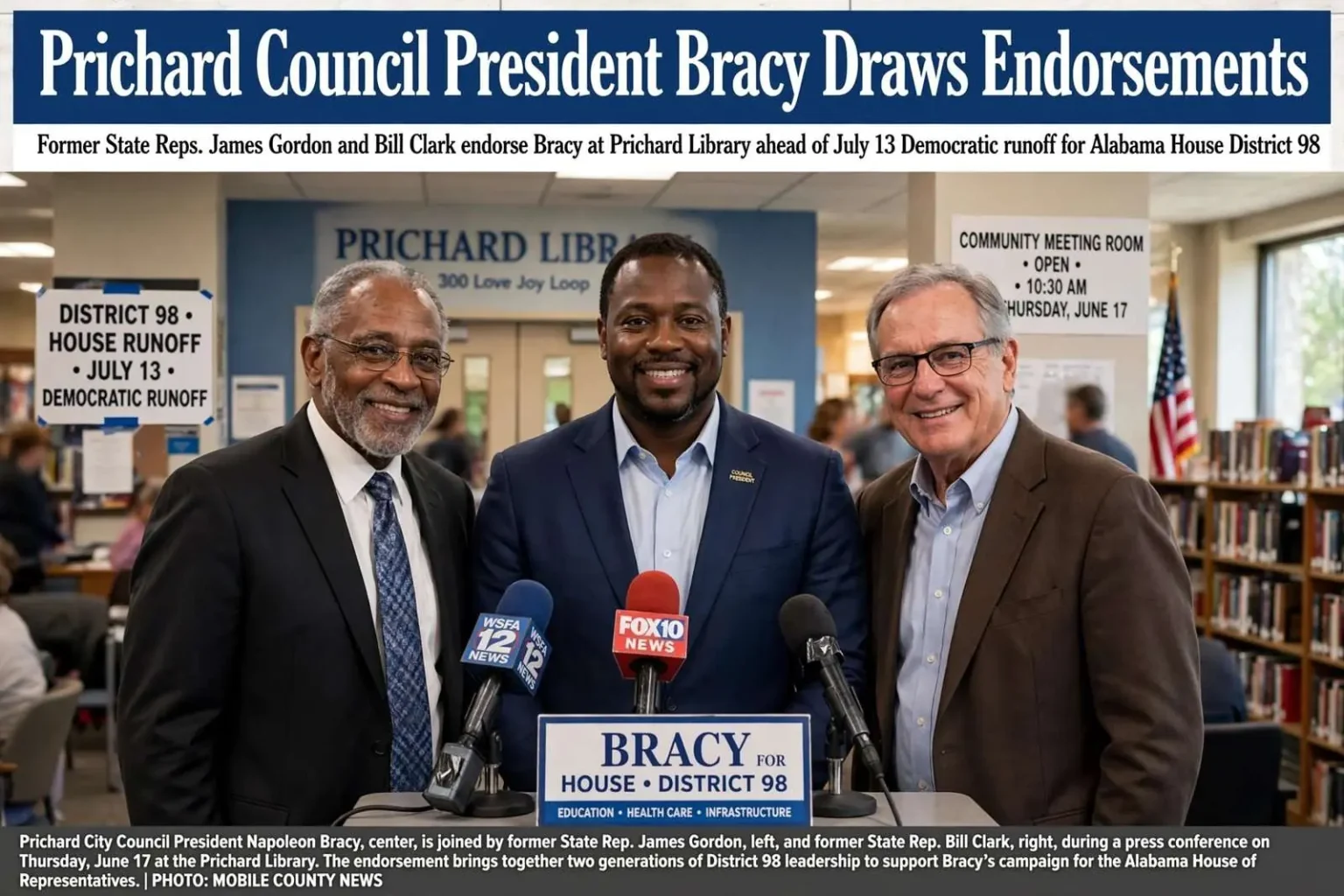
Prichard City Council President Napoleon Bracy gathered his supporters at the Prichard Library this week to announce a pair of endorsements he hoped would carry him through a Democratic runoff for the Alabama House of Representatives, District 98. The endorsements brought together two generations of the district’s legislative history behind a single candidacy, and they arrived at the moment the runoff contest was moving from introductions to persuasion.
Two former lawmakers step up
Among those expected to endorse Bracy were defeated incumbent state Rep. James Gordon and former state Rep. Bill Clark. The Bracy campaign scheduled a news conference for Thursday, June 17, at 10:30 a.m. at the Prichard Library, located at 300 Love Joy Loop, to make the endorsements public. Gordon’s presence carried particular weight, since he had held the seat until his own primary defeat and was now directing whatever remained of his political support toward the man seeking to succeed him.
Endorsements from former officeholders do not deliver votes by themselves, but in a district as compact as District 98 they signal where the community’s established leadership stands. Between them, Gordon and Clark represented years of institutional knowledge about the district’s needs in Montgomery, and each brought a list of supporters, church contacts, and neighborhood leaders that a municipal official running for state office does not automatically command.
A Democrat, Bracy was serving as president of the Prichard City Council. He owned Beyond Expectation Tutoring, Inc., and had worked in the field of education for more than a decade, a background his supporters said prepared him to focus on schools and families in the district. His council presidency put him at the center of Prichard’s budget and personnel decisions, while the tutoring business grounded his campaign’s education argument in daily experience with the district’s students.
The case his backers made
Clark, in lending his support, tied Bracy’s candidacy to the concerns of working residents and retirees in the district. “Bracy will work to improve education and health care benefits in our great state,” Clark said. “He will work to see that Prichard employees and retirees receive what was negotiated in their contracts and fight to improve the infrastructure of District 98.”
Clark’s statement went to the heart of Prichard’s civic anxiety. The city’s obligations to its employees and retirees had become the defining issue of its public finances, and residents followed every development in the question closely. By framing the endorsement around contracts honored and infrastructure delivered, Clark cast the House seat not as a honorific but as a practical instrument for the city’s survival concerns.
Gordon, the incumbent Bracy was seeking to succeed, framed the endorsement in terms of shared values and a shared vision for the community. “Bracy shares the values of our campaign and our family values,” Gordon said. “He understands and will fight for the needs our communities have today and the hopes we have for a secure future for ourselves and for our families.”
Gordon added that Bracy would “work with others to implement the clear change in direction Alabama must have if we are to once again move forward and have a true opportunity to realize the American dream.” The language connected the local race to the broader argument legislative Democrats were making statewide that year, casting the district’s vote as part of a larger effort to redirect the state’s priorities toward education, health care, and working families.
The runoff ahead
Bracy faced respiratory therapist Darren Flott in the July 13 Democratic runoff for the House seat. The winner of that contest would carry the party’s banner into the general election in the fall. Runoffs in the district typically turn on organization and turnout rather than broad persuasion, because the electorate is small, intensely local, and well acquainted with both the candidates and the institutions behind them.
For Prichard, the District 98 race was a matter of close interest. The seat represented a community that had wrestled for years with tight budgets, questions over employee and retiree obligations, and the everyday challenges of infrastructure and public services. Both endorsers pointed to those bread-and-butter concerns as central to the campaign, and to Bracy’s promise to press them in Montgomery.
The district’s geography ties its fortunes to Prichard’s. Encompassing the city and surrounding communities north of Mobile, District 98 sends one voice to the State House for a community whose tax base, population, and public payroll have all been subjects of continuing strain. State assistance, legislative attention to the city’s finances, and the flow of grant money all run through the representative’s office, which is why the city’s retirees and municipal employees followed the race so closely.
Bracy’s dual role, as sitting council president and legislative candidate, placed him at the intersection of city and state government at a moment when Prichard’s finances and future were frequent subjects of local debate. His campaign cast his experience in education and municipal leadership as qualifications for the job, while his opponent’s presence in the runoff ensured that Democratic voters in the district would have the final say on July 13.
The arrangement also invited scrutiny that a purely outside candidate would have escaped. As council president, Bracy was answerable for city decisions even as he campaigned for the state seat, and Flott’s campaign could point to Prichard’s difficulties as a record to be defended. That dynamic – the insider’s resume as both qualification and liability – framed the closing weeks of the runoff contest.
The endorsement event at the Prichard Library was open, and the campaign invited residents to attend and hear directly from the candidate and his supporters. The library itself is one of the city’s most familiar public institutions, and campaign events there carry a symbolic resonance – a plea for investment in education and public services, staged inside one of the investments the district already treasures. With the runoff weeks away, both Bracy and Flott turned to the work of persuading a modest but decisive pool of Democratic voters expected to turn out in the midsummer contest.
Why endorsements matter in District 98
In legislative districts across urban southwest Alabama, the Democratic nomination is ordinarily the decisive contest, and within that contest endorsements function as a map of the community’s alliances. Churches, civic leagues, retired municipal employee groups, and neighborhood associations each carry their own networks, and a nod from a respected former officeholder opens doors that door-knocking alone cannot. The pairing of Gordon and Clark behind one candidate effectively consolidated the district’s recent legislative lineage around Bracy, leaving his opponent to build a coalition from outside the establishment’s chain of memory.
The timing of the announcement, weeks before the July 13 runoff, followed the classic rhythm of Alabama primary politics. Candidates spend the spring introducing themselves and gathering organizational support, then converge on the weeks between the primary and the runoff, when the electorate narrows to committed voters who will actually return to the polls. Midsummer runoffs reward the campaign with the most reliable identification and transportation operation, since a few hundred votes can decide the outcome.
Bracy’s education background gave the endorsements a thematic anchor as well. A decade in education and the founding of a tutoring enterprise aligned naturally with the district’s most consistent concern – the condition of its public schools – and allowed his backers to argue that the district’s next representative would arrive in Montgomery already versed in the education budget debates that consume so much of the Legislature’s time.
The endorsements also carried a message about generational transition. Gordon’s defeat in the primary had closed one chapter of the district’s representation, and his decision to back a younger councilman signaled a passing of the torch rather than a fight over succession. In communities where legislative seats are held for decades and become personal institutions, the blessing of the outgoing officeholder smooths transitions that might otherwise fracture the local party.
For voters, the remaining weeks offered a clear contrast in style and résumé: an educator and city council president with the district’s legislative establishment at his back, against a health care professional offering an outsider’s approach to the same concerns. Both campaigns pointed to the same issues – schools, health care, city finances, streets and drainage – and the July runoff would decide not the substance of the district’s needs but who would carry them to Montgomery. What remained was the oldest work of Alabama politics: yard signs, church announcements, phone lists, and rides to the polls. Whoever ran the better operation of that kind on July 13 would leave the library endorsements behind and begin the longer campaign toward November, with the district’s attention already shifting from the contest itself to the question of what its next representative could actually deliver. For a community that measures its candidates by results, the runoff was only the opening argument.