Baldwin County Probate Judge Stops Performing Weddings as Same-Sex Marriage Becomes Legal
Baldwin County Probate Judge Tim Russell said he will stop performing any weddings, citing workload and moral objections, as Alabama began same-sex marriages.
Baldwin County Probate Judge Tim Russell announced he will stop performing wedding ceremonies of any kind at his office, a decision that came the same day Alabama became the 37th state where same-sex couples could legally marry. The announcement placed the Baldwin County courthouse at the center of a statewide moment, as probate offices across Alabama opened their doors to a new legal reality while their elected officials wrestled, publicly and privately, with how far their personal convictions and official duties overlapped.
Russell, who has served as Baldwin County’s probate judge for five years, said the choice was driven largely by a growing workload in the probate office, though he acknowledged during a news conference that he is also morally opposed to same-sex marriage. The dual explanation captured the position in which many Alabama probate judges found themselves that week: an office drowning in licenses, estates and guardianship filings, and a judicial officer whose personal beliefs were suddenly in tension with a federal court order binding his state.
He said he had committed to performing one more ceremony, a wedding for a former county employee, before stepping away from officiating weddings altogether. Beyond that single obligation, the probate office’s wedding business would simply end — not a ban on any couple, but a withdrawal from the ceremony business entirely, a path several other judges around the state chose in the same period.
What Alabama Law Required — and What It Left to Judges
Alabama law requires probate courts to issue marriage licenses, but it leaves individual judges and court officials discretion over whether they personally perform ceremonies. That distinction became the hinge of the entire episode. The law drew a bright line around licensing: once a couple met the statutory requirements, the probate office’s ministerial duty was to issue the license. Ceremonies, by contrast, were treated as a voluntary service that judges and their staffs performed as a courtesy to the community, and no couple had a legal right to demand one from a particular office.
The practical effect in Baldwin County and a handful of others was a patchwork. Russell joins probate judges in a handful of other Alabama counties who have opted to stop conducting weddings rather than perform ceremonies for same-sex couples, a contrast to officials such as Montgomery County’s probate judge, who said at the time he would marry any couple who applied. Depending on the county, a same-sex couple seeking a courthouse wedding that week might find a judge willing to perform the ceremony, a staff member authorized to do it, or a sign announcing that the office no longer performed weddings at all. Critics of the withdrawals called the approach a distinction without a difference, while supporters of the judges pointed to the letter of the law and the optional nature of ceremonies.
For Baldwin County, the busiest period made the workload argument concrete. The county was among the fastest-growing in Alabama, and the probate office handled a docket that included marriage licenses, adoptions, estate settlements, guardianships, conservatorships and a heavy volume of real estate filings. The prospect of an immediate surge in license applications — on top of routine business and the questions that accompany any major legal change — pressed the office to add staff and rethink its counter procedures before the doors opened.
Demonstrators on the Courthouse Square
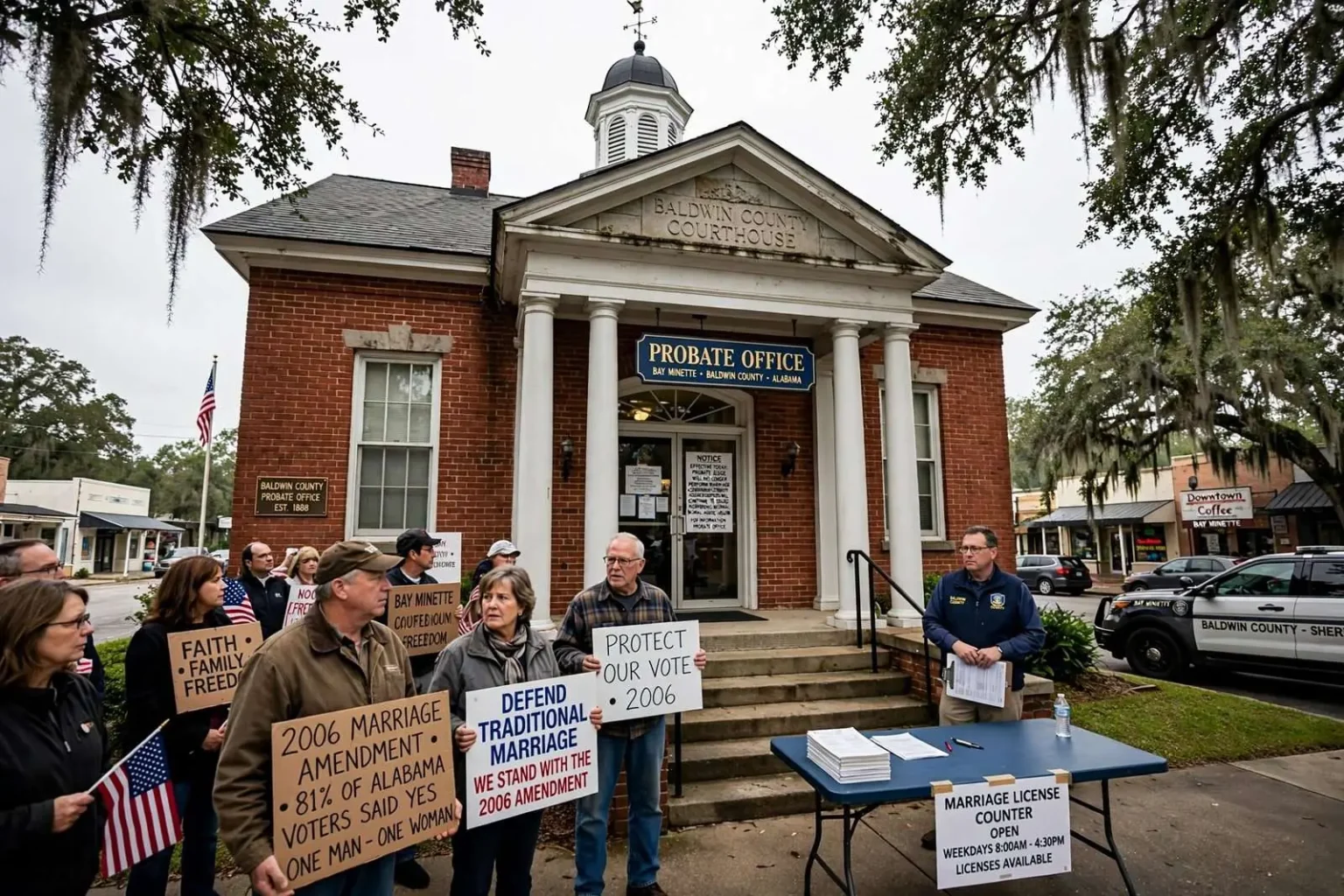
Russell’s announcement came as roughly 50 demonstrators gathered outside the Baldwin County Probate Office on the courthouse square in Bay Minette to show support for Alabama’s 2006 constitutional amendment defining marriage as between a man and a woman. Bay Minette, the county seat north of the Eastern Shore’s population centers, has long been the administrative heart of a county whose largest cities — Fairhope, Daphne, Foley, Gulf Shores — lie farther south, and the courthouse square has historically been the place where Baldwin County’s civic arguments play out.
The amendment at issue had been approved by a wide margin by Alabama voters in 2006, writing into the state constitution the definition of marriage as between one man and one woman. A federal judge had since struck it down as unconstitutional, a ruling that took effect with the U.S. Supreme Court’s refusal to extend the stay — the sequence that made Alabama the 37th state with legal same-sex marriage. Demonstrators held signs referencing the amendment’s original approval margin, underscoring the gap between the statewide vote of a decade earlier and the federal court’s intervention, and at least one longtime local Sunday school teacher spoke in support of the protest.
Awaiting Guidance at the Counter
Russell said his office was awaiting formal legal guidance on how to process marriage license applications from same-sex couples, and that as of Monday morning no such applications had been submitted in Baldwin County. That lull gave the office a window to prepare, but it also reflected the uncertainty that gripped probate offices across the state in the ruling’s first days. Counties had received conflicting signals: a federal court order requiring licenses, a state attorney general’s office signaling it would not defend local judges who refused, and a directive from Alabama’s chief justice instructing probate judges not to issue such licenses at all.
He said the office had added extra staff and prepared updated forms in anticipation of a possible increase in applications, while noting he did not expect a large volume locally. Baldwin County’s marriage license volume had never rivaled that of urban counties, and the judge’s projection was that demand would be modest. Still, the preparations — additional staff on the marriage license counter, forms revised to remove gendered language, a plan for how applicants would be served — showed an office treating the change as an operational event as much as a legal one.
Russell said his office would provide any same-sex couples applying for a license with a copy of an order from Alabama’s chief justice instructing probate judges not to issue such licenses, but added that as a constitutional officer, he ultimately had to follow the directives of the federal court. The formulation neatly summarized the bind in which the state’s probate judges stood: a statewide elected judicial officer at the top of Alabama’s judicial branch was telling them one thing, a federal court with the power of the U.S. Constitution behind it was compelling another, and each judge had to choose which instruction would govern the counter in front of them.
The Probate Office’s Many Roles
The wedding controversy, for all its intensity, touched only a sliver of what the Baldwin County Probate Office does. Alabama probate judges preside over estate probate and will contests, adoptions, guardianships and conservatorships for incapacitated adults, involuntary commitment hearings, and — in many counties — a significant share of the state’s property and recording work. In Baldwin County, one of the state’s fastest-growing jurisdictions, recording volume from real estate transactions alone made the office one of the busiest in south Alabama.
Judges who stopped performing ceremonies were quick to note that nothing about the change affected licensing or any other function. Couples who obtained licenses could marry anywhere an authorized officiant served — ministers, other probate judges willing to perform ceremonies, or anyone qualified under state law. The withdrawals redistributed weddings rather than eliminating them, and over time many Alabama couples simply adjusted to marrying outside the courthouse, a shift that had already been underway nationally.
A Moment That Marked a Generation
The week Russell made his announcement marked a generational shift in Alabama law. Within months, the U.S. Supreme Court’s marriage ruling would extend the same right nationwide and render the county-by-county patchwork obsolete, and Alabama probate offices settled into processing licenses for all couples. Years later, the state legislature would take a further step, overhauling marriage law to remove the certificate-issuing role from probate judges altogether and replacing it with a standardized marriage form recorded by the probate office — a change that eliminated, permanently, the discretion questions that had made offices like Baldwin County’s the focus of national attention.
For the people inside the courthouse square in Bay Minette that day — the judge weighing workload and conscience, the demonstrators holding signs about a decade-old vote, the staff members rehearsing new procedures — the moment was the local face of a national constitutional change. The county’s probate office did its work under the scrutiny that came with it: licenses issued under federal court authority, ceremonies ended at that judge’s discretion, and a community, like the state around it, adjusting to a law that had moved faster than its politics.
The episode also revealed how differently the same legal moment played out across county lines. Couples in some jurisdictions found judges ready to marry them the morning the ruling took effect, while couples elsewhere drove to neighboring counties or made arrangements with local clergy, comparing notes in online forums about which offices were issuing licenses without delay. County probate judges, elected every six years and rooted in their communities, had never faced a test quite like it — a federal mandate, a conflicting order from the state’s top justice, and constituents watching the counter to see which way their own office would go. In Baldwin County, the answer ended up being neither defiance nor full participation, but a quiet withdrawal from the ceremony business that let the office keep issuing what the law required it to issue.