Airbus Says Local Hiring Success Continues at Mobile Assembly Line
Airbus officials told regional workforce leaders that recruiting local talent for its new Mobile A320 assembly line has exceeded early expectations.
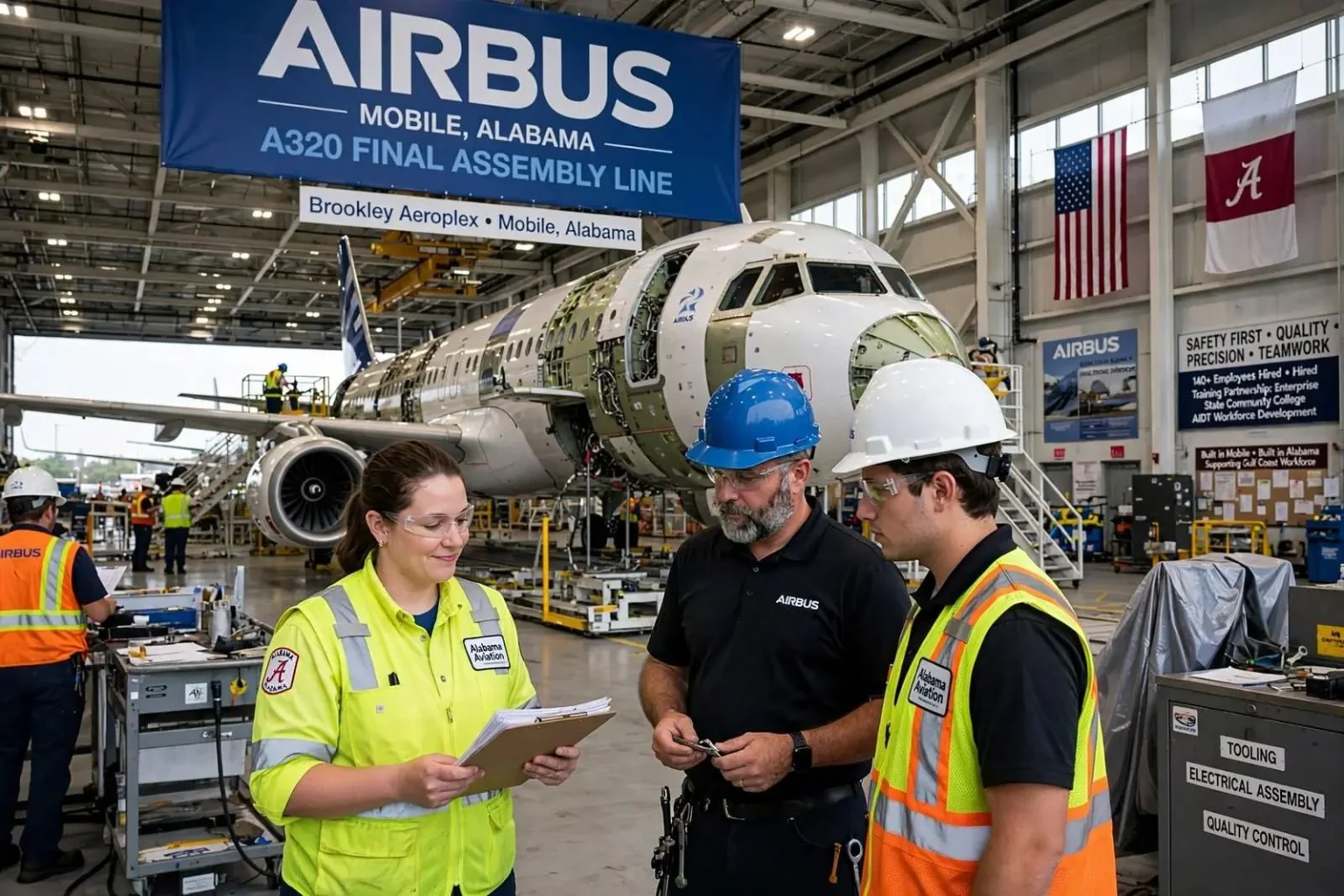
Airbus is finding that it does not need to look far beyond Mobile to staff its new A320 final assembly line, according to the company’s local human resources director, who told a gathering of regional workforce and industry leaders that local recruitment has outperformed early expectations. The update offered the clearest signal yet that the European aircraft maker’s bet on Mobile’s workforce is paying off, months before the first Alabama-built jetliner is due to roll out of the hangar at the Brookley Aeroplex.
Speaking to about two dozen participants at a recent quarterly meeting of the Aviation and Aerospace Advisory Council, Jennifer Ogle said Airbus initially assumed it would need to bring in expatriate workers to fill many of the more technical roles tied to aircraft production and testing. Instead, she said, the local applicant pool has proven far stronger than anticipated, allowing the company to fill specialized positions — including test pilots and ground- and flight-test engineers — with candidates from the Mobile area.
The staffing of test pilots and flight-test engineers with local hires drew particular attention from council members, because those roles rank among the most demanding in commercial aviation. Test crews at a new final assembly line must certify that every aircraft leaving the plant meets airworthiness standards, and the fact that Mobile-area professionals qualified for those jobs surprised even the company’s own planners, who had penciled in expensive relocations from Europe and elsewhere in the United States.
Ogle told the council that being able to find that talent locally represents both a significant cost savings for the company and proof that the skilled workforce needed to support advanced aircraft manufacturing already exists in the region. Relocating an expatriate engineer, she noted, involves moving expenses, housing allowances and long-term assignments that add up quickly; hiring a qualified candidate from the Gulf Coast avoids those costs and roots the new workforce in the community.
A Council Built to Close the Skills Gap
The advisory council itself is a joint effort of the Southwest Alabama Workforce Development Council and Enterprise State Community College, created to identify skills gaps and better align training programs with the needs of the region’s growing aviation and aerospace sector. The quarterly meetings give employers a standing forum to tell educators what jobs are coming and what skills they require, while colleges and training providers report back on how their pipelines are responding.
The meeting was held at the Alabama Aviation Center, a longtime satellite facility of Enterprise State Community College in Mobile, a site that has trained aviation maintenance technicians on the Gulf Coast for decades. The center’s classrooms and hangar space sit just down the road from the Airbus assembly plant at Brookley, making it a natural hub for the region’s aerospace workforce conversation and a supplier of certified mechanics to employers across the area.
Representatives from other key aviation employers in the area, including VT Mobile Aerospace Engineering, Star Aviation, Aero Star and Flight Training of Mobile, also took part in the meeting, discussing industry hiring demand alongside workforce development partners such as the Alabama Technology Network and the Alabama Industrial Development Training program. The presence of so many employers at one table reflects how much the sector has clustered around Mobile’s aviation corridor since Airbus chose the city for its first U.S. assembly plant.
AIDT, the state’s nationally recognized job-training agency, has played a central role in preparing Alabama workers for the new plant, running pre-employment training programs that screen and instruct candidates before they ever reach the assembly floor. Workforce officials at the meeting said that model — which the state has used to recruit automotive and other manufacturers — gives employers a steady stream of job-ready candidates and gives workers a no-cost path into a high-wage industry.
The Alabama Technology Network, which pairs community colleges with manufacturers for process improvement and technical training, described ongoing work helping suppliers and smaller aerospace firms around Mobile adopt the quality standards that come with commercial aircraft production. As the assembly line ramps up, dozens of supplier firms across the region are expected to hire as well, multiplying the employment impact well beyond Airbus’s own payroll.
From First Hires to Full Production
As of the most recent count, Ogle said Airbus had hired more than 140 employees for its roughly $600 million Mobile assembly facility, which was on track to come online later that year, deliver its first Mobile-built aircraft in 2016, and eventually employ about 1,000 people once it reaches full production of 40 to 50 aircraft annually by 2018. The facility assembles A319, A320 and A321 single-aisle jets, the workhorses of the world’s airline fleets, at the only Airbus final assembly line in the United States.
The company’s most recent orientation session drew more than 100 candidates for structural, electrical and cabin assembly positions, with new postings going up regularly across a range of skill levels. Orientation classes mark the final step for hires, who then move into structured on-the-job training under experienced technicians — many of them recruited from established aerospace hubs — before the line begins turning out aircraft.
Ogle acknowledged that application volume has settled since the earliest hiring rounds, when a single opening could draw thousands of applicants, but said the quality of candidates coming through the pipeline has remained strong. The early deluge — driven by the buzz surrounding Airbus’s arrival — has given way to a more focused pool of applicants with relevant backgrounds in manufacturing, aviation maintenance and the skilled trades.
She said prospective applicants should expect to see more production positions posted in the coming months as the assembly line ramps toward full operation, offering continued opportunity for Mobile-area workers to join one of the region’s highest-profile manufacturing projects. Hiring will proceed in waves aligned with the production schedule, meaning that workers who missed earlier rounds will have repeated chances as the plant scales from its first aircraft toward the 40-to-50-per-year target.
Council members noted that the wage levels attached to the Airbus jobs are reshaping expectations across the local labor market. Assembly positions at the plant pay well above prevailing manufacturing wages in the region, which has prompted other employers — from shipbuilders to fabricators along the coast — to reevaluate their own compensation as they compete for the same skilled workers.
A Broader Aerospace Cluster Takes Shape
The other employers at the meeting described their own hiring needs, painting a picture of a sector that is growing well beyond the Airbus plant itself. VT Mobile Aerospace Engineering, which performs heavy maintenance and modifications on commercial jets at Brookley, continues to draw aircraft from carriers around the world to its Mobile hangars. Star Aviation and Aero Star supply engineering, manufacturing and support services to both commercial and defense customers, while Flight Training of Mobile trains pilots whose careers take them into cockpits worldwide.
Workforce planners said the concentration of aviation employers along the Brookley corridor creates a labor ecosystem that benefits everyone: technicians can build careers without leaving the region, employers can recruit from a deepening pool of experienced hands, and schools can justify investment in specialized programs knowing the jobs will be there. That clustering effect was exactly what state and local recruiters promised when the Airbus project was announced, and the advisory council exists in large part to keep the training pipeline matched to the demand.
For students weighing career options, the council’s message was that aerospace careers no longer require leaving the Gulf Coast. Community college programs in avionics, structures and maintenance feed directly into local employers, and the arrival of flight-test and engineering positions filled locally means the ceiling for Gulf Coast aerospace careers keeps rising. Counselors at area schools have begun steering students toward the math and technical coursework that these positions demand.
The quarterly council meetings are expected to continue as the assembly line moves from startup to steady production, with employers reporting hiring numbers, skills shortages and training needs each quarter. Officials involved said the forum has already changed how quickly colleges respond to new requirements, shortening what used to be a years-long lag between an employer’s need and a training program’s response.
For Mobile, the update from Airbus’s own hiring chief amounts to validation of one of the largest economic development bets in state history. The plant was recruited with hundreds of millions of dollars in incentives on the promise that it would anchor a new aerospace industry on the Gulf Coast. Two years into hiring, the company reports that the region’s workers — from the test pilots certifying its aircraft to the technicians building them — are meeting standards that its planners expected to import from abroad, and the pipeline for the hundreds of hires still to come runs straight through Mobile.