Mobile Police Seize Spice, Cash and Firearm in Halls Mill Road Drug Bust
Mobile Police reported a major narcotics seizure on Halls Mill Road, netting cash, a firearm and more than 100 packs of synthetic marijuana.
Mobile Police announced what department spokeswoman Ashley Rains described as a significant narcotics operation this week, following a joint investigation that targeted a residence on Halls Mill Road in Mobile.
The operation was carried out jointly by the Mobile County Street Enforcement Narcotics Team Unit and the Mobile Police Department’s Jaguar Detail, two units that regularly coordinate on cases involving street-level drug trafficking in the city.
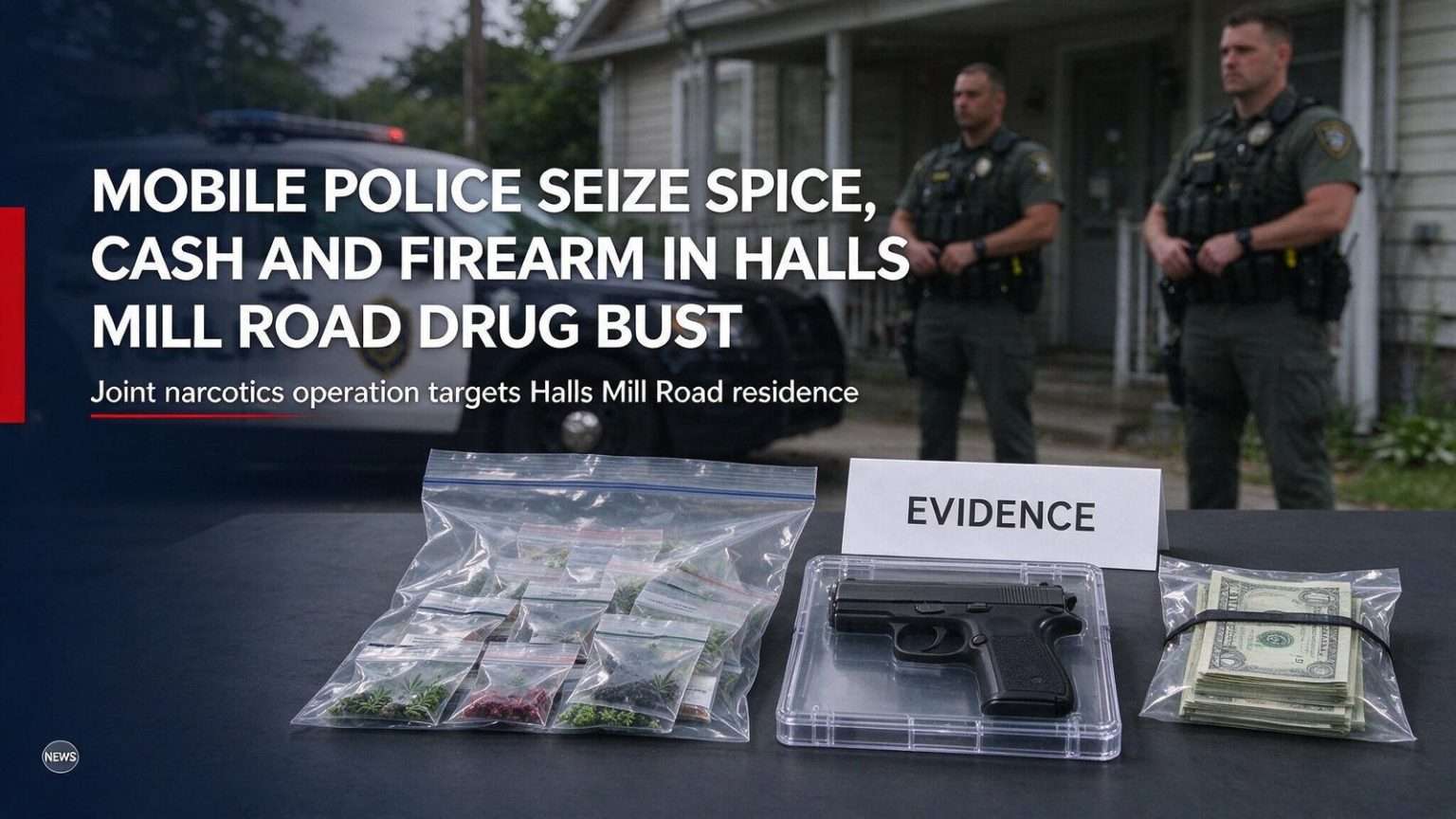
Investigators executed the operation at a location in the 5400 block of Halls Mill Road, a corridor that has drawn law enforcement attention in the past for narcotics activity. According to Rains, officers seized more than $2,600 in cash, a firearm, one vehicle, and 123 individual packs of a synthetic cannabinoid product commonly sold under the street name Spice.
The seizure profile — product packaged in individual sale quantities, cash on hand, a firearm within reach, and a vehicle at the scene — is the combination narcotics investigators look for when building a trafficking case rather than a simple possession one. Packaging matters particularly here: 123 separate packs indicates distribution, not personal use, and Alabama’s drug laws treat that distinction with sharply different penalties.
What Spice is, and why it worries police
Synthetic marijuana products like Spice have been a persistent concern for Mobile-area law enforcement and health officials in recent years, given their unpredictable chemical makeup and the difficulty regulators have had keeping pace with new formulations designed to skirt existing bans.
Spice and similar products are plant materials sprayed with laboratory-synthesized chemicals engineered to mimic THC, the active compound in marijuana. Because the sprayed chemicals change constantly — manufacturers swap one compound for a slightly altered cousin the moment regulators outlaw the last one — the products have been sold openly in convenience stores, smoke shops, and online under names and labels that imply herbal potpourri rather than what they are. The result has been a moving target for law enforcement and poison control alike: a packet sold this month may contain a substance that did not exist, and was not illegal, the month before.
The health consequences are the reason the street product worries hospitals. Users of synthetic cannabinoids have presented to emergency rooms with agitation, hallucinations, seizures, rapid heart rates, and in severe cases organ damage and death — reactions far more dangerous and less predictable than those associated with the plant product the packaging mimics. Gulf Coast emergency departments, including Mobile’s, have periodically issued warnings during waves of adulterated batches that sent clusters of users to the hospital within days of one another.
The regulatory cat-and-mouse has shaped both the market and the law. Alabama legislators have repeatedly expanded the state’s list of banned synthetic compounds, and the Alabama Department of Forensic Sciences has had to identify and schedule substances that were designed specifically to evade the previous list. Each ban narrows the shelf supply for a time; each new formulation restores it. The 123 packs seized on Halls Mill Road are a snapshot of that cycle — product whose exact chemical contents may only be confirmed by laboratory analysis after the arrest, since the packaging and street name guarantee nothing about what is actually inside.
For police, that uncertainty is part of the danger of the work itself. Officers handling suspected synthetic drug seizures face risks that marijuana enforcement never posed — accidental exposure to unknown compounds during searches, K-9 teams poisoned by product left in vehicles, and evidence handlers required to treat every packet as a hazardous material until testing says otherwise.
The units behind the operation
The Mobile County Street Enforcement Narcotics Team — known in area police blotters by its initials — is a multi-agency unit that pools investigators from area departments to work drug cases that cross city limits, while the Mobile Police Department’s Jaguar Detail serves as the department’s own street-level enforcement arm. Joint operations between the two allow a single case to move from complaint to surveillance to search without the handoffs that let targets learn they are being watched.
That coordination matters on corridors like Halls Mill Road, which runs through west Mobile past a mix of subdivisions, apartment complexes, and commercial strips, and which has been the site of repeated narcotics complaints over the years. Investigations into a single residence commonly draw on weeks of tips, undercover purchases, and surveillance before officers ever knock, and the joint-unit structure means the resulting case file can support charges in city or county court depending on where the evidence leads.
Two men, identified by police as Lee McCorkle and Isaac McCullum, were arrested and charged with trafficking illegal drugs as a result of the operation. Trafficking charges in Alabama typically carry more severe penalties than simple possession, reflecting the quantity of narcotics and related assets recovered during the bust.
Why trafficking charges carry more weight
Alabama’s trafficking statute is built around thresholds: quantities of a controlled substance above a legal cutoff trigger the trafficking charge, with mandatory minimum sentences and fines that scale with the amount involved. For synthetic drugs, the state’s scheduling laws have been amended repeatedly to capture the new compounds as they appear, and prosecutors have the option of charging each packaged quantity separately or as an aggregate.
The practical difference for a defendant is stark. Simple possession of a controlled substance is a felony that can carry probation or years in prison; a trafficking conviction brings mandatory prison time, six-figure fines, and — as in this case — the seizure of cash, vehicles, and other property connected to the operation under civil asset forfeiture procedures. The firearm recovered in the operation adds its own exposure, since state and federal law both enhance penalties for drug offenses committed in connection with weapons.
Police did not immediately release additional details about the residence targeted in the operation or how long the investigation had been underway before Tuesday’s arrests — a silence that is deliberate in cases like this, where revealing methods or timelines can compromise related investigations still in progress.
A continuing pattern across the city
The seizure adds to a string of narcotics enforcement actions carried out by Mobile-area task forces aimed at curbing the sale of both traditional and synthetic drugs within city limits. Officials have periodically pointed to joint units like the Street Enforcement Narcotics Team as key tools for disrupting supply chains that feed street-level sales, particularly in neighborhoods that have seen repeat law enforcement activity.
The logic of the task-force model is that street-level sales are the visible end of a supply chain that runs through regional distributors, and that coordinated enforcement — pooling investigators, informants, and equipment across jurisdictions — can work up the chain in a way a single department working alone often cannot. Mobile’s position as a Gulf Coast port city with interstate and rail connections has long made it a focal point for that approach, with federal, state, and local agencies sharing cases that begin with a corner sale and end in an indictment of a distribution network.
For residents, the arithmetic is familiar: a seizure of 123 packs and $2,600 in cash is one residence, one night’s inventory, and one node in a market that renews itself quickly. Enforcement advocates argue the operations still matter, both for the immediate disruption and for the intelligence they generate — phone records, purchase patterns, and seized assets that feed the next case.
What happens next in court
As is standard practice, further information about the case, including any additional charges, would typically be handled through Mobile County court proceedings following the arrests. Arrests on trafficking charges are documented in court filings and preliminary hearings, where prosecutors present enough evidence to establish probable cause and defense counsel begins working the case on discovery. Additional charges — for the firearm, the vehicle, or the cash — can be added as the case develops, and forfeiture proceedings would proceed separately in civil court.
The Mobile Police Department has continued to encourage residents with information about narcotics activity in their neighborhoods to contact investigators, noting that tips from the public often play in building the kind of case that led to this week’s seizure. Complaints about specific addresses — traffic patterns, visitors at all hours, the smell of chemicals — are the raw material that units like the Jaguar Detail and the county narcotics team build investigations from, and department officials say the joint operations announced publicly are a fraction of the cases their tips set in motion.
Residents of the 5400 block and the surrounding streets will likely see the property’s fate play out over the coming months, whether the residence changes hands, gets rehabilitated by a landlord, or sits as a reminder of the operation. What the announcement this week established is the pattern the department has emphasized repeatedly: when tips point to a corridor, the city and county units respond together, and the results — cash, product, weapons, and arrests — are announced in the hope that the next tip comes sooner.