Mobile City Council Reviews Tourism Report, Crime Statistics and Storm Water Contract
Mobile City Council members heard updates on tourism data, citywide crime statistics and a storm water services contract during a Tuesday meeting.
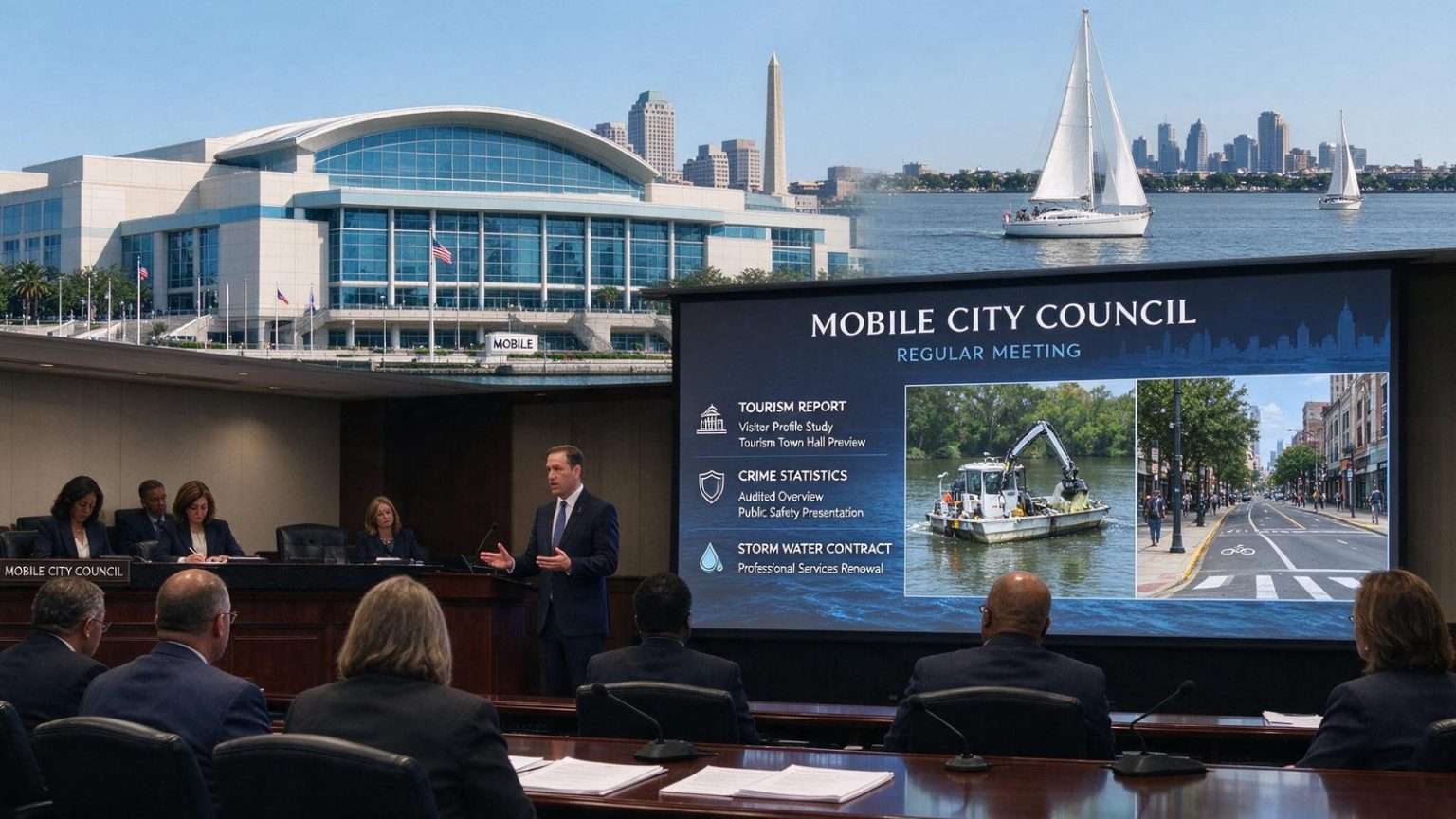
The Mobile City Council took up a wide-ranging agenda during a regular Tuesday meeting, covering everything from tourism marketing to updated crime statistics and a multiyear storm water services contract — a snapshot of the range of issues a city council in a Gulf Coast port city handles in a single afternoon.
The president and chief executive of the Mobile Bay Convention & Visitors Bureau presented early findings from a newly completed visitor profile study, along with a preview of an upcoming two-day Tourism Town Hall planned for later in the month at the Arthur R. Outlaw Mobile Convention Center.
The event is intended to bring together local stakeholders and members of the public to discuss the economic value of tourism investment in the Port City, with a panel of national convention industry experts scheduled to participate. For a city whose tourism fortunes rise and fall with convention bookings, festival seasons and beach traffic passing through on the way to the coast, the town hall format is an effort to build a public case for the money the city and its lodging partners pour into attracting visitors.
The visitor profile study itself is the kind of research destination marketers increasingly rely on: data on who comes to Mobile, why they come, what they spend and how long they stay, gathered to guide everything from advertising buys to the mix of attractions the city promotes. Early findings presented to the council gave the city’s legislative body its first structured look at that picture, ahead of the fuller public discussion planned at the convention center.
Audited crime numbers show declines
Mobile’s police chief also presented audited crime statistics covering roughly a year and a half, from mid-2013 through the end of 2014. The data showed an overall decline in total crime of more than 9 percent and a smaller drop in violent crime, even after the department broadened its criteria for certain offense categories — a methodological change that, in most agencies, would push numbers up rather than down, making the declines more notable.
The audit matters as much as the trend. Crime statistics have a history of being massaged in American cities, and Mobile’s decision to subject its numbers to an outside audit reflects a department trying to establish credibility for its reporting at a moment when its leadership was asking for public trust and continued investment in staffing and technology.
The chief acknowledged the numbers, while encouraging, still reflect the loss of dozens of lives to violence over the prior year and said continued work remains necessary. That candor set the tone for the council’s discussion: statistically, the city was moving in the right direction, but the human toll behind the figures — particularly in the neighborhoods where violence concentrates — remained the department’s central challenge.
Council members have long pressed the department on response times, clearance rates and the visibility of patrols in their districts, and the presentation gave each of them a district-by-district framework for evaluating whether the citywide declines are reaching their constituents. The audit’s broader offense criteria also gave the council a more honest baseline going forward, one that will not flatter future administrations with artificially low starting points.
A $350,000 storm water renewal
Council members also considered a professional services contract worth roughly $350,000 with an environmental firm to continue storm water management work for the city, which the city’s planning director described as largely a renewal of ongoing services. Coastal cities carry obligations under federal clean water rules to manage the runoff that flows from streets and yards into the bay and its tributaries, and the work covered by the contract — monitoring outfalls, mapping drainage, planning improvements — is the technical backbone of that compliance.
A councilman raised concerns about the diversity of the firm’s staff and said he would support the contract for one more year while pressing for changes going forward. His position framed the vote as accountability rather than opposition: the work itself continues, but the firm has been put on notice that its composition of its workforce will be part of the conversation when the contract next comes up for renewal.
The episode reflects a recurring tension in municipal contracting, where councils weigh the continuity and expertise of an incumbent vendor against the city’s stated commitments to broad participation in its business. For Mobile, whose population is nearly evenly divided and whose council districts each carry distinct interests, the composition of firms doing public work has been a live issue on more than one contract.
A trash boat for Three Mile Creek
In other business, the council discussed a grant-funded purchase of a trash-collection boat intended to help clean the Three Mile Creek watershed, a long-standing environmental priority for the city. Three Mile Creek winds through west and central Mobile before emptying toward Mobile Bay, and for years it has carried litter, debris and storm runoff from a wide swath of the city into its slow-moving channels.
The creek gained renewed attention as the city pursued plans to turn its corridor into an asset rather than a liability, with greenway and trail concepts that would link neighborhoods to the water. Those plans depend on a cleaner creek, and the grant-funded boat represents the unglamorous side of that vision — a vessel whose job is to collect what the storm drains deliver before it can accumulate.
Grant funding was central to the pitch. Like most cities of its size, Mobile competes for federal and state environmental grants to fund work its capital budget cannot easily absorb, and council members have generally welcomed purchases that bring outside dollars into local priorities. The boat purchase fit that model: a modest line item for the city, a visible improvement for the watershed, and a tool that municipal crews can deploy after major rains, when debris loads spike.
Complete streets from Water to Beauregard
The council also discussed a separate contract to study “complete streets” design improvements linking Water Street to Beauregard Street in conjunction with the city’s broader downtown planning efforts. Complete streets is a national design philosophy that treats a road as a corridor for everyone — pedestrians, cyclists, transit riders and drivers alike — rather than as a pipe for cars, and it has been steadily adopted by cities remaking their downtowns.
The stretch under study runs through the heart of the city’s historic core, from the waterfront edge at Water Street — home to the convention center and the riverfront parks — inland to Beauregard Street, passing blocks where the city has concentrated redevelopment attention in recent years. A design study is the precursor to construction funding: it identifies where sidewalks, crossings, lighting, bike facilities and drainage improvements would go, and gives the city a shovel-ready document to attach to future grant applications.
For council members, the study connects to the same argument the tourism town hall will make: that downtown Mobile’s competitiveness — for conventions, for residents, for the young professionals the city has been trying to retain — depends on streets that invite people to walk between the riverfront, the restaurants and the neighborhoods. The council’s discussion made clear the two agendas are viewed as a single strategy, with tourism dollars and quality-of-life investment reinforcing each other.
One meeting, the whole city
Taken together, the agenda illustrated the breadth of municipal government in a city of Mobile’s size. In one sitting, the council touched the city’s visitor economy, its public safety performance, its obligations under federal environmental law, the composition of its professional contractors, the health of an urban watershed and the future design of its downtown streets.
Each item carried its own constituency — hoteliers and convention planners, neighborhood watch groups and victims’ advocates, environmentalists and anglers, cyclists and downtown merchants — and each decision will be judged on a different timeline. The tourism study will bear fruit over years of marketing campaigns; the crime audit will be checked against next year’s numbers; the storm water firm has one year to answer its council critic; the trash boat will be visible on the creek within months.
What tied the afternoon together was money and momentum: a city using grants, renewals and studies to stretch its budget across priorities it cannot fund outright, while asking the public — through the town hall and the council’s own meetings — to see the connections between a cleaner creek, a safer city and a busier convention center as parts of a single project of rebuilding Mobile’s standing on the Gulf Coast.
The seven-member council will return to most of these items in the weeks ahead, since contracts of this kind pass through committee review and come back for formal votes with the full document attached. Residents who want to track any of them — the storm water renewal, the complete streets study, the creek cleanup — can follow the agenda packets the city publishes before each Tuesday meeting, where the details behind Tuesday’s discussion appear in black and white.