Byrne and Bentley Head to a Runoff, and the Teachers’ Union Looms Over It
Bradley Byrne led the Republican primary for governor, but the buzz belonged to Robert Bentley. Ahead of the July 13 runoff, the fight turned on the Alabama Education Association and the prospect of Democratic crossover votes.
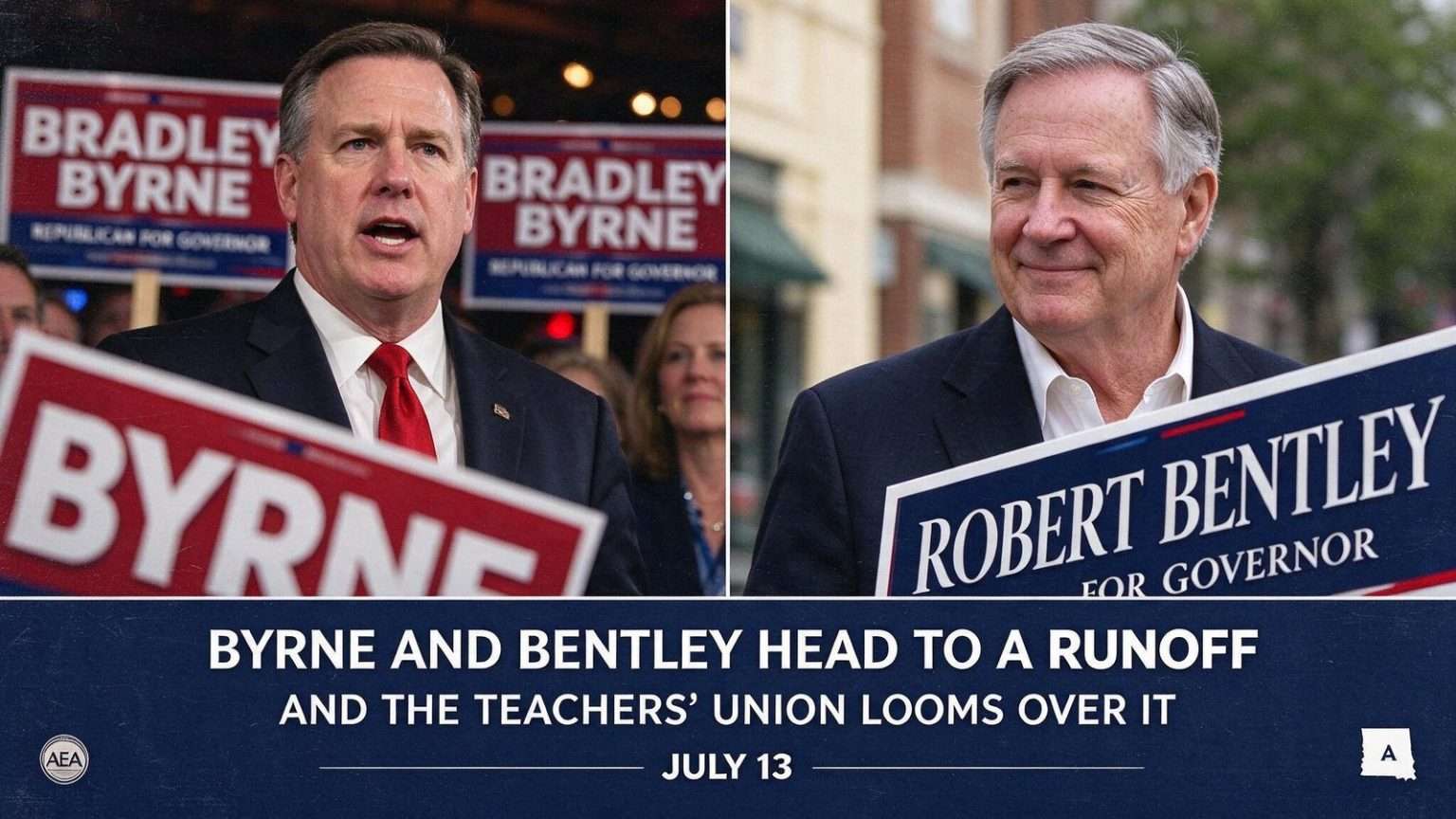
Bradley Byrne led the Republican ticket for governor on June 1, but in the days that followed, the conversation belonged entirely to Robert Bentley — the Tuscaloosa physician and legislator who edged past Roy Moore and, by an eyelash, Tim James to claim the second runoff slot. Many political observers now saw Bentley as the favorite in the July 13 balloting. But five weeks remained, and if any year in Alabama politics promised twists before the finish line, this was it.
The primary’s result rearranged the race’s assumptions overnight. Byrne entered election night as the establishment candidate with the deepest resume and the most polished operation; Bentley entered it as a thrice-dark-horse whose candidacy had been treated as a long shot for a year. When the votes were counted, it was Bentley whose name sat in the runoff alongside Byrne’s, and the campaign’s remaining five weeks would be fought entirely on Bentley’s terms unless Byrne found a way to change the subject.
The candidate nobody shot at
Bentley got through the first round in part because he was not seen as a genuine threat. The combatants were Byrne and James, with Moore and Bill Johnson filling out the field. While Byrne and James spent millions tearing at each other, Bentley — the kindly, avuncular doctor who pledged to take no salary until Alabamians were back at work — was left alone, accumulating votes among voters tired of the whole shouting match.
That changes in a head-to-head runoff. Bentley and his record would now face a deeper examination, and how Byrne managed that scrutiny would likely determine the outcome. In a two-man field there is nowhere to hide: every vote Bentley cast in the Legislature, every position he took before the campaign, and every statement from the primary would be in circulation within days.
At the moment, Bentley was perceived as standing above the mudslinging while Byrne and James had been grappling in the ditch. As Willie Stark observes to Jack Burden in Robert Penn Warren’s All the King’s Men, “There is always something.” Stark meant dirt. But “something” can just as easily be a legitimate issue that, once highlighted, gives undecided voters cause to reflect. Five weeks is enough time to make “something” the whole election — and both campaigns knew it.
The AEA pressure point
The obvious line of attack was the Alabama Education Association. For a Republican legislator, Bentley had enjoyed a warmer-than-average relationship with the teachers’ union, and he had not crossed its leaders, Paul Hubbert and Joe Reed. In Alabama Republican politics, that is not a footnote; it is a case file waiting to be read aloud.
It fit neatly with a Byrne runoff strategy of turning the election into a referendum on whether Hubbert and Reed would continue to hold the reins of state power. Byrne, as the former chancellor of the two-year college system, had tangled with the organization’s influence and paid a price for it, and his campaign believed Republican primary voters shared the grievance. In that framing, Bentley is not demonized so much as cast as a tool of Alabama politics’ master manipulators — a decent man who would govern as they directed.
Even a fully realized version of that attack would have limits, and both sides understood them. Primary voters had just spent a year watching Byrne and James spend fortunes on attack advertising, and the appetite for another round of it was uncertain. A message that worked as an argument between campaigns could curdle as simple negativity, particularly against an opponent whose public image — the soft-spoken country doctor who parks his own car — had been built precisely on being the unpolitician.
Bentley’s counters were ready-made. His pledge not to take a salary until unemployment fell was the kind of line that survives hostile scrutiny precisely because it is simple. His decade in the Legislature gave him a record to defend, but also a story to tell about casting conservative votes without making headlines. And his second-place finish on June 1 came with the most valuable commodity in a runoff: momentum, and a rival’s voters who had been told for weeks that Bentley was not a serious man.
The electorate that decides it
The runoff audience is smaller, older, better-informed and more ideological than the primary’s, which cuts in different directions. The hard core that turns out for a July runoff is the most AEA-skeptical segment of the Republican electorate, which is why Byrne’s team liked its issue. But that same electorate had just passed over Byrne — the candidate who ran hardest on establishment credentials — for a legislator they had barely considered, which is why Bentley’s team liked its position.
Tim James’s voters were the immediate prize. The tile executive’s rough-edged, anti-establishment message — and his famous argument over speaking English on driver’s license exams — built a following that had just been denied a runoff by an eyelash. Where that bloc landed, and whether it landed anywhere at all, could matter enormously in a race expected to be decided by a few thousand votes. Roy Moore’s departure from the ballot removed a constituency of social conservatives who had shown no loyalty to Byrne’s wing of the party either.
The larger shadow
Hovering over the Republican runoff was the question of the general election in November, and the different paths the two candidates offered the party. Byrne represented the safest general-election candidate on paper — a Republican whose record and resume made him difficult to caricature, whose two-year college tenure provided both his best material and his vulnerabilities, and who had spent a career in institutions the party trusts. Bentley represented riskier but potentially more powerful politics: a candidate who could campaign as an outsider even while holding public office, and whose biography connected with voters the establishment had been losing.
The Democrats, meanwhile, watched the five weeks unfold with their own calculations. A bruised, broke Republican nominee emerging from a bitter runoff would suit them fine; a unity candidate with a fresh face and a clean story would not. In that sense, the runoff was never just about which Republican would face November — it was about what kind of party the Alabama GOP’s newly dominant coalition intended to be.
How the five weeks would be spent
Runoff campaigns in Alabama are fought on terrain the primary never touches. Television markets matter less than they do in a crowded primary because the universe of likely voters is so small and so well-defined; direct mail, church networks, talk radio and the candidates’ own schedules carry more weight. Five Sundays of worship, five weeks of civic club lunches and county party fish frys — that is the real calendar of a July runoff, and both candidates knew the ground game would matter as much as anything aired on television.
Money favored Byrne, who had demonstrated an ability to raise it and whose backers included much of the state’s business community. Bentley’s fundraising had run lean, but his June 1 showing changed the calculation overnight; donors who wait for proof of viability had just received it. Whether the money arrived fast enough to matter in five weeks was one of the race’s open questions.
The AEA question, stated plainly
It is worth being precise about what the Alabama Education Association attack actually alleged, because the debate often blurred it. AEA is the professional organization of the state’s teachers, and through its political arm it has been for decades the most formidable electoral force in Alabama, capable of punishing legislators who cross it and rewarding those who do not. Hubbert and Reed ran that machine from Montgomery, and no governor in modern times had governed without accounting for them.
Byrne’s argument was that Bentley had never fought them and therefore never would — that a Bentley governorship would leave the organization’s grip on the two-year college system and the Legislature untouched. Bentley’s implicit answer was that he had spent ten years casting conservative votes without needing AEA’s permission, and that his career showed no loyalty that a governor with a mandate could not override. Which of those portraits the primary electorate believed would say as much about the voters as about the candidates.
The accusation carried a practical edge, too. Whoever won the runoff would inherit a Legislature where the organization’s strength was real, and a budget crisis that guaranteed confrontation over education spending. The runoff argument about AEA was, in that sense, a preview of governing philosophy: confrontation or coexistence with the most powerful interest group in the state.
What to watch on July 13
The signs to watch were clear enough: whether Bentley’s favorability held up under his first sustained scrutiny; whether James’s and Moore’s voters showed up at all; whether Byrne’s AEA message penetrated beyond the audience that already agreed with it; and whether either campaign found the “something” that Willie Stark promised was always there. Five weeks was little time, but in a race this close, it was the whole game — and in Alabama politics, runoffs have a way of producing outcomes nobody predicted on the night the polls closed.