Closed-Door Meeting Raises Fresh Questions About Openness on Mobile County School Board
Two Mobile County school board members drew scrutiny after holding a closed-door meeting with a school system employee, reviving concerns about transparency even under new board and superintendent leadership.
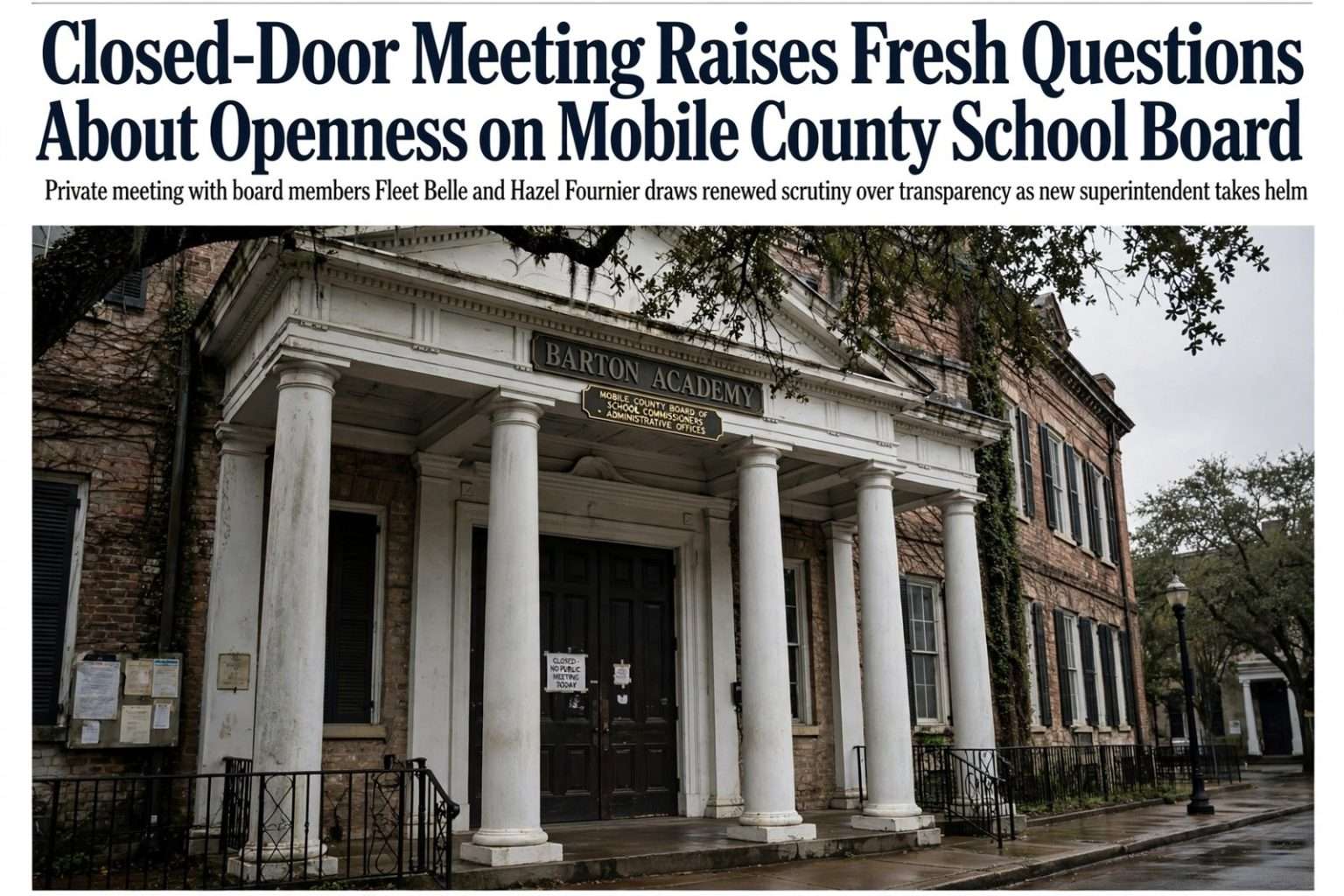
A new superintendent and a newly seated board president have not been enough to change some old habits at the Mobile County Board of School Commissioners, according to board watchers who say two commissioners held a private meeting with a school system employee outside of public view earlier this month. Board members Fleet Belle and Hazel Fournier were the subject of scrutiny after the closed-door session came to light, drawing renewed criticism of a board that has spent much of the past few years dealing with turnover and turmoil at the top.
The meeting took place away from cameras and the public agenda, the kind of informal gathering that has repeatedly put the board at odds with expectations of transparency in how it conducts the public’s business.
The episode is a reminder of just how much scrutiny falls on the board that operates out of the historic former Barton Academy building in downtown Mobile, the 19th-century structure that for generations has served as the administrative home of the county’s public school system.
What the Open Meetings Act requires
Alabama’s Open Meetings Act generally requires elected bodies, including school boards, to conduct their deliberations and decision-making in sessions open to the public, with only narrow exceptions such as certain personnel and legal matters. Gatherings involving individual members and staff that fall outside that framework tend to fuel suspicion that the real decisions are being made away from the public record, even when no law is technically broken.
The law’s exceptions are drawn narrowly for a reason. Personnel matters and attorney-client discussions can legitimately be handled behind closed doors, but the statute presumes openness and requires boards to cite the specific exception they are invoking, to convene and adjourn publicly, and to keep the substance of substantive votes in public session. Meetings held outside that structure, without notice and without a stated exception, occupy a gray zone that transparency advocates say is precisely where bad habits take root.
Government watchdog groups and newspaper editorial writers in Mobile have repeatedly pressed the school board on such gatherings, arguing that a two-member meeting with an employee may skirt the letter of the act while violating its spirit. The act’s design leaves such sessions difficult to police, since there is no notice to challenge and no minutes to inspect, which is why the scrutiny tends to come after the fact rather than before.
A system in transition
The concern comes at what should be something of a fresh start for the board. Roy Nichols took over as superintendent only weeks earlier, succeeding Harold Dodge, whose departure had itself been a source of upheaval within a system that had also seen a sitting board member impeached and removed from office in recent years. A relatively new board president had likewise just taken the gavel, raising hopes among some that the board’s culture might shift along with its leadership.
Nichols arrived with a long résumé in Alabama education and a mandate to steady a system that educates tens of thousands of children across Mobile County and controls a budget in the hundreds of millions of dollars. Superintendents of systems that size answer not only to their boards but to state education officials and federal monitors, and the tone a superintendent sets with his own governing board tends to ripple through the administration he builds beneath him.
The board’s recent history gave that task a difficult backdrop. An impeachment and removal of a sitting member, whatever its underlying cause, left a residue of suspicion around the dais, and the leadership turnover that followed meant the board had spent years relearning its own procedures as often as it debated policy.
Those hopes are now being tempered by skepticism. Critics of the board’s practices say they see little evidence so far that the change at the top has translated into a change in how business gets done, and they are watching to see whether Nichols is willing to press the board toward greater openness even as he settles into a superintendent’s post that comes with a substantial salary and plenty of institutional pressure to avoid rocking the boat.
Why it matters beyond the boardroom
For a school system that educates tens of thousands of children across Mobile County and controls a budget in the hundreds of millions of dollars, the question of whether its governing board conducts business in full view of the taxpayers who fund it is more than a procedural footnote. It goes to whether the public can trust that decisions about hiring, spending and policy are being made on the merits, in the open, rather than worked out beforehand behind closed doors.
The practical consequences of opaque board behavior are familiar to anyone who follows large school districts. Contracts worth millions can move through agendas whose outcomes were decided weeks earlier. Administrators can learn their fates from a phone call rather than a personnel docket. And parents who take time off work to address the board can find that the vote they came to influence was settled before they sat down.
Mobile County’s system, the largest school district in Alabama, carries particular weight in these debates because its decisions touch communities from downtown Mobile to the growing suburbs along the Eastern Shore and out to the county’s rural fringes. A board seen as cutting deals privately risks alienating the very neighborhoods whose support the system needs for tax renewals, building programs and student assignments.
What transparency advocates are watching
Board watchers say the test of the new leadership will be visible in small things before it shows in large ones: whether significant items appear on agendas in time for the public to react, whether committee discussions happen on the record, and whether individual board members channel their questions and concerns through public sessions rather than side conversations with staff.
The private meeting attributed to Belle and Fournier will likely prompt little in the way of formal consequence, since gatherings short of a quorum fall outside the Open Meetings Act’s enforcement machinery. But the episode has already done the reputational damage that such meetings do, handing critics a fresh example of the gap between the board’s stated commitment to openness and its practice.
Nichols, for his part, has said little publicly about the board’s internal culture, which observers read as the caution of a new superintendent measuring his authority. Former superintendents of the system have learned that publicly embarrassing the board is a short road to a short tenure, and Nichols’s early weeks have been spent on administrative appointments and budget groundwork rather than governance fights.
Whether the board’s habits change under the new leadership team will be judged over months, not weeks. The standard the public can apply is simple, and transparency advocates repeat it every time an episode like this one surfaces: the public’s business should be conducted where the public can see it, and a school system that asks taxpayers for hundreds of millions of dollars should expect them to watch how every one of those decisions gets made.
Barton Academy and the weight of history
The building where the board conducts its business is itself a lesson in the system’s long memory. Barton Academy, completed in the 1830s as Alabama’s first public school building, became the administrative headquarters of the Mobile County system after generations of educational use, and its Greek Revival portico has watched over every major decision the board has made since. Meetings held inside its walls carry, for many Mobilians, a sense of civic continuity that makes deviations from open practice feel like breaches of an old promise.
The building’s condition has also been a recurring budget question for the board, which has weighed restoration plans for the aging landmark even as classroom needs across the county compete for the same dollars. Every closed-door controversy, editors and board watchers note, makes the case for the building’s public use harder to argue with a straight face.
The board itself is an unusual body in Alabama local government. As the Mobile County Board of School Commissioners, it is a separately elected school board whose members represent districts across the county, wielding authority over the state’s largest school district independently of the county commission and the city councils within its borders. That independence concentrates power, and with it, the expectation that the board’s deliberations will be visible to the voters who elect its members.
The superintendent’s balancing act
Roy Nichols’s first weeks in office illustrate the balance every superintendent of a large district must strike. The system he now runs spans more than a hundred schools, employs thousands of teachers and support staff, and faces the full range of pressures confronting urban districts: aging buildings, desegregation-era obligations, competitive suburbs, and a state funding formula that leaves districts dependent on local support. None of that work proceeds without a functional relationship with the elected board that holds his contract.
At the same time, the superintendent is the system’s chief administrator, the one official with both the standing and the institutional knowledge to insist that board-staff interactions run through proper channels. Administrators who receive direction from individual board members outside public meetings are placed in an impossible position, answering to nine elected officials rather than to the administration the public can observe. Pressing for that discipline is among the least glamorous and most consequential things a new superintendent can do.
Board watchers in Mobile have seen the pattern before: a new superintendent arrives, promises openness, and gradually accommodates the board’s informal practices as the price of survival. The skeptics now watching Nichols are, in effect, asking whether this transition ends differently, and they have committed to measuring his tenure against the standard the recent episode tested.
For the county’s parents and taxpayers, the stakes reduce to confidence. A board that deliberates in public can be judged in public, and a system that educates tens of thousands of children will earn its community’s trust, or lose it, one meeting at a time.