Serda’s Coffee Company Opens on Royal Street, Filling a Downtown Mobile Void
Serda's Coffee Company has opened on Royal Street in downtown Mobile, offering espresso drinks, wraps and paninis, a beer selection with Guinness on tap, and free Wi-Fi for the district's residents and workers.
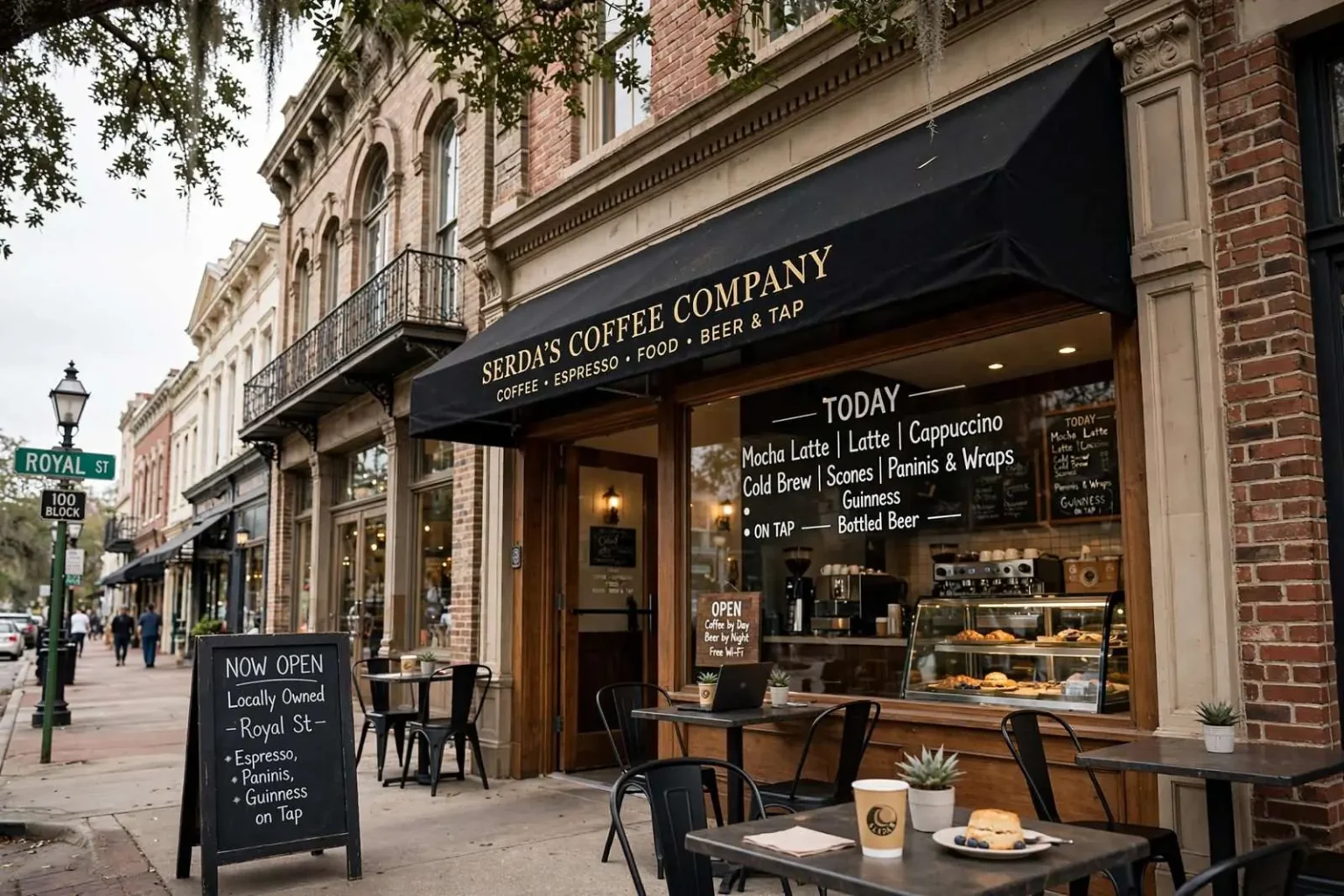
Downtown Mobile residents have a new option for their morning coffee run now that Serda’s Coffee Company has opened its doors on Royal Street. For people who live and work in the district, the opening fills a gap that has lingered for years: a locally run coffee shop that isn’t a national chain. The shop takes its place along one of the most historic commercial corridors on the Gulf Coast, a block of Royal Street lined with restored nineteenth-century storefronts within easy walking distance of Bienville Square, Government Street, and the heart of the Lower Dauphin entertainment district.
The new shop’s early offerings include espresso drinks such as mocha lattes, along with scones, wraps and paninis. The menu is built for the full range of downtown routines, from a quick espresso before work to a sandwich and a refill at midday. Serda’s has also stocked a selection of bottled beer and put Guinness on tap, an unusual combination for a coffee shop and one that broadens its appeal well beyond the morning commute into an all-day gathering spot.
That dual identity — coffeehouse by day, casual neighborhood bar by evening — mirrors a model that has worked in other revitalizing downtowns across the Southeast, where a single well-run establishment often becomes the anchor tenant of a whole block. A customer can arrive at 7 a.m. for a latte and a scone before the office, return after lunch for a panini and Wi-Fi time, and still find the doors open after dark for a pint and conversation.
A Gathering Place for Downtown Workers and Residents
Free Wi-Fi rounds out the draw, giving downtown workers, freelancers and anyone else who needs a place to sit with a laptop a reason to linger rather than grab a drink and go. In a district where office workers, attorneys, city employees and cruise-terminal visitors all move within a few blocks of one another, a reliable table and a good connection are more valuable than they might appear. Remote work has changed what downtown residents expect from their neighborhood, and cafés have become the de facto meeting rooms of the modern city.
The location on Royal Street places the shop in the heart of downtown Mobile, an area that has been slowly rebuilding its retail and restaurant base as more residents move into lofts and apartments in the historic district. Conversion of upper floors of historic commercial buildings into residential space has brought a permanent population back to streets that emptied out every evening for decades. Each new resident is a potential daily customer for a coffee shop, and each new café makes downtown living more practical for the next resident.
Small, independent openings like this one matter disproportionately in a downtown core that is still working to prove it can support day-to-day foot traffic beyond special events like Mardi Gras and Bayfest. During Carnival season, Royal Street and the surrounding blocks absorb enormous crowds, and during festival weekends downtown restaurants routinely see their best business of the year. The challenge for any downtown merchant is the long stretch of ordinary weeks in between, when survival depends on regulars rather than revelers.
Why Independent Coffee Matters in Mobile
A coffee shop with extended hours, food options and a beer and wine list gives nearby residents a reason to spend time — and money — within walking distance of home rather than driving to the suburbs. Every dollar spent at a locally owned shop tends to circulate locally, supporting area suppliers, local payroll and the property owners who have invested in restoring downtown buildings. Chain coffee, by contrast, sends its profits out of the market and rarely becomes a civic living room the way a neighborhood café can.
The Mobile market has seen growing appreciation for independent coffee in recent years, part of a broader Gulf Coast trend in which specialty roasters and owner-operated cafés have multiplied across the region. Customers have become more discriminating about espresso quality, bean sourcing and atmosphere, and independent shops compete on exactly those points. Serda’s entry into the Royal Street market puts that kind of offering within reach of the growing residential population downtown.
The timing also fits the rhythm of downtown life. Mobile’s historic district has a walkable street grid, shaded sidewalks and a density of small commercial buildings that lends itself to café culture in a way that strip-center suburbs never quite manage. Cities across the South that have invested in bringing residents back to their cores — from Pensacola’s Palafox Street to New Orleans’ Bywater — have typically found that coffee shops arrive early in the revival and then help pull everything else along.
A Sign of Confidence in the District’s Revival
For downtown Mobile, the arrival of an independent coffee shop is a small but telling data point in the broader story of the district’s revival. Retail follows rooftops, but rooftops also follow retail, and the entrepreneurs who sign leases in a recovering downtown are making a calculated bet that the trajectory continues. A coffee shop lives or dies on repeat daily business, so opening one on Royal Street is a statement of confidence in the district’s weekday vitality, not just its festival economy.
Local business owners and city boosters have long pointed to exactly this kind of amenity — walkable, locally owned, open late enough to serve as a meeting spot — as evidence that downtown living is becoming more viable for a wider range of residents, not just a novelty for a handful of urban pioneers. Young professionals, empty-nesters and students all tend to cite coffee shops and restaurants among the top amenities they look for when choosing where to live, and Mobile’s downtown advocates have made the same argument in their recruiting pitches for new residential development.
The measure of the shop’s success will come over ordinary Tuesdays and Wednesdays in the months ahead, when Mardi Gras is a distant memory and Bayfest is a season away. If morning lines are steady, the lunch counter busy and the evening taps flowing, Serda’s Coffee Company will have validated both its own bet on Royal Street and the larger argument that downtown Mobile can sustain the small businesses that make a district feel like a neighborhood. Either way, downtown workers and residents now have one more reason to stay on the peninsula for their daily routine.
The shop’s Royal Street address also connects it to Mobile’s tourism economy. Visitors arriving for cruises out of the Alabama Cruise Terminal on Water Street, attendees at convention events, and heritage tourists exploring the city’s antebellum architecture all pass through the downtown grid, and an independent café with local character is exactly the kind of stop guidebooks and hotel clerks recommend. Unlike a chain store that looks the same in every city, a locally owned coffee shop doubles as an introduction to the place itself.
For the immediate neighborhood, the practical benefits are straightforward. Residents of downtown lofts gain a morning destination within a short walk. Office workers gain an alternative to the drive-through line. Meeting-goers gain a neutral, informal venue between the courthouse complex and the business houses along Government Street. And the Guinness tap and bottled beer selection give the shop a second life after the workday ends, when coffee demand fades but the desire for a comfortable third place does not.
How the combination plays out in practice will depend on the same forces that shape every downtown business: consistency, staffing, and the steady accumulation of regulars. But the ingredients are in place — a historic street with growing residential population, a menu broad enough to cover morning through evening, and a community that has spent two decades arguing that downtown Mobile deserves exactly this kind of establishment. Royal Street now has one.
Downtown stakeholders will also be watching the spillover effect. Coffee shops tend to lengthen the hours a street feels active: they open earlier than most retail and stay useful later than most offices, putting eyes on the sidewalk during the quiet hours when a block can otherwise feel abandoned. Urban planners sometimes call this temporally dense use, and it is one of the cheapest forms of public safety a district can buy, because an occupied storefront does more for a street’s sense of security than any camera.
The Guinness tap and bottled beer selection give the shop a second life after the workday ends, when coffee demand fades but the desire for a comfortable third place does not. The decision to pour stout alongside espresso is a pragmatic response to the economics of a small retail space. A coffee shop’s profitable hours are concentrated in the morning; a beer tap and a bottled selection extend revenue into the evening without requiring a second buildout or a second staff. Cities across the Southeast have watched the coffee-and-craft hybrid become a standard small-business model, and Mobile’s licensing framework accommodates it through the same on-premises beer and wine permits any neighborhood bar would hold.
It also answers a real gap in the downtown calendar. Before the evening dinner rush and after the afternoon coffee lull, there is a stretch of hours when downtown has historically offered little to do but leave. A room where someone can nurse a latte at 10 a.m. and a pint at 5 p.m. keeps people on the peninsula through that dead zone, which in turn supports the restaurants and shops around it.
For the people who already live downtown, the calculus is simple: one more daily errand handled without a car. The historic district’s residential revival has always been constrained by the small inventory of everyday conveniences, and a full grocery store remains the most requested missing piece. But the list of small conveniences — a café, a dry cleaner, a sandwich counter — is what makes the difference between a district people sleep in and a district people live in. Serda’s Coffee Company adds a significant line to that list, and its first year on Royal Street will say a great deal about how quickly the rest of downtown’s retail base fills in around it.