GOP Circles Buzz Over Possible Bonner Run for Governor in 2010, But Congressman Downplays Talk
Republican circles are speculating that Rep. Jo Bonner could be eyeing a 2010 run for Alabama governor after his new House Appropriations Committee assignment, though Bonner says his focus is on re-election.
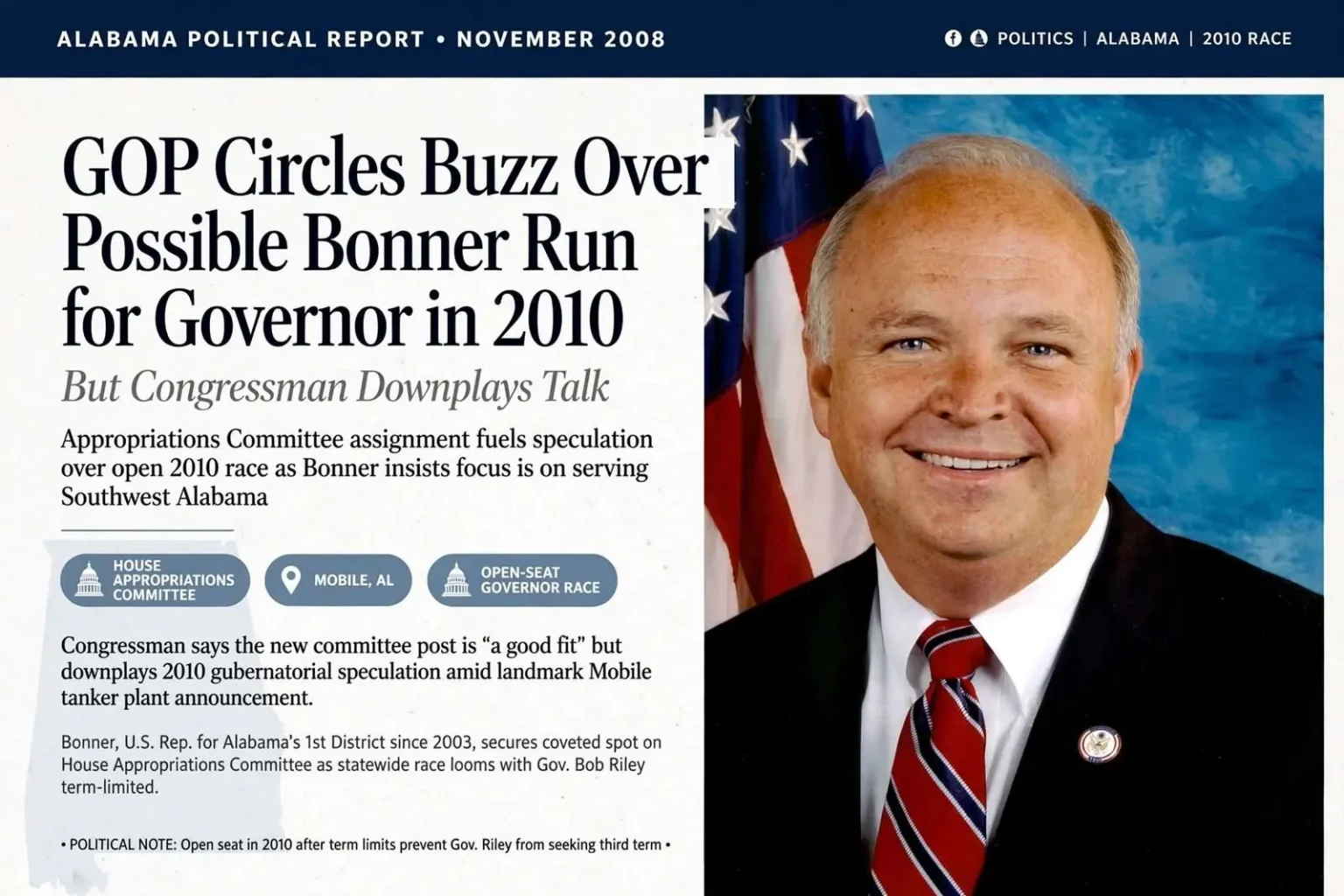
Speculation is circulating in Alabama Republican circles that U.S. Rep. Jo Bonner could be positioning himself for a run at the governor’s office in 2010, after the Mobile congressman landed a coveted assignment on the House Appropriations Committee. In a state where statewide campaigns are built years in advance and where a seat on the chamber that controls federal spending is among the most powerful perches a House member can hold, the assignment was read by party insiders as more than a routine committee placement. Within days, the question being asked at Republican gatherings from Mobile to Huntsville was not whether Bonner had the profile for a statewide race, but whether he had the appetite for one.
The chatter comes even as another, more distant name has floated around Alabama political talk for a later cycle: NBA Hall of Famer Charles Barkley, who has mentioned interest in a 2014 run. Barkley, the Leeds native whose outspokenness has made him a fixture of national television, has repeatedly flirted with the idea of a gubernatorial campaign, and his name guarantees headlines whenever it surfaces. For now, though, it is the 2010 race drawing attention, and Bonner’s new committee post has fueled talk that he is quietly building toward a statewide campaign.
The 2010 contest is already taking shape as one of the most wide-open gubernatorial races in years, since incumbent Gov. Bob Riley is barred by term limits from seeking a third consecutive term. Open-seat races for governor in Alabama attract crowded fields on both sides, and the absence of an incumbent means the party’s fresh faces, veteran officeholders, and wealthy outsiders all have reason to consider the leap. Bonner’s name joining that conversation is unsurprising to anyone who has watched his rise, but his new Appropriations seat gives the speculation a firmer foundation than it had before.
A coveted assignment
Bonner pushed back on that framing without closing the door entirely. “Look, I love my job,” Bonner said. “I feel like this new committee assignment will give me a chance to – and I don’t mean in terms of bringing more projects back to Alabama – but I think this is a good fit, even though the environment is different and we’re going to have to make some tough decisions.”
The assignment itself is a signal worth reading. The House Appropriations Committee is one of the smallest and most exclusive committees in Congress, and its members hold direct leverage over federal spending decisions that touch every state. For a southwest Alabama district whose economy is anchored by shipbuilding, aerospace, and the port of Mobile, a seat at that table carries obvious benefits, and Bonner framed it as a fit rather than a stepping stone. His insistence that the value is not about “bringing more projects back to Alabama” was an acknowledgment of the earmark politics that appropriations seats have traditionally invited, and of a budget environment in which such projects face growing scrutiny.
The timing of the speculation is notable. On the same day the talk intensified, officials announced that an air tanker assembly plant would be built in Mobile – the payoff of the long-running competition between Boeing and the Northrop Grumman-EADS team for a massive Air Force refueling tanker contract. The tanker fight had stretched across years and multiple procurement rounds, pitting Boeing’s bid against the European Aeronautic Defence and Space Company and Northrop Grumman partnership that had chosen Mobile as its assembly site. For the Gulf Coast’s ambition to become a serious aerospace hub, the plant’s announcement was a landmark moment.
A win of that magnitude, delivering thousands of aerospace jobs to Mobile, could hand Bonner a wave of local popularity heading into any future statewide bid. Aerospace payroll transforms a regional economy, and the politician associated with landing it inherits credit that endures well past the ribbon-cutting. Statewide, the tanker announcement also burnished the argument that south Alabama’s delegation delivers for the state, a point Bonner could carry into any campaign narrative about bringing jobs to every corner of Alabama.
The decision he has not made
Bonner, however, said he had not decided whether to pursue the governor’s mansion in Montgomery. He was candid about what a serious campaign would require. “I like what I’m doing, and I’m confident we’ve got a good list of qualified men and women that are out there that would be able to focus the time and resources in the tune of $15 million to run for governor,” he said.
The figure was not an exaggeration. Competitive gubernatorial campaigns in Alabama have grown into eight-figure undertakings, with television advertising in the Birmingham, Huntsville, Mobile, and Montgomery markets consuming the overwhelming share of the budget. A candidate who begins raising 18 to 24 months before the election must average tens of thousands of dollars a week, largely through call time, events, and the constant solicitation of donors who expect access in return.
The congressman has previously said he dislikes the fundraising grind that a statewide race would demand, though he did not rule it out completely. “I’m not going to tell you that I one day won’t consider looking down the road, but right now the road I’m looking down is being the best congressman I can be for southwest Alabama,” he said. The formulation left the door ajar without walking through it, which is precisely how seasoned Alabama politicians keep their options open while declining to become the story.
Bonner argued it made little sense to dwell on a race two years away. “I don’t see a scenario. I think the person who runs for governor will have an obligation – on our [the Republican] side – to continue build on the foundation that [Gov.] Bob Riley has laid for us and I think there are a lot of people out there that will build on that foundation and keep us moving in the right direction,” he said.
The reference to Riley’s record was telling. Riley’s tenure has emphasized ethics initiatives, economic development recruitment, and Hurricane recovery efforts along the Gulf Coast, and the Republican field that ultimately forms will compete largely over which candidate can most credibly claim that inheritance. By framing the race as a matter of building on Riley’s foundation rather than repudiating it, Bonner positioned himself within his party’s mainstream without committing to the contest that would test the claim.
Focus on the district
With his own re-election bid for the 1st Congressional District seat only months away, Bonner said his focus was squarely on that race rather than any statewide ambitions. “I just don’t think it just serves any purpose to speculate about an election that’s two years away, when I’ve got one that six month, seven months away,” he said.
The 1st District stretches across the southern tier of the state, taking in Mobile, Baldwin County, and communities along the Florida line, and its voters have sent Bonner back to Washington repeatedly since he first won the seat in 2002. He is considered heavily favored to win re-election to the seat he has held since 2003. A comfortable re-election contest gives him the luxury every ambitious politician wants: a base campaign that requires little risk while the statewide field takes shape without him.
That cushion also shapes the strategic calculus. A congressman who must fight for survival has no bandwidth for a gubernatorial bid; one who coasts to re-election can spend the following year courting donors and county chairmen across all 67 counties. Bonner’s overwhelming position at home is, in that sense, one more asset that the speculation about 2010 is built on. Whether he ultimately converts it into a statewide campaign will depend on decisions that, by his own account, he has not begun to make.
For now, the questions about 2010 remain exactly that – questions, asked in county committee meetings and donor circles while the congressman himself declines to answer them. The combination that set the talk in motion, an Appropriations seat and a landmark aerospace announcement arriving in the same news cycle, is the kind of coincidence that Alabama political watchers have learned to take seriously, even when the politician at its center insists it is nothing. What is certain is that Bonner enters the next two years with a safe district, a powerful committee post, and a state party searching for its next generation of statewide candidates.
Whether that adds up to a gubernatorial campaign will be determined not by the speculation but by the unglamorous work Bonner says he prefers: appropriating, advocating for the district, and winning re-election first. In Alabama, the politicians who end up in the governor’s mansion have rarely announced the climb at the start; they have let the field, the money, and the moment make the case for them. Bonner, for his part, seems content to let everyone else do the talking.