Mobile School Board President Fleet Belle Accused of Runoff Dirty Tricks Against Levon Manzie
Mobile County School Board President Fleet Belle faces accusations that his campaign used an elderly woman to file complaints against runoff opponent Levon Manzie and tried to pull school board attorneys into the fight.
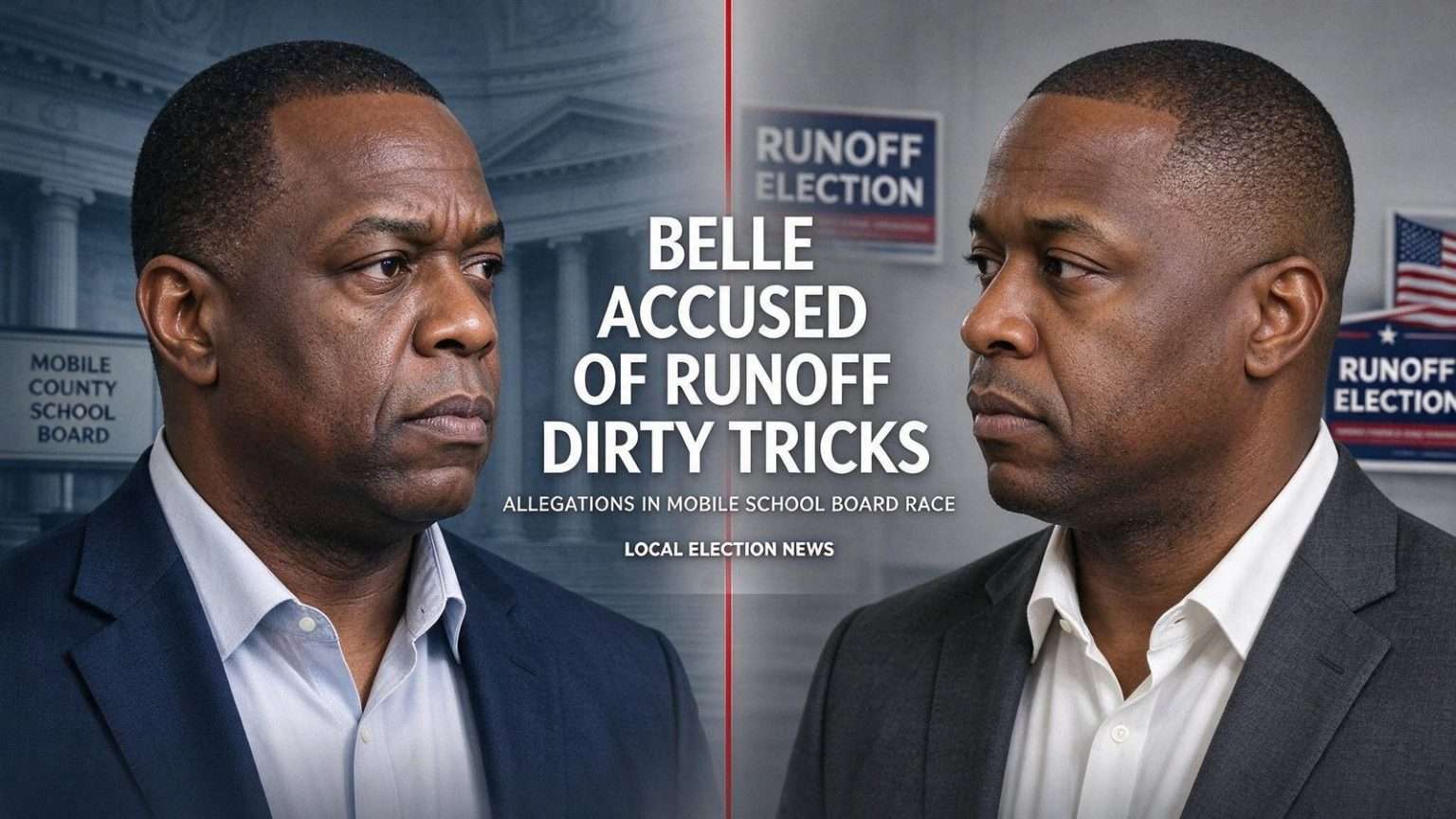
Mobile County School Board President Fleet Belle faced fresh accusations of political maneuvering ahead of his runoff election against challenger Levon Manzie, with critics alleging that Belle’s campaign enlisted an elderly woman to file complaints against Manzie and then attempted to draw the school board’s own attorneys into the dispute.
According to the allegations, the apparent scheme unfolded as Belle sought to fend off Manzie in the upcoming runoff, with critics describing the effort as an ill-conceived attempt to manufacture trouble for his opponent rather than compete on the merits. The specifics of what the elderly woman’s complaints alleged, and how far the effort to involve school board attorneys actually went, remain the subject of dispute, but critics say the episode fits a broader pattern of questionable judgment during Belle’s tenure as board president.
The use of a third party to file complaints, if it occurred as described, would raise questions that go beyond ordinary campaign friction. Alabama election seasons are famously competitive, and school board races in Mobile County are no exception, but critics drew a distinction between pointed campaigning and what they characterized as manufacturing official-looking grievances against an opponent.
The broader pattern critics cite
Critics pointed to a string of issues they say have defined Belle’s time in office, including past tax problems and previous instances in which he was accused of using his position to help family members secure favorable arrangements. Taken together, critics argue, the pattern raises serious questions about whether Belle should continue to lead a board responsible for overseeing one of Alabama’s largest public school systems.
For his part, Belle has not been shown to have been charged with any crime in connection with the episode, and the full details of what transpired, including any response from Belle or his campaign, were not fully aired in the initial reporting on the allegations. Supporters of the board president have cautioned against judging the matter on critics’ descriptions alone, noting that complaints filed during election season are not unusual and that the motivations behind the accusations deserve the same scrutiny as the conduct being alleged.
The accusations landed at a particularly sensitive moment. With the runoff approaching, both campaigns were working to define the contest for a shrinking electorate, and each side understood that a story about character — anyone’s character — could move more voters than a month of platform discussion.
How the dispute played out within the board itself was an open question. If the board’s attorneys were asked to review or act on complaints connected to the campaign, colleagues of Belle would face their own decisions about whether board resources were being used appropriately, adding an internal dimension to what was already a public political fight. Boards in large districts rarely comment on pending matters involving their own officers, which can leave voters without official answers until after the election is decided.
What the board presidency controls
The Mobile County school board presidency carries substantial responsibility, overseeing a school system serving tens of thousands of students and a budget that runs into the hundreds of millions of dollars. The board sets policy for schools across the county outside the incorporated city systems, hires and evaluates the superintendent, approves the annual budget, and decides matters ranging from school construction to student discipline policy. How the board is led — how meetings are run, how grievances are handled, how the superintendent is held accountable — shapes the daily experience of teachers, students and parents across the district.
Board leadership races in Mobile County have periodically drawn intense local scrutiny precisely because of that scale, with voters and civic watchdogs treating school board contests as high-stakes contests over the stewardship of local public education rather than a minor down-ballot affair. Local media and civic organizations have repeatedly examined school board candidates’ finances and conduct, and past board members have faced investigations and public censure over issues involving the use of their positions.
The district’s budget alone makes the stakes plain. Hundreds of millions of dollars in combined local, state and federal funding flow through the system each year, supporting everything from teacher salaries to bus routes to building maintenance across one of the largest geographic school districts in the state. Decisions about where new schools are built, which programs are expanded and which positions are cut fall to the board, and those decisions reverberate through neighborhoods and property values across Mobile County.
The runoff dynamic
Runoff elections in Alabama are triggered when no candidate in the initial race secures a majority of the vote, sending the top two finishers into a head-to-head second round. That dynamic tends to sharpen campaign tactics, as candidates and their supporters look for any edge in a smaller, more decisive electorate.
Turnout in runoffs typically drops well below the level of the first election, which means the voters who do show up are more likely to be the parties’ most committed participants — and more reachable by direct contact, door-knocking and, critics say, negative campaigning. Political observers in Mobile County have watched runoff contests shift on late-breaking controversies, making the final weeks of a runoff the period when allegations like these carry the most potential weight.
Critics of Belle argue that the alleged effort to use a third party to file complaints against Manzie, and to potentially draw school board legal staff into a campaign dispute, crossed a line from hardball politics into an improper use of institutional resources for personal political ends. School board attorneys are public employees whose work is supposed to serve the district, not any candidate’s campaign, and involving them in a dispute between sitting officials and a challenger raises questions about whether the machinery of the board itself was being aimed at electoral purposes.
The period ahead
The runoff between Belle and Manzie was set to determine who would lead the school board through a period of significant budget and policy challenges facing Mobile County’s public schools.
Those challenges are familiar to large urban districts across Alabama: tightening budgets, aging school buildings, competition from private and charter alternatives, and the persistent task of improving student achievement in a system with wide gaps between its strongest and weakest schools. Whoever emerged from the runoff would inherit a policy agenda already in motion, with spending priorities and administrative decisions pending that would test the new board leadership immediately.
State education officials were also watching Mobile County closely during this period, as the district worked through accountability measures and improvement plans at its lowest-performing schools. A board distracted by internal disputes or leadership turnover risks losing momentum on those efforts, which is one reason business and civic leaders in Mobile have repeatedly involved themselves in school board elections despite the offices being technically nonpartisan and down-ballot. The county’s economic development community has long tied workforce readiness to public school performance, giving the board’s composition consequences well beyond the classroom.
For voters, the allegations presented a narrowing choice about character and judgment. Manzie’s supporters argued the episode showed the need for new leadership at the board’s top, while Belle’s backers maintained that the accusations were timed for maximum damage and lacked documented substance. With both candidates having served in public roles, each campaign also worked to remind voters of the other’s record, ensuring the runoff would be decided as much on trust and temperament as on any single policy dispute.
Why school board races matter here
Civic observers note that Mobile County’s school board has historically been a proving ground for local political careers, and board decisions touch more families than nearly any other elected office in the county. A board member’s district spans communities with very different needs — growing suburbs needing new classroom capacity, older urban neighborhoods dealing with under-enrolled buildings, and rural stretches where bus routes and consolidations dominate the conversation.
That breadth is why allegations of misusing board authority draw such attention. A question about whether the board’s attorneys were pulled into a campaign dispute is, at bottom, a question about whether the public’s institutions remain neutral ground, and residents on both sides of the runoff said they wanted a clear answer before casting ballots.
The election’s outcome would set the tone for how the board handled the coming years’ difficult decisions — from budget trade-offs to personnel matters — and whether the district’s leadership would operate with the confidence of a community already watching its public schools closely. Whatever the result, the episode served as a reminder that in Mobile County, school board politics are treated as anything but a backwater, and the conduct of board members is examined with a rigor usually reserved for countywide and statewide offices. Elections here, residents and observers agree, are rarely quiet.