Salute to First Responders Spotlights Mobile-Area Firefighters, Officers and Deputies
A recurring Salute to First Responders feature highlights Mobile-area police officers, sheriff's deputies, firefighters and dispatchers, from a fallen officer's toy drive legacy to a new Special Operations Unit hire.
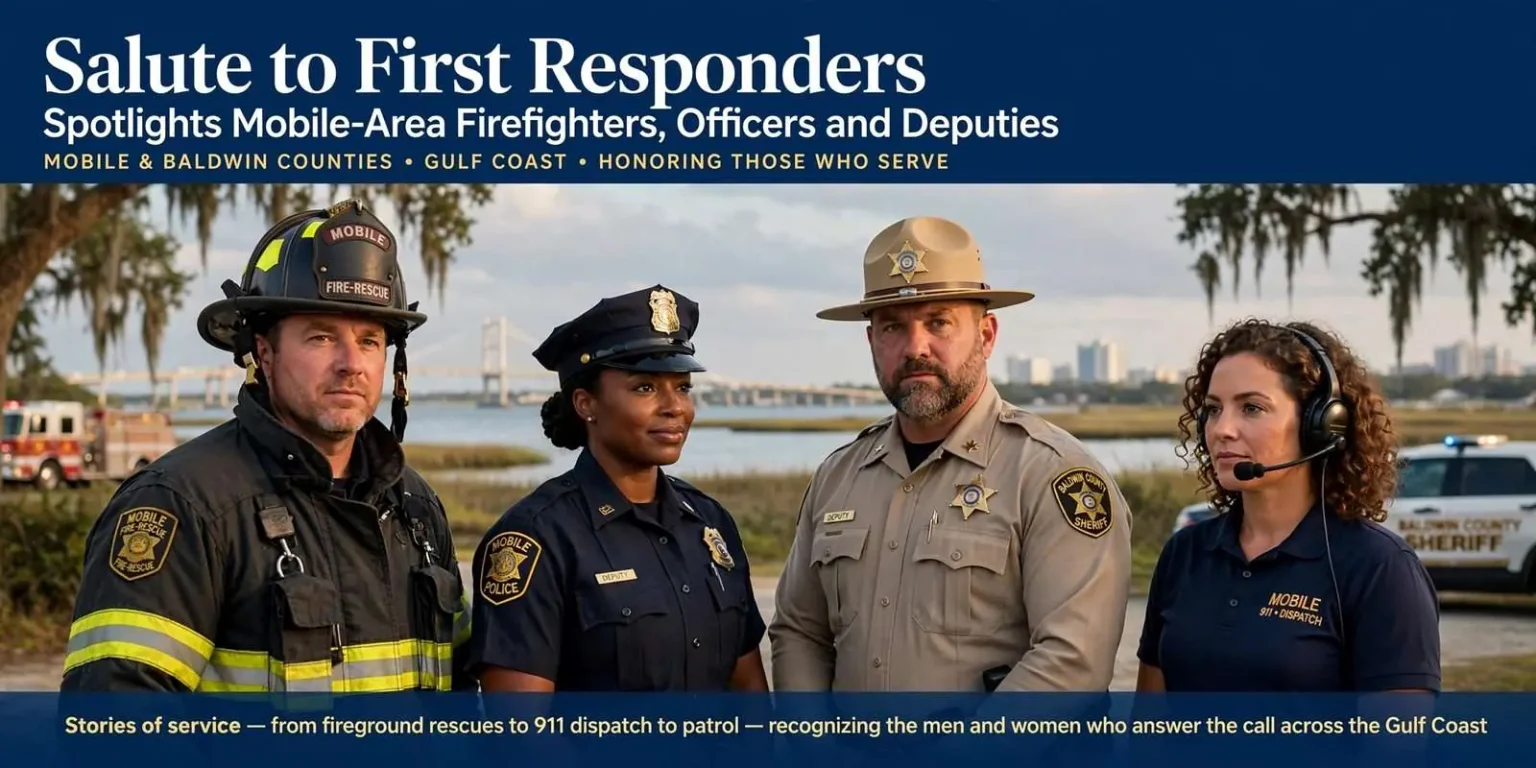
Across the Mobile area, a recurring feature called Salute to First Responders has been putting names and faces to the men and women who answer calls for help, from police officers and sheriff’s deputies to firefighters and 911 dispatchers. A recent round of segments highlighted stories ranging from a firefighter’s brush with death to officers keeping a fallen colleague’s memory alive, offering a window into the people behind the badges and uniforms across Mobile and Baldwin counties. Taken together, the installments sketch a portrait of public safety work on the Gulf Coast that runs from the catastrophic to the quietly routine — and, occasionally, to the heartwarming.
A Firefighter’s Brush With Death
One segment featured veteran firefighter Brad Cox, who survived a near-fatal fire on Dauphin Island 11 years ago. Gale-force winds turned the blaze into what Cox described as a “monster.” Fires on a barrier island are a particular kind of emergency: wind-whipped flames move faster than equipment can respond, and a structure fire can spread to neighboring homes before the first engine finishes its approach. Cox’s story captured how quickly the predictable danger of the job can turn into a fight for survival.
“After being in there two or three minutes, the windows broke and I basically had a humongous flashover,” Cox said. A flashover — the moment when superheated gases ignite throughout a room at once — is among the deadliest phenomena a firefighter can face, and surviving one intact is rare. Cox’s account of those minutes inside the island home offered viewers of the segment a visceral sense of what the uniform asks of the people who wear it.
The ordeal also pointed to a quieter subject in the feature: what happens to responders in the years after an incident like that one. Veterans Recovery Resources, based in Mobile, provides services addressing the mental, emotional and spiritual toll that incidents like that one can take on first responders and their families, not just military veterans. The organization’s work reflects a growing recognition across the Gulf Coast that post-traumatic stress does not require a war zone, and that the accumulated weight of emergency calls — fires, crashes, shootings, drownings — follows responders home whether or not any single incident makes the news.
Honoring Military and Public Safety Service
The feature also paid tribute to Sergeant First Class Levorn Rowser, a Mobile resident who served 22 years in the U.S. Army. His recognition folded the region’s deep military ties into its public safety story, a natural fit in a metro area ringed by military installations and dotted with veterans’ organizations. For many in the area’s public safety ranks, service in uniform did not begin with a badge, and segments like Rowser’s traced that continuum.
Elsewhere in the Mobile County Sheriff’s Office, Deputy Joseph Marzella was recognized as Deputy of the Month after helping close out two drug busts. Narcotics work in Mobile County operates on both the neighborhood scale — street-level sales that shape the quality of life in a subdivision — and the corridor scale of traffickers moving product through the Port City. A deputy earning monthly recognition usually means an investigation moved from a tip to an arrest to a closed case, the unglamorous middle work that the Salute segments are designed to make visible.
During National Public Safety Telecommunicators Week, the segment turned its attention to Mobile’s 911 dispatchers, often described as the first, first responders, fielding emergency calls before officers, deputies or firefighters ever arrive on scene. Dispatchers work a different kind of emergency — invisible to the public, conducted entirely through a headset, where the decisions made in the first thirty seconds of a call can determine whether help arrives in time. The week of recognition exists because their work is otherwise easy to overlook: when the system works, the caller never learns the dispatcher’s name.
Keeping a Fallen Officer’s Legacy Alive
Slain Mobile Police Officer Justin Billa was remembered for his compassion, including his habit of handing out toys to children on his beat. His widow, Erin Billa, held a toy drive through the Justin Billa Foundation, and his fellow officers have continued working to keep his memory alive through the organization. Billa’s death while answering a call in the city’s Fowl River area was one of the hardest moments in recent memory for the Mobile Police Department, and the foundation built in his name has turned that loss into a recurring act of community care — toys collected and distributed to children the way Billa himself did on his rounds.
The tribute stood alongside a more difficult story: the remembrance of Danielle Smith, which the segment noted did not have a happy ending, but which organizers said carried a deep message of humanity from those sworn to serve and protect the community. Not every call ends well, and the feature’s willingness to include an unresolved tragedy alongside the honors gave the series a fuller picture of what the work demands from the people who do it.
Community Connections and New Faces on the Force
Several segments highlighted officers building bridges with the public. Mobile police officer Lee Banks was recognized for going the extra mile after forming a friendship with 14-year-old William Walker. Friendships like that one are the everyday texture of community policing — not a program with a budget line, but an officer and a teenager whose path crossed often enough to become something steady. The Mobile Police Department’s “Movie in the Park” events were also featured as an effort to bridge the gap between officers and residents in the community, trading the formality of a police station for folding chairs and a projector screen in the neighborhoods the department serves.
Newer officer Sean Tuder was highlighted as part of a wave of law enforcement talent the department has attracted amid recent changes, while a group of recruits was featured working toward becoming sworn members of the Mobile Police Department. Recruiting and retaining officers is one of the persistent challenges for departments across the Gulf South, and the segment’s focus on the newest faces was a deliberate counterpoint to the often-negative coverage of policing: these are the people deciding, in real time, to take the job.
Specialized Units Making a Difference
The Baldwin County Sheriff’s Office was recognized for adding the first woman to its Special Operations Unit, a team focused on combating drug and human trafficking along Interstates 10 and 65 — corridors that law enforcement says carry a significant share of the roughly 90 percent of the nation’s drugs that originate in Mexico or Central America. Baldwin County sits at the junction of those two interstates, where the coast’s tourism economy and the region’s freight arteries intersect, and the sheriff’s specialized unit exists because traffickers use the same highways everyone else does. A milestone hire for the unit was, in that light, both a personnel story and a statement about how the office intends to staff its most demanding work.
Within the Mobile Police Department, Sergeant Joe Cotner of the Special Crimes Unit’s Child Abuse Detail was credited with playing a role in saving dozens of children from abuse. Child abuse investigation is among the most quietly demanding assignments in any department, pairing forensic precision with interviews that must be handled with extreme care. Officer Frederick Freeman was also recognized for taking a gunman off the streets after a shooting in the Spring Hill area left two people wounded, one of whom nearly lost an eye. A case that closes with a weapon recovered and a suspect in custody is the kind of result the Salute segments exist to mark.
Lighter Moments on the Job
Not every segment centered on crisis. One story introduced an Orange Beach firefighter who created a special Thanksgiving centerpiece for his crew, a nod to the tradition of firehouse families gathering around the table three times a day, seven days a week. Fire stations run on shared meals, and a holiday spent on shift is a holiday spent with the crew — a reality of the job that outsiders rarely see. Mobile’s motorcycle officers were also featured in a new book, recognized for the work they do keeping revelers safe during the busy Mardi Gras season, when the streets of downtown Mobile fill with parades and the crowds that follow them. Even a Walker County cheer coach earned recognition in the broader feature for teaching young athletes life lessons that extend well beyond the sidelines.
Together, the stories offer a broad look at the range of people who make up the region’s public safety community, from rookies just starting their careers to veterans who have spent decades in service, and from moments of tragedy to moments of everyday kindness. The series’s premise is a simple one — that the people behind the badges deserve to be seen as people — and across Mobile and Baldwin counties, each installment delivers on it one name at a time.