Two Escape Total-Loss House Fire in West Mobile
A West Mobile house on St. Moritz Drive near Zeigler Boulevard was destroyed by fire early Saturday, but a man and woman inside both escaped unharmed.
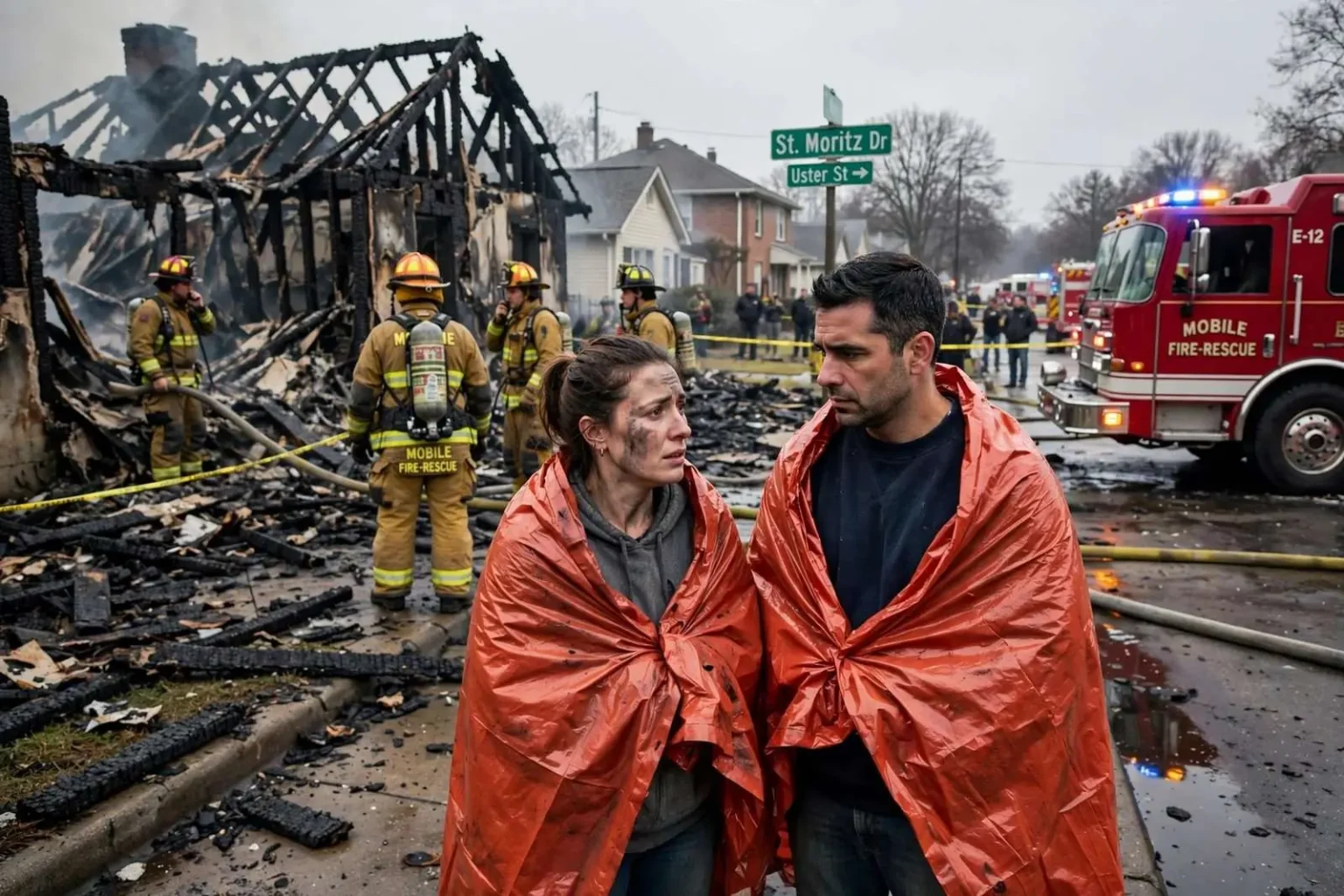
A West Mobile home was left a total loss after an early Saturday morning fire, but the two people inside managed to escape before the flames could trap them, according to Mobile Fire-Rescue officials.
Crews responded to the house on St. Moritz Drive, near Uster Street off Zeigler Boulevard, around 9 a.m. after neighbors or occupants reported the blaze. By the time firefighters arrived, the fire had already taken a serious hold on the structure, and crews shifted immediately to a defensive posture aimed at keeping the flames from spreading while knocking down the main body of fire.
The neighborhood off Zeigler Boulevard sits in one of the busier corridors of West Mobile, a section of the county where older subdivisions mix with newer construction and where fire crews from stations spread across the western districts answer a steady share of the department’s residential calls. A mid-morning fire on a Saturday, when many residents are home, drew onlookers to the street as smoke rose over the block and fire apparatus lined the narrow residential road.
Investigators have not yet released a cause for the fire, and Mobile Fire-Rescue has not said whether the blaze is considered suspicious. Determining the origin of a residential fire that has fully involved a structure can take investigators days or even weeks, particularly when the home has been rendered a total loss and physical evidence is limited.
What investigators face after a total loss
Fire investigation is a discipline of fragments. Investigators work backward from the least-damaged portions of a structure, tracing burn patterns, looking for the point of origin and testing hypotheses about what could have ignited the first fuel there. When a house is destroyed — its roof collapsed, its contents burned through — the evidence they depend on is precisely the evidence most likely to have been consumed. That is why officials are cautious about speculating on cause in the first hours after a fire, and why the findings, when they come, often take far longer than the public expects.
The possibilities in any such fire range from accidental causes — electrical faults, cooking equipment, heating appliances, carelessly discarded smoking materials — to natural causes such as lightning, to the rare cases of arson. Until investigators can examine the scene methodically, interview the occupants and rule possibilities out one by one, the official record remains open. Mobile Fire-Rescue’s investigators coordinate with other agencies when a cause points toward criminal conduct, and any determination of suspicion would have to be supported by what the scene itself reveals.
A narrow escape
A woman who was asleep inside the home when the fire broke out described the experience as one of the closest calls of her life, saying she had never felt closer to death. She and a man who also lived at the home both made it out safely, avoiding what could have been a fatal outcome had the fire progressed further before they awoke or were alerted.
Their escape came down to timing and, apparently, alertness — theirs or a neighbor’s. Fires that reach a structure’s interior in the morning hours, while occupants sleep, are among the deadliest scenarios fire departments confront, because smoke and toxic gases can overcome sleeping residents long before flames reach them. That the pair made it out without injury, from a home that could not be saved, is the outcome Mobile Fire-Rescue officials point to whenever they talk about the difference early detection makes.
Firefighters described the home as a complete loss once the flames were extinguished, leaving both occupants without a place to stay. Everything inside — furniture, clothing, documents, keepsakes — was lost to the fire or to the water and debris that follow it, a total displacement that arrives without warning and leaves families starting from nothing but what they happened to be wearing.
Where the help comes from
In the aftermath, the Mobile Fire-Rescue Department’s chaplain program and the American Red Cross stepped in to help the displaced pair secure temporary shelter, food and other essentials while they begin to sort out next steps.
The chaplain program is a standing resource within Mobile Fire-Rescue that pairs displaced residents and grieving families with support services in the hours and days immediately following a fire or other emergency, when the need for basic necessities like shelter and clothing is most urgent. The program’s volunteers and staff chaplains ride alongside the department’s response to serious fires, tend to shaken residents at the scene, and connect families with the practical and emotional help they need once the hoses are rolled up — a role that has grown as departments across the country recognize that a family’s crisis continues long after the fire is out.
The Red Cross similarly maintains a disaster response function in the Mobile area specifically geared toward helping families recover from home fires, which remain one of the most common types of disaster response calls the organization handles locally. While hurricanes dominate the region’s disaster imagination, the Red Cross’s day-to-day work on the Gulf Coast is largely built around single-family fires — volunteers responding to a displaced household, arranging a hotel stay or other temporary lodging, providing debit cards for food and clothing, and connecting families with recovery resources in the weeks that follow.
For a couple standing in front of a burned home on a Saturday morning, that machinery matters. Insurance claims, landlord questions and the search for permanent housing all take time, and the first night after a total loss is the one no family is ever prepared for. The partnership between fire department chaplains and Red Cross volunteers exists precisely to fill that gap.
Containment and the lessons for neighbors
No injuries were reported in connection with the fire beyond the initial scare described by the woman who escaped. Mobile Fire-Rescue crews cleared the scene after ensuring the structure was fully extinguished and secure, and neighboring homes were not affected by the blaze.
Containment, in a dense residential neighborhood, is never automatic. Crews arriving to a fully involved house must protect the exposures on either side, watch for wind-driven embers landing on nearby roofs, and manage the risk of collapse before pushing water onto the main fire. That the damage ended at the property line reflects the speed of the initial response and the work of the crews on the scene — and it spared the block the multi-home losses that some residential fires inflict.
Residents in the area were reminded that working smoke detectors remain one of the most effective tools for giving occupants precious extra seconds to escape a fast-moving house fire, particularly one that starts overnight or in the early morning hours while residents are still asleep. Fire safety officials repeat the message every year because the statistics behind it do not change: a large share of home fire deaths occur in houses without working smoke alarms, and the devices cost little more than the batteries that keep them running.
The economic aftereffect of a house fire also ripples through a block in quieter ways. A burned structure left standing becomes a matter of neighborhood concern — a hazard for children, a drag on nearby property values and a magnet for debris — until it is demolished or rebuilt. Owners of total-loss homes face a decision between clearing the lot and starting over, and in older West Mobile neighborhoods where land often retains more value than the damaged structure, that decision shapes what a corner of the neighborhood looks like for years afterward. Neighbors on St. Moritz Drive will watch the lot closely in the coming months, both for what gets built there and for the reassurance that the hazards of a burned-out shell are dealt with promptly.
The fire also underscored the way word travels in a mobile-era neighborhood. Reports to 911 came from neighbors or occupants, and within minutes of the first engine’s arrival, residents had gathered along the street, sharing photos and updates as crews worked. Fire officials regularly note that those early calls — the ones that bring the first engine within minutes of ignition — are often the deciding factor between a fire that damages one room and a fire that destroys a home. In this case, the report came in time for crews to prevent the blaze from spreading beyond the property, even though the house itself could not be saved.
Fire departments in Mobile County, as elsewhere, urge residents to test detectors monthly, replace batteries at least once a year and replace units a decade old, and to plan and rehearse two ways out of every room in the house. For the two people who walked away from the St. Moritz Drive fire, the escape was close enough to fatal to make the point better than any campaign: the margin between a frightening morning and a deadly one is measured in the seconds that detection and preparation buy.
The investigation into the fire’s cause remains open, and Mobile Fire-Rescue has said it will release findings once investigators have completed their work at the scene.