University of South Alabama Mobile
Mobile County JROTC Students to Intern With Fire-Rescue Department
Mobile County JROTC students will intern with Mobile Fire-Rescue starting next school year, part of a first-of-its-kind Alabama school partnership.
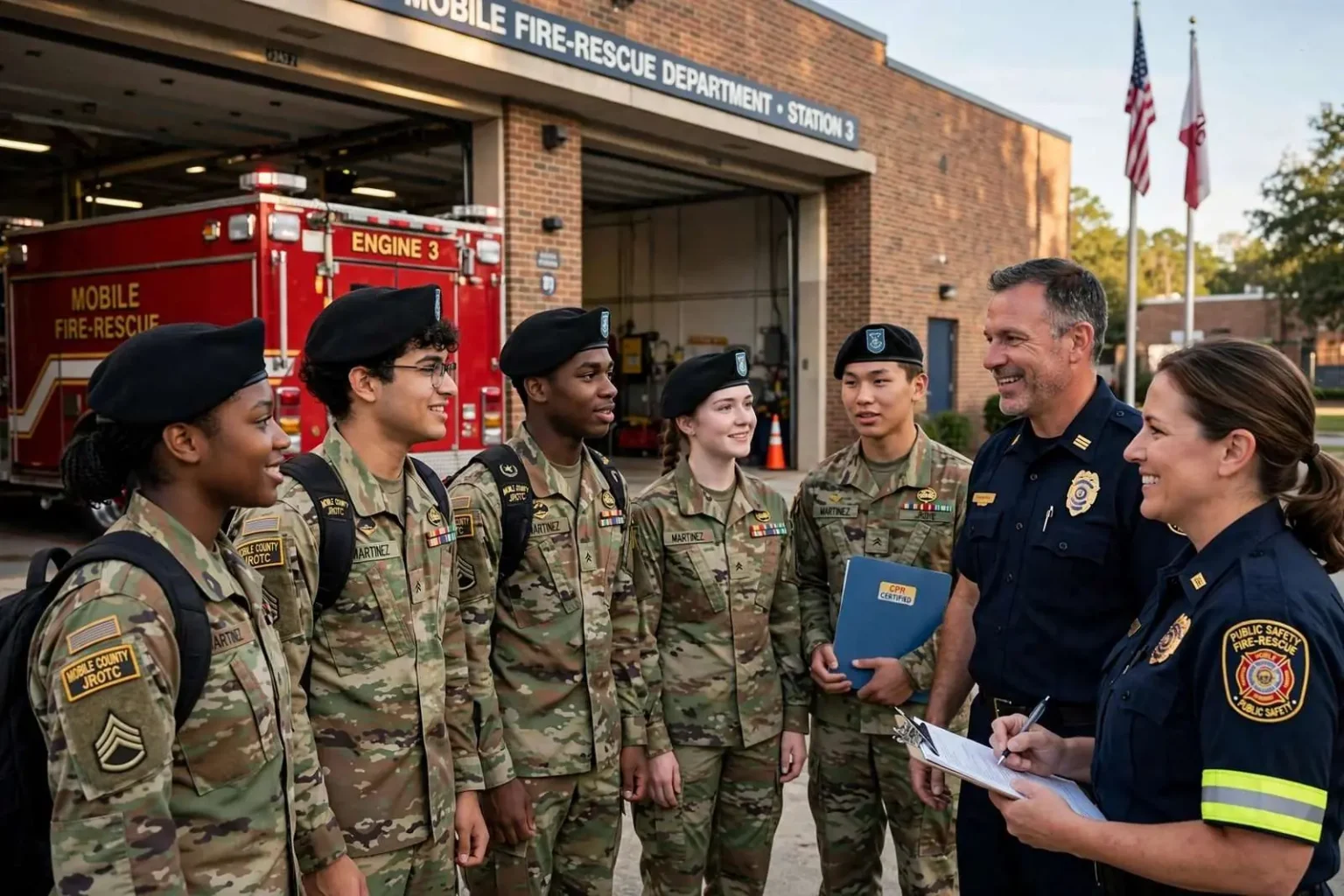
A new partnership between the Mobile County Public School System and the city of Mobile will place a dozen or more Junior ROTC students inside the Mobile Fire-Rescue Department starting with the 2015-2016 school year, in what officials described as the first program of its kind in Alabama.
Under the agreement, announced this week, JROTC seniors will spend 10 hours each week, from 1:30 to 3:30 p.m. on school days, working alongside Fire-Rescue staff to learn the administrative and leadership side of running an emergency response department.
Lt. Col. (ret.) Robert Barrow, who directs the school system’s Army JROTC program, said the goal is to give students real-world experience they otherwise would not get in a classroom. “This opportunity will allow seniors to get real-time, real-world experience,” Barrow said, adding that organizers hope the internship inspires some participants to eventually pursue careers with the department.
Mobile Mayor Sandy Stimpson framed the program as part of a broader effort to keep talented young people in the city rather than losing them to job opportunities elsewhere. “It’s so important to stop the attrition of our best and brightest having to go somewhere else to find jobs,” Stimpson said.
Rear Adm. (ret.) Rich Landolt, the city’s executive director of public safety, said Fire-Rescue was a natural fit for the pilot program because the department can hire applicants as young as 18, unlike the Mobile Police Department, which requires candidates to be at least 21. That age difference means a student who completes the internship as a high school senior can move directly into the department’s hiring pipeline, while a peer interested in policing faces a longer wait.
The internship will be open to any interested student, Landolt said, regardless of gender, as long as they show genuine interest in fire and rescue work. More than 1,700 students are currently enrolled in Mobile County’s JROTC program, according to Barrow, giving the pilot a large pool to draw from in its first year and room to grow if it succeeds.
To qualify for the Fire-Rescue internship, students must meet several requirements, including physical fitness standards, CPR certification, and the ability to commit to the required weekly hours. Mobile Fire-Rescue officials said the selected students will be treated as working members of the department’s support staff during their afternoon rotations, with responsibilities that mirror what entry-level civilian employees handle.
Inside Mobile Fire-Rescue
The Mobile Fire-Rescue Department is one of the largest fire services on the Gulf Coast, operating stations across the city and providing fire suppression, emergency medical response and specialized rescue services to Alabama’s third-largest city. Departments of that scale depend on far more than firefighters on engine companies: logistics, training divisions, communications, fleet maintenance, community outreach and administration all keep the system running, and those are the corners of the department where interns will spend their hours.
Placing students in the administrative and leadership side of the department, rather than in firefighting roles themselves, is deliberate. High school seniors cannot fight fires, but they can learn how a department budgets, plans, communicates and manages its people — knowledge that positions them to enter fire science programs, EMS academies or the department’s own hiring process after graduation with a head start most applicants never have.
JROTC as a Pipeline
The school system’s Junior ROTC program, with more than 1,700 students enrolled, is among the larger programs of its kind in the region. Army JROTC units operate at high schools across the county, teaching leadership, discipline, citizenship and physical fitness through classes, drills and community service. The program’s purpose is not recruitment into the military so much as development of young leaders, and the Fire-Rescue internship extends that mission into civilian public service.
Barrow, a retired Army lieutenant colonel, has directed the program with an emphasis on connecting cadets to real institutions. For cadets, the internship offers something a classroom cannot: a professional environment, adult mentors outside their school and a daily routine that looks like employment. For the school system, it offers a way to show students that meaningful careers exist in their hometown.
Workforce Development in the Stimpson Administration
Stimpson’s comments placed the program squarely within his administration’s focus on keeping young talent in Mobile. The city had been working to connect its public schools with employers and institutions — from shipbuilding and aviation to healthcare — on the theory that a student who interns locally, builds local contacts and sees a local future is far more likely to build a life in Mobile. The Fire-Rescue internship is a pilot in that larger strategy, and its first class of participants will effectively test whether the model should expand to other city departments.
Landolt, a retired Navy rear admiral leading the city’s public safety apparatus, brought a military-style structure to the effort: clear eligibility requirements, defined hours, fitness standards and CPR certification. Those requirements serve a dual purpose, screening for students who are serious while giving participants benchmarks that mirror the actual standards the department applies to applicants.
What Students Must Do to Qualify
The physical fitness standard, CPR certification and weekly time commitment mean the internship is not a passive elective. Students will need to schedule around the fixed 1:30 to 3:30 p.m. window, maintain their coursework, and complete certification training — often available through JROTC or career-technical programs — before or during the placement. The requirements are designed to reflect the discipline the department expects of its own people, giving students an honest preview of what public safety careers demand.
Because the program is open regardless of gender, it also offers the department a chance to widen its recruiting funnel. Fire services nationally have worked for decades to attract more women and more diverse candidates, and a high-school-age internship removes some of the barriers — uncertainty about the work, lack of contacts, no visible pathway — that keep students from considering the field.
A First for Alabama
Officials’ description of the partnership as the first program of its kind in Alabama gives Mobile a claim other systems will watch. School districts across the state have built career-technical partnerships with hospitals, manufacturers and community colleges, but embedding JROTC cadets inside a major municipal fire department on a fixed weekly schedule is a model without a statewide precedent. If Mobile’s pilot produces graduates who join the department or pursue fire science and EMS training, expect other city-school partnerships to copy the structure.
The timing also aligned with a national conversation about the fire service’s next generation. Departments across the country have struggled to recruit qualified candidates as requirements rise and interest in public safety careers competes with other fields, and youth pipelines like Mobile’s are among the strategies the fire service has embraced. Departments that start with students at 17 or 18 — before those students commit to other paths — build applicant pools that know the department, understand the work and have already begun meeting the standards.
The View From the Classroom
For the seniors selected, the internship will reshape their final year of high school. Mornings will look like any other senior schedule, but afternoons will place them inside a working government department, absorbing its routines, its chain of command and its culture. Teachers and JROTC instructors say students in placements like these typically return to campus more focused, having connected their coursework to a concrete future.
The school system’s calendar was built with the arrangement in mind: the 1:30 to 3:30 p.m. block on school days avoids conflicting with core classes and returns students to campus or home by the end of the regular day. Transportation, supervision and evaluation details were worked out between the district and the department before the launch, with the department’s staff providing day-to-day direction and JROTC instructors monitoring academic standing.
What Comes After Graduation
Participants who complete the internship will have several routes open. The department can hire applicants as young as 18, so a graduate could apply directly into the department’s civilian or support ranks while training toward firefighter or medic eligibility, which requires additional certification and academy training. Others may enroll in fire science or paramedicine programs at area colleges, carrying with them the advantage of a year or more of inside experience. Still others may discover through the placement that public service appeals to them in other forms — emergency management, law enforcement at 21, or municipal administration.
That range of outcomes is the point, officials said. The internship is designed to open a door, not lock students into one hallway. For a dozen or more students in the first class, the afternoon hours inside Fire-Rescue will be the first job-like experience of their lives — and, for some, the first step into the uniforms they will wear as adults.