Baldwin County Sheriff Honored for Drug Prevention Work, Says Two Counties Are ‘One Community’
Baldwin County Sheriff Huey 'Hoss' Mack received the Joseph Treadwell award for his work with the Drug Education Council.
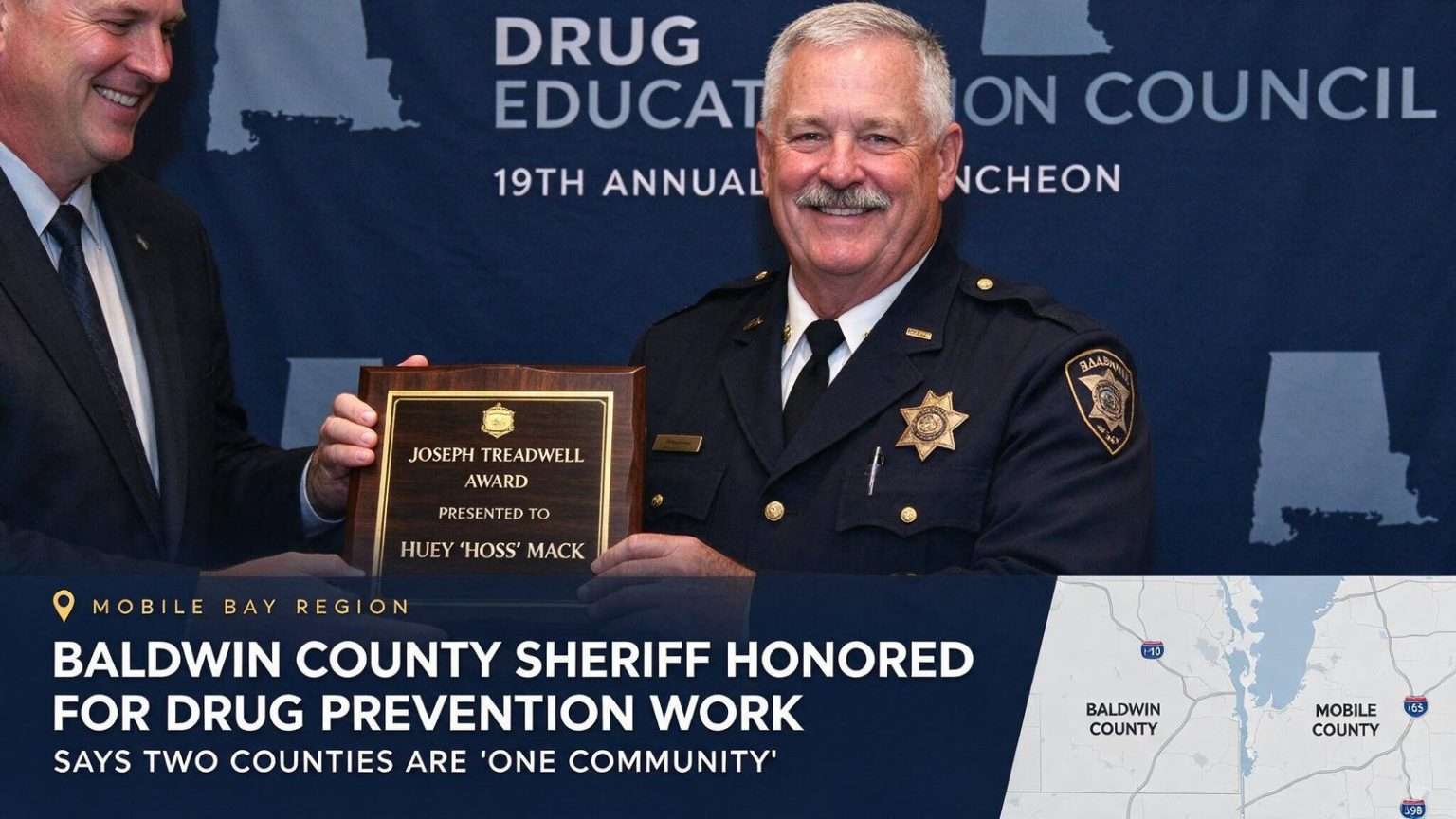
Baldwin County Sheriff Huey “Hoss” Mack was honored with the Joseph Treadwell award at the Drug Education Council’s 19th annual luncheon this week, recognizing his long-running involvement in the organization’s substance abuse prevention efforts. The honor placed the Baldwin County sheriff on a list of regional leaders that the council has recognized over nearly two decades of luncheons, and it put a spotlight on the cross-county partnerships that define law enforcement around Mobile Bay.
Mack, a 29-year veteran of law enforcement, has served as Baldwin County’s sheriff since his election in 2006. His career has spanned the rapid growth of Baldwin County, one of the fastest-growing counties in Alabama, where a expanding population along the Interstate 10 corridor has brought both new demands and new resources to the sheriff’s office. Under his leadership the department has had to scale its patrol, investigation and school-based programs to keep pace with communities stretching from Spanish Fort and Daphne down to Gulf Shores and Foley.
He holds a master’s degree in management from Troy University, an academic background that has shaped his administrative approach to running a large county agency, and he currently serves as president of the Alabama Sheriffs Association, giving him a statewide platform alongside his local duties. In that role he has represented the state’s sixty-seven sheriffs on matters ranging from legislation in Montgomery to training standards and interagency cooperation.
An Award Rooted in Local Philanthropy
The award is named for Joseph Treadwell, who spent more than four decades in the Mobile automobile business before dedicating a significant portion of his estate to local charitable causes, including support for the Drug Education Council’s prevention programs. Treadwell’s legacy endures in a range of civic institutions across the Mobile area, and the award bearing his name has become the council’s way of tying its mission to the tradition of private philanthropy that funded much of its early work.
Awards like the Treadwell honor are typically presented to community leaders whose work has extended beyond their formal job duties to support the council’s broader mission. The selection of a sitting sheriff underscores how central law enforcement has become to the council’s strategy: prevention, education and enforcement are treated as complementary parts of a single effort rather than separate silos.
Credit Redirected to the Rank and File
In accepting the honor, Mack was quick to redirect credit to the officers he leads. “I accept it for the law enforcement officers who work every day,” he said, adding that law enforcement can play a meaningful role in addressing substance abuse alongside prevention and education efforts. The framing reflected the view he has carried throughout his tenure — that arrests alone do not solve the underlying problems of addiction, and that deputies who encounter the consequences of substance abuse on every shift are positioned to steer people toward help as well as toward jail.
That philosophy has practical meaning in Baldwin County, where sheriff’s deputies and school resource officers work in a district system that covers a large and varied county. School-based prevention, drug take-back programs and coordination with treatment providers all rely on officers willing to see the work as more than enforcement, and Mack’s remarks positioned his department’s daily efforts as part of that continuum.
The Drug Education Council has served the greater Mobile Bay region for nearly two decades, working with schools, families and law enforcement agencies to promote substance abuse prevention and treatment resources. Its programs reach into classrooms across Mobile and Baldwin counties, support families navigating addiction, and provide training and materials to the agencies on the front lines. The annual luncheon serves both as a fundraiser and as a public accounting of the organization’s work, and the Treadwell award is its signature moment each year.
Two Counties, One Community
A recurring theme of the luncheon was the partnership between Baldwin County and Mobile County law enforcement. Mack highlighted his working relationship with Mobile County Sheriff Sam Cochran, a past recipient of the same award, framing the partnership as emblematic of how closely the two counties’ agencies collaborate on shared regional challenges.
The geography makes the point unavoidable. The Mobile Bay separates the two counties, but the population moves constantly across it: commuters cross the Bayway and the Bankhead Tunnel each morning, students and workers travel in both directions daily, and the drug markets and trafficking routes that concern deputies in Baldwin County are the same ones that concern officers in Mobile. Investigations do not stop at the county line, and neither do prevention efforts.
“We are Baldwin County and Mobile County, but we are one community,” Mack said. The line captured the premise behind joint operations, shared intelligence and the kind of regional cooperation that agencies on both sides of the bay have cultivated through task forces and formal agreements. When a sheriff in one county is recognized by an organization based in the other, the crossover is the point — the award acknowledges that substance abuse is a regional problem that no single jurisdiction can address alone.
What the Sheriff’s Office Actually Does
For residents unfamiliar with the scope of a county sheriff’s office, the recognition is a useful window into the work. The Baldwin County Sheriff’s Office handles patrol and investigations across the county’s unincorporated areas and supports municipal departments, operates the county jail, serves civil papers, and staffs school resource positions. Each of those functions intersects with substance abuse: deputies on patrol make the initial contact in overdose and drug cases, jail staff manage a population with high rates of addiction, and resource officers are often the first adults to identify students at risk.
Mack’s current focus is split between running the day-to-day operations of that office and his statewide duties with the sheriffs association, a dual role that keeps him engaged both with Baldwin County’s local challenges and with the policy conversations that shape law enforcement across Alabama. The association presidency has given him a seat at the table on issues such as funding, training and the state’s response to the drug trade, and it has meant that Baldwin County’s perspective carries weight in Montgomery.
His longevity in office is itself notable. Re-elected repeatedly since 2006, he has led the office long enough to see generational change both in the department’s personnel and in the nature of the drug problems it confronts — from the pill mills and methamphetamine labs of earlier years to the synthetic opioids that have complicated enforcement and treatment alike across the Gulf Coast.
The Council’s Role in the Region
The Drug Education Council occupies a distinct niche among Gulf Coast nonprofits. Rather than providing treatment directly at clinical scale, it concentrates on education, prevention programming and coordination — working with school systems to deliver evidence-based curricula, helping families find treatment resources, and supporting the law enforcement and community groups whose work touches the same population. Its longevity, approaching two decades, has made it a fixture in the region’s public health landscape.
The 19th annual luncheon is a measure of that staying power. An organization that survives and grows for nearly twenty years on the strength of community support has built relationships across every sector the problem touches: schools, courts, churches, treatment providers and law enforcement. Honoring a sheriff at the annual event signals to the donors and agencies in the room that the council sees enforcement and prevention as partners in the same mission.
For Mack, the award adds to a career that has spanned nearly three decades in law enforcement. He came up through the ranks at a time when community policing was reshaping how agencies approached drugs and crime, and his comments at the luncheon suggested he sees the recognition as an affirmation of that approach rather than a personal accolade.
Why Regional Cooperation Matters on the Gulf Coast
The one-community framing Mack used has concrete institutional backing. Law enforcement agencies across Mobile and Baldwin counties routinely collaborate through multijurisdictional task forces that target drug trafficking, and the two sheriffs’ offices share intelligence, training resources and, in major cases, investigative personnel. The Port of Mobile, the Interstate 10 and Interstate 65 corridors, and the waterways of the Gulf Coast make the region a natural route for trafficking, which means the work of one agency’s narcotics unit regularly feeds another’s prosecutions.
Prevention work follows the same logic. A teenager who attends school in Baldwin County but spends weekends in Mobile faces the same pressures, the same social networks and the same dealers. Programs funded and coordinated on one side of the bay inevitably serve families on the other, which is why the Drug Education Council’s footprint has always been regional rather than municipal. The council’s partnerships with both counties’ sheriffs reflect that reality, and the repeated recognition of sheriffs from both counties — Cochran before Mack — reinforces the message that the organization’s mission does not recognize the county line running down the middle of the bay.
There is also a practical funding dimension. Grants for drug prevention and enforcement increasingly require documented regional cooperation, and agencies that can show sustained partnership stand a better chance of bringing federal and state money into the area. The public display of unity at events like the council’s luncheon is part of that case: it demonstrates to funders and to the community that the region’s agencies operate as a network rather than as isolated offices.
A Career Recognized by Peers
Recognition from a prevention organization carries a particular weight for a career law enforcement officer. Sheriffs are judged daily by the enforcement side of their work — response times, clearance rates, jail operations — and those metrics never capture the slower, less visible work of prevention. An award from the Drug Education Council measures exactly the part of the job that usually goes unmeasured: the years of school visits, the drug take-back events, the partnerships with treatment providers, the willingness to talk about addiction as a health problem as well as a criminal one.
Mack’s acceptance comments made clear that he views the honor in those terms. By accepting it “for the law enforcement officers who work every day,” he framed the award as belonging to the deputies and staff who translate policy into practice — the officers who encounter addiction on every shift and decide, encounter by encounter, whether the response is an arrest, a referral or a phone call to a family member.
The Joseph Treadwell award now sits alongside the other markers of Mack’s career: the master’s degree from Troy University, the presidency of the Alabama Sheriffs Association, and nearly three decades of service that began long before he first ran for office. At a luncheon celebrating the council’s 19th year of work in the region, the message from both the honoree and the organization was the same — the work against substance abuse around Mobile Bay is shared, ongoing, and strongest when the two counties treat themselves as what they are: one community.