South Mobile County Stores Pass Underage Alcohol Compliance Check as Task Force Prepares Leadership Change
A Mobile County alcohol compliance sweep found every store checked in south Mobile County refused to sell to underage buyers.
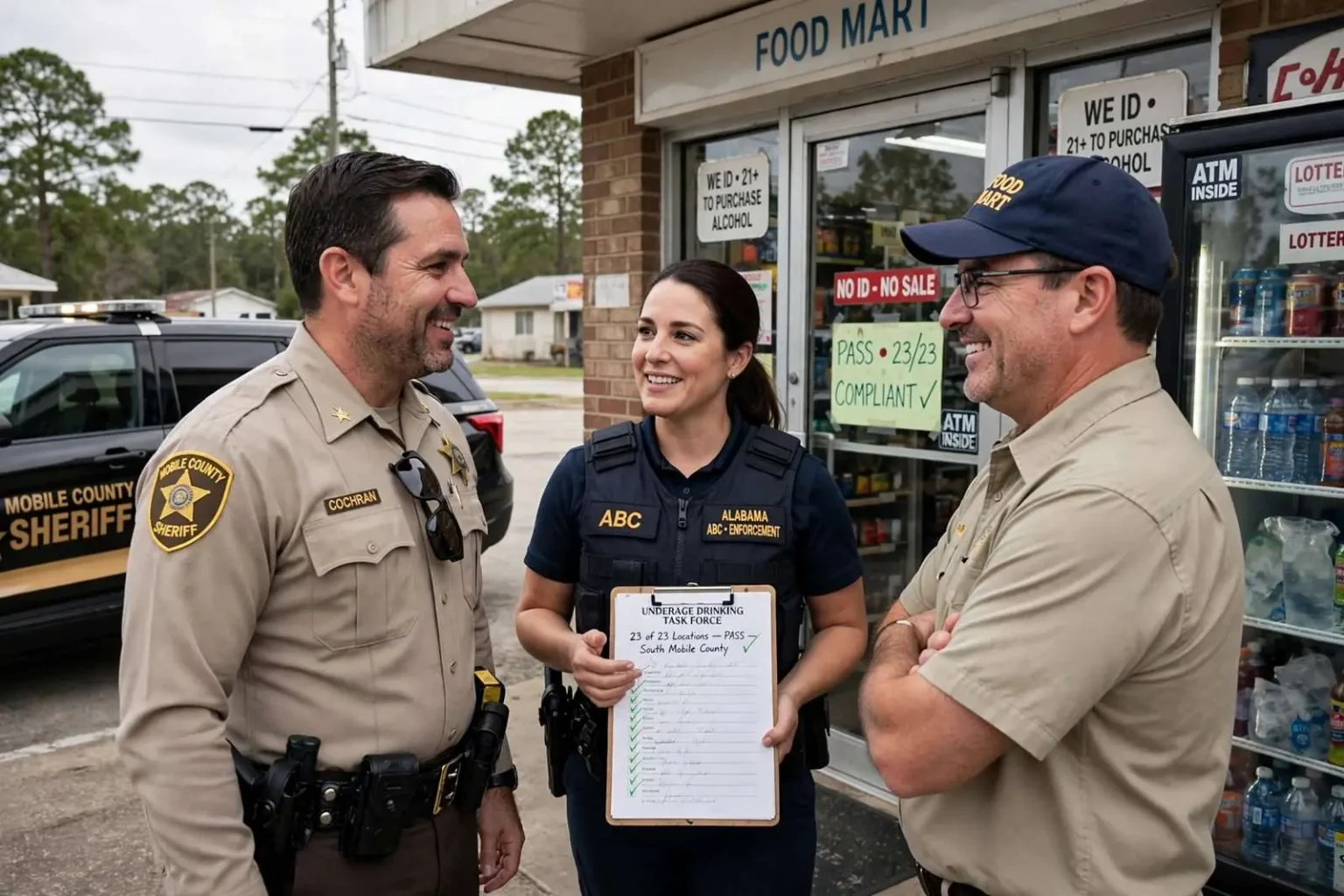
Every store checked during a recent underage drinking compliance sweep in south Mobile County refused to sell alcohol to a minor, according to results announced by local law enforcement. The Mobile County Sheriff’s Office worked alongside state Alcoholic Beverage Control agents to visit 23 retail locations, and all 23 passed, a perfect record that officials credited to years of community education efforts.
A clean sweep across two dozen businesses is rarer than it sounds. Compliance checks in most jurisdictions routinely turn up at least a handful of failures, and each failed sale sets off a chain of consequences for the clerk, the owner and the store’s state license. A perfect round, law enforcement officials say, is the clearest evidence that a prevention program is actually changing behavior rather than just documenting it.
How the Checks Work
The compliance check is part of an ongoing initiative known as the Underage Drinking Task Force, a partnership between the sheriff’s office, ABC enforcement, school officials, and area merchants that has operated in Mobile County for roughly a decade. The program periodically sends young-looking testers into stores to see whether clerks properly check identification and refuse sales to anyone under 21.
The method, used by enforcement agencies nationwide, is designed to measure ordinary practice rather than best behavior. Testers visit unannounced, carry their real identification and answer questions truthfully, which means a clerk who glances at the ID has every chance to catch the discrepancy. When a tester attempts a buy, agents and deputies observe from nearby, and the outcome is recorded for each location. Stores that pass are often notified afterward, which merchants themselves regard as valuable — a documented pass is proof of a working counter policy.
Mobile County Sheriff Sam Cochran said the results reflect years of consistent messaging to business owners about the consequences of selling to minors. Store owners who sell to underage customers can face steep fines from the state and risk losing their liquor license entirely if violations continue, a penalty structure the sheriff’s office has emphasized repeatedly in outreach to merchants across the county.
That penalty structure is what gives the task force its leverage. Under Alabama’s alcohol licensing rules, a store’s license is its most valuable operational asset, and repeat violations can put it in jeopardy. Clerks face their own exposure, and owners who train their staff carefully — carding every customer who looks young, keeping registers logged and reminders posted — protect both their licenses and their employees.
A Leadership Transition for the Task Force
The task force has been guided for the past several years by a sheriff’s office public information officer who has helped coordinate compliance checks, merchant training, and community outreach events. That leadership role is now transitioning to the director of a substance use treatment and prevention organization, who has already been handling many day-to-day responsibilities for the task force in recent months ahead of a formal transition expected later this month.
Officials described the shift as a natural evolution for the program, pairing law enforcement’s enforcement authority with an organization that specializes in substance abuse prevention and treatment programming for young people. Prevention-focused nonprofits bring skills that a sheriff’s office does not always staff for itself — curriculum development, school partnerships, counseling referrals and grant writing — while the sheriff’s office and ABC retain the enforcement tools that give the partnership its teeth.
The model mirrors a national trend in which underage drinking coalitions move from enforcement-only operations toward comprehensive prevention programs. Federal and state grant makers increasingly favor coalitions that combine compliance checks with school-based education, parent outreach and treatment access, on the theory that citations alone address the supply side of a problem that also has a demand side.
The task force’s mission has always combined the threat of legal consequences with community education, aiming to change norms around underage drinking rather than relying solely on citations and fines. That dual approach is credited with sustaining merchant cooperation over a decade — stores that understand the reasoning behind a check are more likely to embrace the visits than resent them, and merchants who feel like partners are more likely to call law enforcement when something suspicious does occur.
Why South Mobile County Draws the Focus
South Mobile County has been a regular focus of these periodic checks given its mix of convenience stores, gas stations, and package stores along well-traveled corridors. The southern end of the county blends small communities, agricultural stretches and the approach routes to the beaches, producing a retail landscape where alcohol sales are spread across many small outlets rather than concentrated in a few large ones. Spread-out retail makes consistent training harder and makes periodic verification more important.
A perfect compliance record among two dozen stores marks a notable milestone for a program that has, in past years, turned up violations requiring follow-up enforcement action. Officials are careful not to declare victory on a single round — compliance can drift as staff turnover brings new clerks who never heard the training pitch — but the trend across repeated rounds is the metric the task force watches most closely.
Community leaders involved in the task force say sustained cooperation between merchants and law enforcement, rather than one-time crackdowns, has been key to building a culture where clerks consistently ask for identification. The distinction matters in practice: a crackdown produces a week of careful carding followed by relapse, while a standing partnership produces habits that survive staff turnover and busy holiday weekends.
What Comes Next
The task force plans to continue periodic compliance checks throughout Mobile County as part of its ongoing prevention work. Upcoming rounds are expected to rotate through other parts of the county, keeping every licensed retailer aware that a check could come on any given day — a certainty that prevention specialists consider one of the program’s most effective features.
The leadership transition arriving this month will test the partnership’s durability. Programs that depend heavily on one coordinator often wobble when that coordinator moves on, and the task force’s answer has been to hand daily operations to an organization built for the long-term prevention work rather than to any single person. Sheriff’s officials say the compliance-check calendar will not skip a beat during the handoff, and the perfect score in south Mobile County gives the incoming leadership a clear benchmark to defend.
For the merchants of south Mobile County, the results serve as public recognition of what officials describe as years of doing the small things right at the counter — checking the ID, refusing the sale, and keeping the alcohol out of the hands of the county’s underage residents.
The Stakes for Young People
The enforcement effort exists because underage drinking remains one of the most consequential risks teenagers face. Alcohol is involved in a large share of the leading causes of adolescent injury and death, from vehicle crashes to drownings, and research consistently shows that young people who begin drinking early face higher risks of dependence later in life. Communities that combine enforcement with education aim to push the average age of first drink upward — a shift that public health officials regard as one of the most measurable indicators of a prevention program’s success.
School officials participating in the task force extend that work into the classroom, where prevention curricula and student-led campaigns reinforce the message that compliance checks send at the retail counter. The pieces reinforce one another: students hear the prevention message at school, see it enforced at the store, and encounter both from adults they know rather than distant authorities.
A Decade of Building Trust
Roughly ten years of operation has given the Mobile County task force something most newly formed coalitions lack: relationships. Deputies know which merchants have questions about licensing. ABC agents have worked with the same store owners across multiple rounds of checks. School administrators and prevention specialists coordinate calendars around school events and busy retail seasons. That accumulated trust is difficult to replicate and explains why officials describe the leadership change as an evolution rather than a restart.
The partnership also reflects the realities of rural and suburban law enforcement. Small retail communities cannot each run their own prevention programs, and a sheriff’s office cannot staff a youth substance abuse initiative on its own. Pooling the enforcement authority of the state ABC board, the investigative reach of the sheriff’s office, the access of the schools and the expertise of treatment providers multiplies what any single agency could accomplish.
Measuring Success Over Time
A single perfect round is encouraging; the pattern across years is what convinces officials the program works. When violations appear in one round, the task force follows up with targeted training at the failing stores, and repeat failures escalate to formal enforcement. When rounds come back clean, as the south Mobile County sweep did, the coalition directs its energy toward maintaining habits — refresher training for merchants, renewed outreach to new store owners and continued messaging for parents.
The task force’s leaders describe the work in generational terms. The clerks carding customers today were teenagers when the program began, and the current middle schoolers will one day stand behind the same counters. Each round of checks, each merchant meeting and each school presentation builds toward a Mobile County where refusing a sale to a minor is simply how business is done — a norm so established that a perfect compliance score stops being news.
Until then, officials say, the sweeps will continue on their irregular schedule, unannounced and countywide, with the sheriff’s office and its new partner organization working side by side to keep the number of failed checks at zero.