The Real Costs Behind Baldwin County’s Digital Renaissance Laptop Program
Baldwin County's $24 million laptop-for-every-student program has racked up repair, insurance and financing costs since its 2011 launch.
Baldwin County’s ambitious effort to put an Apple laptop or iPad in the hands of nearly every public school student has delivered on its promise of expanded classroom technology, but records show the four-year-old program has also come with a steady stream of breakage, financing costs and mixed reviews from the students using the devices daily. The program stands among the largest 1-to-1 computing initiatives in Alabama, and its size has made every cost, setback and success a matter of public record and public debate across the county.
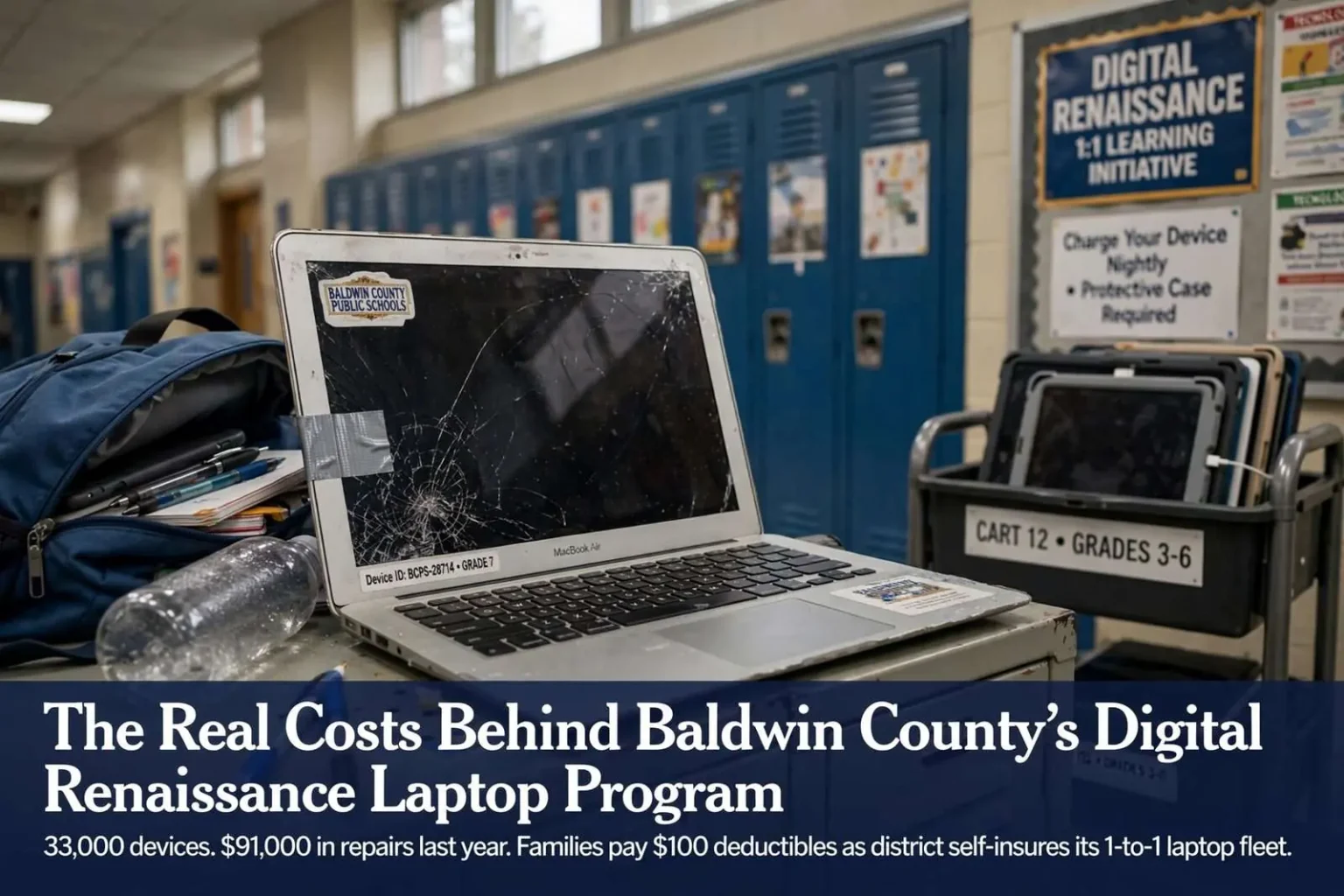
Since the rollout began, students have cracked, dropped, soaked and otherwise damaged hundreds of the district’s laptops. School board member David Cox said the machines are built to withstand typical classroom wear, but conceded that any electronic device is inherently more fragile than a textbook. Last year alone, the district spent more than $91,000 replacing broken or lost computers, while parents paid a combined $520,000 in $100 deductible fees over two years to cover roughly 5,200 irreparably damaged or lost machines.
Those numbers translate into a simple arithmetic that families across the county have learned to budget for: a cracked screen or a laptop left on a school bus can mean a $100 deductible, a fee that exceeds what many parents ever spent on school supplies in a year. The damage rate also illustrates the physical realities of handing fragile electronics to thousands of children between the ages of 8 and 18, from backpacks slung onto pavement to water bottles leaking in the same bag as a MacBook.
Where the program came from
The program, dubbed the “Digital Renaissance” by former superintendent Alan Lee, was modeled after a similar 1-to-1 computing initiative in Mooresville, North Carolina. Mooresville’s district had become a national showcase for the idea that universal device access could lift student achievement, drawing visits from educators and policymakers from across the country, and Lee brought that model back to Baldwin County as the template for his own system.
Lee argued in 2011 that traditional classroom limits on what a teacher or textbook could offer were holding back student achievement, and pushed to eliminate those barriers with internet-connected devices. The argument reframed the laptop not as an accessory but as the basic instrument of instruction, the way a laboratory is basic to chemistry class. The district launched a pilot at Baldwin County High School in Bay Minette in 2012 before expanding it to every high school and junior high in the system, using the pilot year to work out logistics, from charging infrastructure to filtered internet access, before the program scaled up.
The financial commitment has been substantial. The district agreed to pay Apple $15.1 million through 2015 as part of the rollout, which earned Baldwin County an “Apple Distinguished School” designation. The program went districtwide the following year, with students in grades 3-6 receiving MacBook Air laptops and younger students in grades K-2 receiving iPads, though only students in fourth grade and above are permitted to take devices home. Between laptop bags and software, early units cost the district about $1,063 apiece, with later models running closer to $799.
How the county pays for it
To fund an additional wave of roughly 6,900 iPads and 7,900 laptops, bringing the district’s total device count to more than 33,000, officials took out a $9.6 million loan from a local bank, backed by revenue from a temporary penny sales tax voters approved in 2012. The device count alone signals the scale of the operation: at more than 33,000 units, Baldwin County’s fleet rivals the student population of many mid-sized cities, and each device eventually ages out, breaks down or must be replaced on a rolling cycle.
District financial officials say loan payments are actually being made through a separate, long-term sales tax rather than the temporary one, and the district has already paid several million dollars back on the note. The distinction matters to county taxpayers, who were promised that the temporary penny tax would fund construction needs, and the financing arrangement has been a recurring point of explanation for board members fielding questions about how a technology program of this scale is sustained in a district that also faces building maintenance, growth and staffing costs.
The 2012 vote that approved the temporary penny sales tax came after county leaders made the case that Baldwin County’s explosive enrollment growth, driven by the influx of new residents to the Eastern Shore, the Foley corridor and the Gulf beaches, demanded new classrooms and renovated buildings. The sales tax structure means that visitors and commuters as well as residents contribute to the county’s school funding, a feature that spreads the burden in a county whose population swells with tourists each summer, and whose taxable sales run far ahead of its residential tax base.
Self-insuring the fleet
To control costs, the district shifted away from a private insurer and moved to self-insuring the laptops last year, charging families a $64 annual fee per student. The change cut the per-student cost compared with the previous coverage, and it moved the district from paying premiums to an outside company toward covering its own claims, in effect making the school system the insurer of its own 33,000-device fleet.
Officials say the approach gives them flexibility to make quick, low-cost repairs, though it also means the district has relatively limited reserve funds on hand in the event of a widespread equipment failure. Board members have called that scenario unlikely given the scale and reliability of the devices. The trade-off is a classic self-insurance calculation: savings in most years, risk in the rare catastrophic one, and a district that has chosen to accept that risk in exchange for keeping the program’s cost per family down.
Self-insurance also changes the incentives around repair. Without a third-party claims process, technicians in the district’s own shops can swap screens, keyboards and batteries the same week a device fails, returning a laptop to a student in days rather than the weeks a commercial claim can take. For a program whose entire premise depends on daily device access, turnaround time is not a convenience but a requirement, and district officials have pointed to it as one of the quiet advantages of the model they adopted.
Mixed reviews from the classroom
Reactions from students and parents around the county have been mixed. Some students say the laptops run slowly or go unused in certain classes, while others describe tripping hazards from charging cords and general wear from daily use. The complaints are familiar in districts that have scaled device programs quickly: hardware that outpaces the wireless network, teachers at different levels of comfort with the technology, and the daily logistics of charging, storing and carrying expensive equipment through a full school day.
Other families and students point to real benefits, including easier communication with teachers, access to international coursework partnerships, and better preparation for the technology-driven demands of college. The global course partnerships, in which Baldwin County students connect with classes and instructors far beyond the county line, represent the kind of offering a district of small rural high schools could never support with staff alone, and supporters of the program treat it as evidence that the original 1-to-1 vision is being realized in ways a textbook could never match.
Administrators at several schools say the biggest factor in successful adoption has been adequate training time for both teachers and students before laptops are handed out. Schools that invested the time, building lessons around the devices before deployment day, report smoother rollouts and better classroom use than schools that handed out machines first and figured out instruction afterward. The lesson, repeated across 1-to-1 districts nationwide, is that the device is the cheapest part of the program; the professional development and planning around it determine whether the investment changes anything in the classroom.
The district behind the devices
Baldwin County Public Schools operates one of the larger school systems in Alabama, covering a county that stretches more than 50 miles from the industrial docks of north Baldwin to the beach towns at the state’s southern tip. The system serves communities as different as Bay Minette, the county seat of timber and corrections employment; Fairhope and Daphne on the Eastern Shore, where much of the county’s residential growth has concentrated; and Gulf Shores and Orange Beach at the coast. A laptop program that works identically in every one of those communities is an operational achievement in itself, given the differences in home internet access, family income and school infrastructure across that geography.
The county’s enrollment growth has been relentless for years, fed by the migration of families to Alabama’s Gulf Coast and by the schools’ reputation, which local real estate agents rank among the county’s chief selling points. Every new subdivision on the Eastern Shore or the Foley corridor adds students who arrive expecting the devices to be waiting, which is why the district’s device counts keep climbing and why the financing question never really closes. A 1-to-1 program is not a purchase but a subscription, renewed with every incoming kindergarten class.
The national context of 1-to-1 computing
Baldwin County’s experience mirrors the broader history of 1-to-1 computing in American schools. Districts that adopted devices early, including the Mooresville district that inspired the Digital Renaissance, reported engagement gains and, in some studies, measurable improvements in achievement, while other districts struggled with costs, breakage and uneven classroom use. Maine’s statewide laptop program, one of the longest running in the country, demonstrated both the promise and the maintenance burden of putting computers in every student’s hands, and its lessons have echoed through every district that followed.
The central finding across those programs has been consistent: hardware does not change outcomes, teaching does. Districts that paired device deployment with sustained teacher training, curriculum redesign and technical support saw returns; districts that treated the purchase as the project did not. Baldwin County’s administrators, in identifying training time as the decisive factor in their own schools, were restating in local terms what a decade of national experience had already established, and their district’s four-year record, with its $91,000 replacement bills and its international course partnerships, reflects both sides of that ledger.
For now, the Digital Renaissance continues, with more than 33,000 devices in circulation, a self-insured repair operation, a $9.6 million note being paid down and a county full of students who have never known a classroom without a machine of their own. The program’s supporters and skeptics agree on one thing: the devices are not going away, and the question that matters to Baldwin County’s taxpayers and parents is no longer whether the schools will have them, but how well the district manages the costs, the breakage and the teaching that the machines were bought to change.