A Jackson Soldier’s World War I Dog Tags Surface in a French Village After 107 Years
The dog tags of Hilliard Chastain, a Jackson native who served with the famed Rainbow Division in World War I, were found in the French village of Jussarupt and will be returned to his family on Bastille Day.
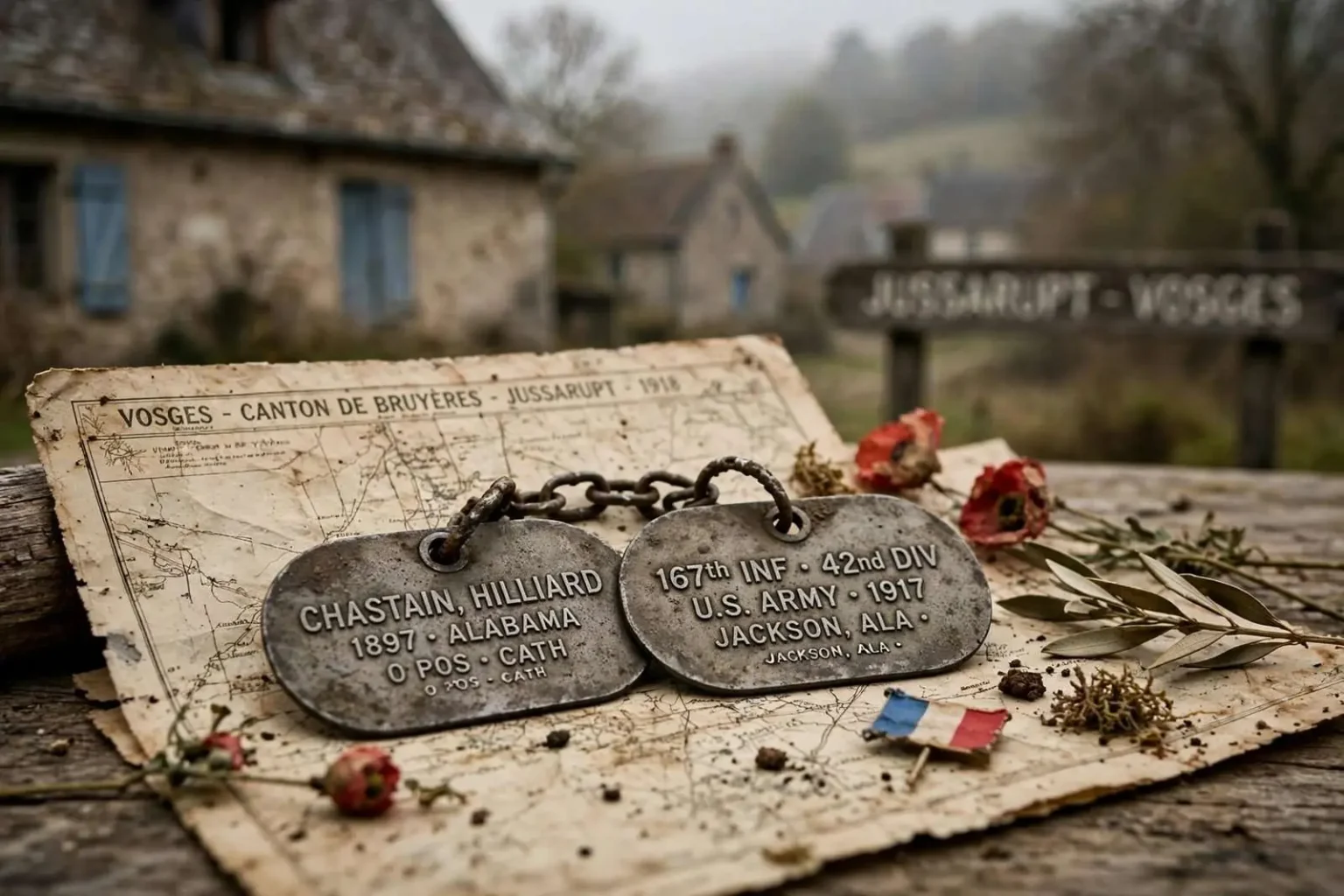
More than a century after a young man from Jackson shipped out to fight in the trenches of Europe, a small piece of him has come back. The dog tags of Hilliard Chastain, an Alabama soldier who served in World War I, were recently discovered in France — and French citizens intend to hand them back to his family.
The Discovery
The tags were found in the French village of Jussarupt, in the Vosges region of eastern France.
Residents there plan to return them to the Chastain family on Bastille Day, July 13, at a reception in Atlanta. Bastille Day is France’s national holiday, commemorating the storming of the Bastille in 1789 — a fitting occasion for a gesture of Franco-American remembrance.
Dog tags are, by design, among the most personal objects a soldier carries. Stamped with a name and identifying information and worn against the skin, they exist for the grim purpose of identifying a man who cannot identify himself.
That a set belonging to an Alabama soldier remained in French soil for more than a hundred years, and was then recognized, researched and traced back to a family across the Atlantic, speaks to the care with which French communities in former battle zones continue to tend the memory of the Americans who fought there.
Who Hilliard Chastain Was
Chastain was born in 1897 and joined the Alabama National Guard in 1917 — just in time for the United States’ entry into World War I. He served in the U.S. Army’s 167th Infantry Regiment, part of the 42nd Infantry Division. That division is one of the most storied formations in American military history, known then and now as the Rainbow Division.
The Rainbow Division
The 42nd Division was assembled from National Guard units drawn from 26 states, an unusual composition at a time when Guard divisions were typically raised within a single state. It was Maj. Douglas MacArthur — decades before he became one of the most famous generals in American history — who supplied the nickname, observing that the 42nd would “stretch over the whole country like a rainbow.”
The Rainbow Division proved key in several of the battles that turned the war against Germany. Its Alabama component, the 167th Infantry Regiment, descended from the state’s National Guard and earned a formidable reputation in France for its aggressiveness in close combat. Men from small Alabama towns — places like Jackson — fought in some of the most severe engagements the American Expeditionary Forces experienced.
The 167th’s best-remembered fight came at Croix Rouge Farm, in France’s Aisne department, on July 25-26, 1918, during the Aisne-Marne offensive, when the Alabamians attacked German machine-gun positions across open fields and woods. A memorial at the site, a bronze of a soldier carrying a fallen comrade, honors the regiment, and an identical statue stands in Montgomery.
Survival, Illness and Discharge
Chastain served in France and Germany until April 1919, remaining overseas well past the November 1918 armistice as part of the occupation and demobilization. He was honorably discharged in May 1919 after recovering from influenza and pneumonia, which had hospitalized him for nearly a month, according to Anne-Laure Desjonqueres, the Consul General of France in Atlanta.
That detail places him within one of the great catastrophes of the era. The 1918 influenza pandemic swept through the armies of Europe and killed enormous numbers of soldiers who had survived combat. For many American servicemen, the deadliest enemy in France was not German artillery but the virus that moved through the crowded camps and hospitals. Chastain contracted it and lived.
A Life on the Water
After the war, Chastain moved to Mobile, where he became the captain of the tugboat Carrie Mack — a working life on the waterways of the Alabama Gulf Coast, guiding vessels through the port that has long been the economic engine of the region.
He died in 1959 of an apparent heart attack at the age of 61. His family’s roots ran throughout southwest Alabama. His obituary listed four brothers, two of whom lived in Jackson — A.W. and Clarence Chastain. Another brother, Herbert Chastain, lived in Prichard, and Joseph Chastain lived in Saraland. He had one son, Hilliard Chastain Jr., who died in Georgia in 1993.
Why These Returns Still Happen
Across the former Western Front, farmers, hobbyist historians and local heritage societies continue to recover artifacts from ground that saw fighting more than a century ago. Helmets, shell casings, buttons and occasionally identification tags still emerge from fields and forests.
In France, returning such items to the descendants of the soldiers who carried them has become something of a tradition — an act of thanks that outlasts the generation that received it.
For Clarke County, the story restores a name. Hilliard Chastain was a teenager from Jackson who enlisted the year his country entered the war, served in one of its most famous divisions, survived both German guns and the influenza pandemic, and came home to work the waters of Mobile Bay. On July 13, in Atlanta, his tags will be placed back into the hands of his family.