Citronelle Man, 62, Killed When Truck Strikes Tree on US 45 in Mobile County
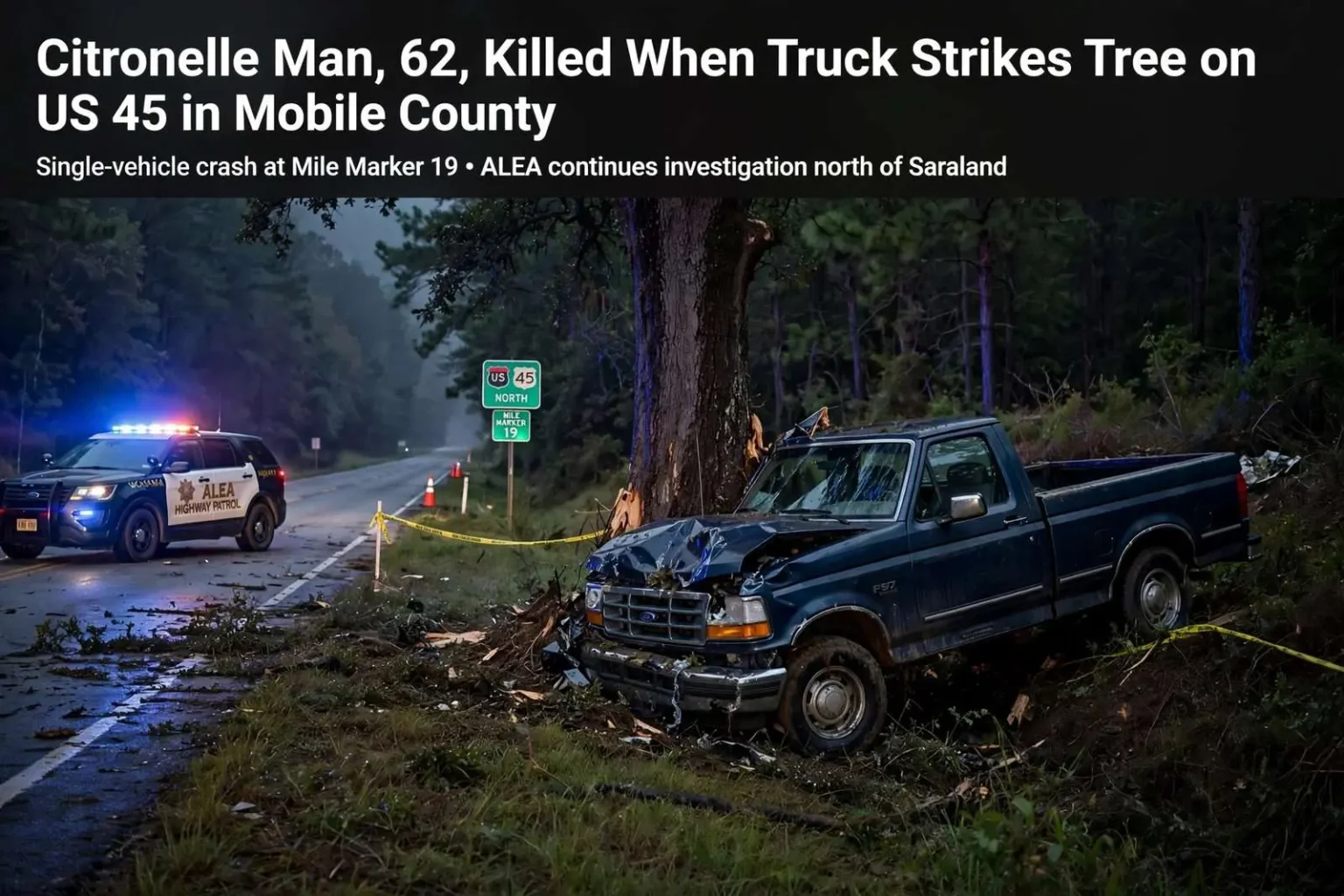
ALEA says Charles Richard Scoggin, 62, of Citronelle died when his Ford F150 struck a tree on US 45 near the 19-mile marker north of Saraland.
Background: US 45 through northern Mobile County
The crash occurred along a stretch of US Highway 45 that runs through rural northern Mobile County, where the highway passes a mix of forest and farmland between Citronelle and Saraland. The corridor serves as the main artery for the communities in the county’s northern reaches, carrying commuter traffic, logging trucks and local drivers between the small towns and the metropolitan area to the south. Traffic thins after dark, but the road’s combination of curves, driveways and limited lighting makes its nighttime conditions far different from what a daytime driver experiences.
State troopers routinely urge drivers to use extra caution on that corridor at night, when visibility drops and wildlife crossings are common. Deer strikes and run-off-the-road crashes are a recurring hazard on rural Alabama highways in the late-night hours, and the 19-mile marker stretch north of Saraland has seen its share of serious collisions over the years. Troopers advise drivers to reduce speed, scan the shoulders for movement and take extra care on curves where headlight coverage is shortest.
How ALEA investigates fatal crashes
ALEA’s Highway Patrol Division is investigating what caused the truck to leave the roadway. In fatal crashes, troopers document the scene in detail — vehicle positions, roadway evidence, sight lines and vehicle condition — and the findings feed a report that can take weeks to complete. Investigators also work to determine whether impairment, speed, a medical event or another vehicle contributed, though nothing about cause had been released as the investigation continued.
Further details — including whether any other vehicles were involved — had not been released as the investigation continued. That is standard practice in cases where the findings have not yet been finalized, and troopers generally release updates only when the investigative report is complete or when criminal charges result from the findings.
Citronelle and the communities along the highway
Citronelle, a city of roughly 3,900 residents near the Washington County line, anchors the northern end of the corridor. The community has deep roots in the timber and oil industries, and many of its residents commute south along US 45 for work. For a town its size, a traffic death on the highway that serves as its lifeline is felt across the community — in the schools, the churches and the businesses where the victim is known personally.
The loss also lands in a region that has campaigned for years to improve rural road safety. Northern Mobile County’s state legislators and local officials have periodically pushed for improvements along the US 45 corridor, from passing lanes to lighting at key intersections, citing the distance rural first responders must travel to reach crash scenes. Response times in the county’s northern stretches run longer than in the metro core, which is one reason rural crash survival rates lag urban ones.
MOBILE COUNTY, Ala. — A 62-year-old Citronelle man died late Tuesday night when the pickup truck he was driving left US Highway 45 and struck a tree. The Alabama Law Enforcement Agency’s Mobile Post said Charles Richard Scoggin was driving a 1997 Ford F150 north of Saraland when the crash happened at the 19-mile marker of US 45. The collision occurred during the late-night hours, according to troopers, when traffic on the rural highway is lightest and visibility is at its worst.
Single-vehicle run-off-the-road crashes remain among the deadliest categories on Alabama’s rural highways. When a vehicle leaves the travel lane at highway speed, the outcome often depends on what sits beyond the shoulder — and in the forested stretches of northern Mobile County, that frequently means mature trees close to the roadway, leaving little margin for a driver who drifts or loses control.
Troopers continue to investigate what caused the F150 to depart the roadway, and their findings will determine whether anything beyond the roadway itself contributed to the crash. What is already known is the loss: a 62-year-old man from a small north Mobile County community, killed on the road that connects it to the rest of the county.
The human cost of rural highway crashes
Fatal crashes along the county’s rural corridors ripple outward in ways that metro-area collisions often do not. In small communities like Citronelle, the victim of a late-night wreck is likely to be a neighbor, a church member or a relative of someone in town, and word travels through those networks within hours. Local first responders — volunteer fire departments and county rescue squads — are often the ones who answer the call, and they face the same burden when the person in the vehicle is someone they know.
Safety advocates mark crashes like this one when they argue for continued attention to rural road conditions. The combination of darkness, speed and narrow shoulders that defines much of US 45 north of Saraland is common across south Alabama, and each fatality along the corridor renews the conversation among residents about what it would take to make the drive safer — better lighting, cleared rights-of-way, or simply the vigilance troopers keep asking for.
As the investigation proceeds, the Highway Patrol’s report will provide the final accounting of what happened at the 19-mile marker Tuesday night. Until then, the loss stands with the family and community of Charles Richard Scoggin, and with the stretch of highway that claimed him — a reminder to every driver heading north out of Saraland after dark of how quickly a routine trip can end.
Late-night driving on rural corridors
The late-night hours when this crash occurred carry risks that accumulate quietly. Fatigue peaks after midnight, headlight range limits reaction time at highway speed, and the deer and other wildlife that move along the edges of forested stretches are most active between dusk and dawn. Safety officials have long advised drivers on rural highways to slow down after dark precisely because the margin for error shrinks: at night, a driver’s sight distance is what their headlights reach, not the stopping distance their speed requires.
Vehicle condition matters on these roads as well. Older pickups like the 1997 Ford F150 involved in the crash are common work vehicles across rural Mobile County, and their handling at highway speed depends on tires, brakes and loading that owners juggle alongside the demands of daily work. Troopers investigating run-off-the-road crashes routinely examine all of these factors, along with roadway conditions that night, before reaching conclusions about cause.
When a crash becomes fatal
The difference between a wreck a driver walks away from and one they do not is often decided in seconds and inches. Roadside trees are among the most unforgiving fixed objects a vehicle can strike, which is why highway departments prioritize clearing rights-of-way and why guardrails are installed where trees stand close to the road. On the rural stretches of US 45, the tree line in places runs near the shoulder, and a vehicle that departs the roadway has little room to recover before impact.
First responders in northern Mobile County — a chain of volunteer fire departments and county rescue units stretched along the corridor — answer these calls with the equipment and staffing their small communities can field. Their response is complicated by distance: the nearest hospital emergency departments are in Saraland, Mobile and Citronelle’s clinic-level facilities, meaning serious injuries sustained at the 19-mile marker face a transport measured in tens of minutes before definitive care is reached.
After the report is filed
When ALEA completes its investigation, the findings go to the family and, where relevant, to prosecutors. Families of crash victims in Mobile County can also request the investigative report through the state’s public records process, and many do so while arranging services and settling their loved one’s affairs. In cases with no other vehicles involved, the report typically resolves the practical questions — cause, circumstances, whether a medical event or mechanical failure played a role — that a family is left asking in the days after a sudden loss.
Community response in Citronelle and the settlements along the highway will follow the pattern familiar to small towns across south Alabama. Neighbors bring food, churches open their doors, and the local schools quietly arrange support for students related to the victim. These are the support structures that hold small communities together after a loss, and they operate without announcement in the days between the crash and the funeral.
Safety advocates use crashes like this one to renew standing advice for the corridor: buckle up on every trip, however routine; keep speeds suited to conditions rather than to the posted limit; and take fatigue seriously, particularly for drivers making the commute between northern Mobile County and jobs in the metro area after a long shift. None of that advice changes what happened at the 19-mile marker Tuesday night, but it is the advice troopers will repeat as long as drivers travel that road after dark.
The Highway Patrol’s investigation remains open, and troopers have asked anyone who witnessed the crash or who has information about the events of that night to come forward. Witnesses along US 45 between Citronelle and Saraland may hold details that scene evidence alone cannot supply — the direction of the truck’s drift, the presence of another vehicle, the timing of what they saw.
Until the report is final, the facts are the ones the Mobile Post has confirmed: Charles Richard Scoggin, 62, of Citronelle, driving a 1997 Ford F150 north of Saraland, left US Highway 45 at the 19-mile marker late Tuesday night and struck a tree. He did not survive. The road where it happened remains one of the busiest rural corridors in Mobile County, and the crash stands as the kind of loss that corridor has seen before — and that the drivers who travel it every day are asked to work against, every trip.