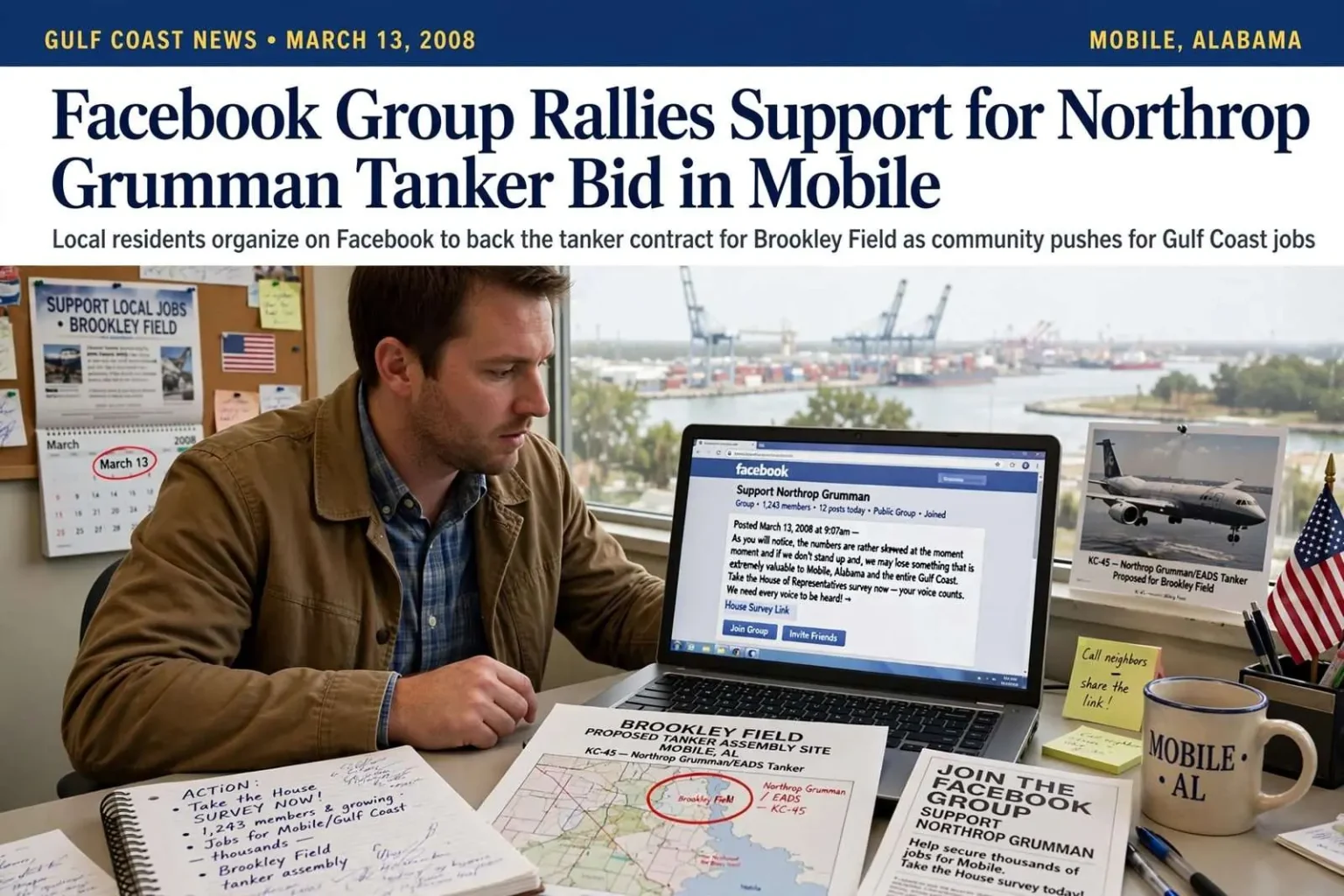
In the spring of 2008, a fight over one of the Pentagon’s biggest aircraft programs produced one of the more unlikely scenes in Mobile’s economic development history: local residents organizing on Facebook to lobby Congress. On the morning of March 13, 2008, invitations began circulating across the social network, urging friends and neighbors to join a group called “Support Northrop Grumman.” The group’s immediate goal was simple — get members to participate in an online survey hosted on the U.S. House of Representatives’ website, where early results appeared to be running against the Northrop Grumman and EADS team.
“As you will notice, the numbers are rather skewed at the moment and if we don’t stand up and shout, we may lose something that is extremely valuable to Mobile, Alabama and the entire Gulf Coast,” the group’s page told prospective members. Organizers cast the effort as a last chance for ordinary people to be heard before Washington settled the question without them.
The Stakes at Brookley Field
Behind the online campaign stood one of the largest economic development prospects in Mobile’s history. Northrop Grumman and its European partner EADS had proposed building a new assembly line at Brookley Field in Mobile to construct aerial refueling tankers for the U.S. Air Force. The contract was worth tens of billions of dollars and, in the eyes of regional leaders, carried the potential for thousands of jobs across the Gulf Coast — assembly line positions, supplier contracts, and the durable industrial base that comes with building military aircraft.
The Air Force had already made its choice. Earlier in 2008, service officials selected the Northrop Grumman/EADS team over rival bidder Boeing, a decision that surprised many defense analysts who had expected the longtime tanker maker to keep the work. The award meant that a major American tanker program, instead of staying on the West Coast, would be built on the Gulf of Mexico — with Mobile’s Brookley Field as the centerpiece.
Boeing quickly fought back. The company formally protested the Air Force’s decision to award the work to the Northrop Grumman/EADS team, challenging how the competition had been judged and throwing the outcome into fresh doubt. The protest set off a lobbying battle that stretched from Capitol Hill hearing rooms to Mobile’s own neighborhoods, as both camps pressed lawmakers and public opinion to see the contest their way.
For Mobile, the moment carried echoes of an older story. Brookley Field had served as a busy military air depot during World War II, when aircraft maintenance and supply operations made it a cornerstone of the local economy. The Air Force closed the base in 1969, a blow that took decades to absorb, and the site was later reborn as an industrial airport serving aviation, aerospace and manufacturing tenants. The prospect of a modern tanker assembly line rising on the old base represented the kind of second act cities along the Gulf Coast had been chasing for a generation.
A Social Network in Its Infancy
That a defense procurement fight playing out in Washington had migrated onto a college-oriented social network said as much about the moment as it did about the contract itself. In 2008, Facebook had only recently opened its doors to the general public after years as a campus-only platform, and many adults in Mobile were joining it for the first time. Organizations, campaigns and advocacy groups were only beginning to experiment with the site as a tool for rallying supporters, and no established playbook existed for turning online membership into political pressure.
For a grassroots push built around a regional jobs contract to appear there was, as observers at the time noted, a fairly unusual sight. It mixed the emerging language of social networking — invites, groups, wall posts — with old-fashioned constituent pressure on Congress, the kind of letter-writing and phone-calling campaign that Gulf Coast civic groups had run for decades. The organizers of “Support Northrop Grumman” were essentially testing whether a new medium could do the work of the old ones, and doing it in public, where anyone skeptical of the tactic could watch it unfold.
The choice of venue reflected the nature of the fight. Because the tanker decision would ultimately be resolved in Washington — through the GAO protest, congressional pressure and the Pentagon’s own reviews — the audience that mattered was federal. An online survey run by the House of Representatives gave supporters a direct, measurable way to register their views with the people who would influence the outcome, and the Facebook group served as the organizing hub for getting them there.
What the Contract Meant Locally
The episode is a reminder of how directly national defense and trade decisions can be felt at the local level. For Mobile and the surrounding Gulf Coast counties, the tanker contract represented far more than an abstract federal appropriations line. It was tied to the future of Brookley Field, the region’s manufacturing base, and the livelihoods of workers who hoped to build the aircraft — machinists, electricians, assemblers and the web of suppliers that follows a major airframe program.
Regional leaders had spent years courting aerospace employers, positioning Mobile as a Gulf Coast manufacturing hub with a deep-water port, a growing airport industrial complex and a workforce trained through the area’s technical colleges and shipbuilding traditions. The tanker award was viewed as the kind of anchor project that could validate that strategy, drawing additional suppliers and investment to the region the way earlier industrial recruitments had reshaped other Southern cities.
That local stake is what pushed ordinary residents, not just industry lobbyists, to organize and make their case directly to lawmakers through whatever channels were available to them, Facebook included. The people joining the group were not defense policy specialists. They were workers, business owners and parents who understood that a tanker line at Brookley would mean paychecks and opportunity close to home, and who were willing to learn the arcana of procurement protests in order to defend it.
An Early Lesson in Digital Organizing
The push also illustrated an early example of a pattern that would become increasingly familiar in the years that followed: communities using social media to apply pressure on a federal decision with direct local consequences. Long before hashtag campaigns and viral petitions became standard tools of civic engagement, Mobile-area residents were already testing whether a Facebook group could move the needle on a multi-billion-dollar defense contract that many believed would define the region’s economic future.
In hindsight, the March 2008 effort sits at the beginning of a learning curve the whole country would climb. Political campaigns, advocacy organizations and neighborhood associations would spend the following decade refining how to convert online attention into calls, letters, survey responses and votes. The Mobile group’s instincts — pick a concrete action, explain the stakes plainly, give people a deadline — anticipated much of that playbook, even if the tools were rudimentary by later standards.
The tanker fight itself would continue long after the survey closed. The Government Accountability Office would take up Boeing’s protest, Congress would debate the award, and the competition would remain unsettled for years, a rolling saga of protests, rebids and rewrites that kept Mobile and its Gulf Coast neighbors watching Washington closely. Through each turn, the local stakes stayed the same: the promise of an aerospace future anchored at Brookley Field, and the fear that a decision made hundreds of miles away could take the opportunity off the table.
The mechanics of the group were modest but purposeful. Members were encouraged to share the invitation with their own networks, to take the House survey themselves, and to press family members, coworkers and neighbors into doing the same. There was no budget, no staff and no office — just a page on a young social network and a core of volunteers convinced that the region’s silence would be read as indifference. In a procurement fight where public sentiment could shape how lawmakers leaned, every survey response counted, and the group treated each new member as another voice that might tip the tally.
What the episode demonstrated, in the end, was less about Facebook than about Mobile. A community that understood exactly what was at stake did not wait for its economic fate to be decided quietly. It organized with the tools at hand, made its case where the decision-makers were looking, and showed that a regional jobs fight could be waged one click at a time. For a city that had spent four decades rebuilding after the loss of its Air Force depot, that willingness to shout — politely, persistently and in a brand-new public square — was itself a sign of how much the tanker contract mattered, and how far residents were willing to go to keep it.