West Mobile Curbside Paper Recycling Program Expanded in 2008
A 2008 WKRG report detailed a curbside paper and cardboard recycling program serving several West Mobile neighborhoods.
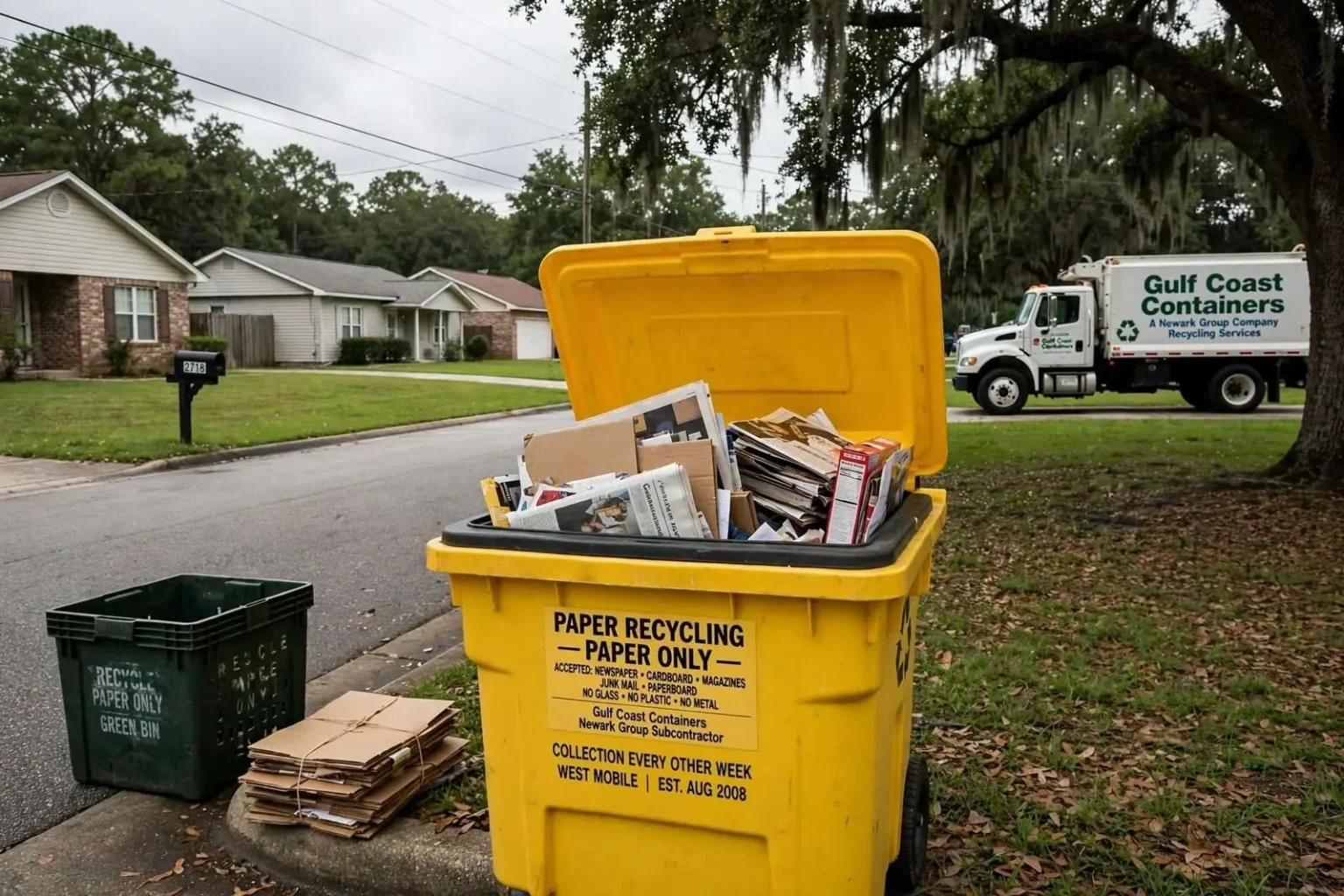
In August 2008, a curbside paper recycling program was serving several West Mobile neighborhoods, according to a report published by a local station, giving thousands of households in the city’s western suburbs their first regular route to keep newspaper, cardboard and mixed paper out of the landfill. The program operated on a simple exchange: residents set out paper on collection day, and a private hauler carried it away every other week.
Residents in the participating area received yellow carts, slightly smaller than standard trash containers, for paper and cardboard. The bright yellow carts served double duty — they held a household’s two weeks’ worth of paper products, and they made the program visible from the street, a constant reminder to neighbors not yet enrolled that recycling had arrived on their block. Carts of that generation were designed for single-stream paper collection only: newspaper, magazines, office paper, junk mail, paperboard and flattened cardboard, with glass, plastic and metal still bound for the garbage can.
Who Ran the Program
The Newark Group and its subcontractor Gulf Coast Containers collected the materials every two weeks. The Newark Group, a national paper recycling company with operations across the Southeast, specialized in recovering fiber that mills could repulp into new paper products — cardboard, containerboard and newsprint. Gulf Coast Containers, its local subcontracting partner, handled the collection routes that connected West Mobile curbsides to the regional recycling supply chain. The partnership model was typical of the era: municipalities wanted recycling service without building a system of their own, and private processors wanted the fiber volume that a metropolitan area like Mobile could generate.
The economics worked because paper was, and remains, one of the few recyclable commodities with a stable industrial market. Cardboard especially — the shipping box material that households accumulate steadily — carried real value to mills, which meant a hauler could collect, bale and sell the material rather than charging residents the full cost of disposal. Every two weeks, the yellow carts fed a supply chain that ended at paper mills across the region.
The Neighborhoods Served
The reported service area included Pinehurst, Inverness, Mary Knoll, Mary Knoll Place, Sugar Creek, Lexington, Woodlea, Hillcrest Crossing, Savannah Trace and Lamp Lighter Woods — a list of established residential subdivisions spread across West Mobile, west of I-65 and beyond the airport corridor. These were mature neighborhoods, built out largely in the 1970s through the 1990s, with the household density and curbside access that made a subscription-style collection route practical. The program’s boundaries followed subdivision lines rather than city ward lines, reflecting how the hauler signed up areas neighborhood by neighborhood.
Switching to the Yellow Carts
Residents with older green bins were asked to exchange them for the newer carts, an administrative detail that mattered more than it sounds. The older bins — the small open crates residents had used previously — required sorting or permitted loose paper that could blow into the street on windy Gulf Coast days. The lidded yellow carts kept material contained, protected it from the region’s frequent afternoon thunderstorms, and standardized what crews lifted into trucks. Cart exchanges are the unglamorous work of recycling programs, but a fleet of uniform carts is what makes a route efficient enough to sustain.
The biweekly cadence fit the material. Paper accumulates more slowly than garbage in most households — a stack of newspapers, a pile of shipping boxes, a grocery sack of junk mail — and two weeks is generally enough to fill a cart without overflowing. The schedule also let one collection truck serve twice as many households as a weekly route would, keeping the program’s costs down in an era when curbside recycling was still fighting to prove it could pay for itself.
Recycling in Mobile County, Circa 2008
At the time, the program did not include a full-scale curbside recycling system, though organizers said they hoped that could eventually happen. That distinction defined recycling in Mobile in 2008: no unified citywide program accepted the full range of household recyclables at the curb, and residents who wanted to recycle plastics, glass and metals hauled them to drop-off sites or private buy-back centers. Paper was the beachhead — the material with a working market and a private hauler willing to run routes — and the West Mobile program grew out of that narrow opening.
Regional context made the effort part of a larger trend. Across Alabama and the Gulf Coast in the late 2000s, curbside recycling was expanding city by city, driven by rising landfill tip fees, growing environmental awareness and the marketing muscle of paper companies seeking fiber. Baldwin County’s municipalities were building their own programs, and Mobile’s suburban neighborhoods were watching. The West Mobile paper routes sat at the leading edge of that wave in Mobile County.
What the Carts Meant for Households
For participating families, the yellow cart changed household habits in small but persistent ways. A cereal box went into the cart instead of the trash. The Sunday newspaper, catalogs, school papers and moving boxes accumulated in a garage corner until collection morning. Households that had never thought twice about paper waste began separating it, and the visible presence of carts up and down the block normalized the practice for neighbors on the fence. Behavioral research on recycling has consistently found that convenience and social proof — seeing carts on other curbs — do more to drive participation than public service announcements ever do.
The program also carried an educational footprint in the schools of the participating neighborhoods, where paper recycling drives were already a fixture. Children who collected newspaper at school brought the habit home, and a curbside cart gave them a destination for it. The two-week rhythm was simple enough for any household member to track, and that simplicity was the program’s practical genius: no sorting bins, no drop-off trip, no special knowledge required.
The Path Not Yet Taken
The organizers’ hope for eventual full-scale curbside recycling pointed at the challenge that would define the following decade for Mobile County. Full programs — accepting plastics, metals and glass alongside paper — require processing infrastructure, stable commodity markets and either a municipal budget line or a utility fee. In 2008, none of those pieces were in place in Mobile, and the private paper program filled the gap as far as the market alone could carry it. The program’s history matters as a record of how the city’s recycling grew incrementally, neighborhood by neighborhood and material by material, rather than arriving all at once.
A Historical Snapshot
This article is a historical summary of a 2008 local report, and program details may have changed. Collection operators change, routes expand and contract, and the recycling industry itself has been transformed since then by China’s national sword import restrictions, which upended commodity markets for recyclables worldwide in the years after 2017. What the August 2008 report preserves is a moment when West Mobile’s neighborhoods were among the first in the county to receive regular curbside paper collection, run by a national recycler working through a local subcontractor, serving a specific list of subdivisions with yellow carts exchanged for green bins.
For residents researching their own service today, the useful facts from the 2008 record are the neighborhood list, the collection partnership and the biweekly schedule — the skeleton of how curbside recycling took root west of the city center. The larger story it documents is familiar across the Gulf South: recycling in this region did not arrive as a single municipal decision but as a patchwork of private routes, neighborhood by neighborhood, built one commodity at a time until a full system could follow. In August 2008, in ten West Mobile subdivisions, paper was the commodity that got the curbside started.
The two-week collection cycle also embedded itself in the household calendar of the participating neighborhoods. Residents learned to time their garage cleanouts and box breakdowns to the cart schedule, and collection mornings in the yellow-cart neighborhoods took on the same visual rhythm as garbage day itself — rows of lidded carts standing at the curb before the truck arrived. That parity with regular garbage service was precisely the point: organizers understood that recycling survives only when it demands no more thought than the trash can it sits beside.
Commodity context in 2008 favored the experiment. Cardboard prices had climbed with the shipping economy, newsprint mills across the Southeast were hungry for recovered fiber, and the Newark Group’s business model — feeding regional paper mills with curbside material — was profitable enough to fund route expansion without municipal subsidy. The subcontracted arrangement with Gulf Coast Containers kept local trucks and local drivers on the routes while the national company handled the baling, brokerage and mill relationships that turned neighborhood paper into industrial feedstock.