Curbside Paper Recycling Expanded in West Mobile County in 2007
In 2007, curbside collection of post-consumer paper expanded to about 250 additional homes in western Mobile County, according to WKRG.
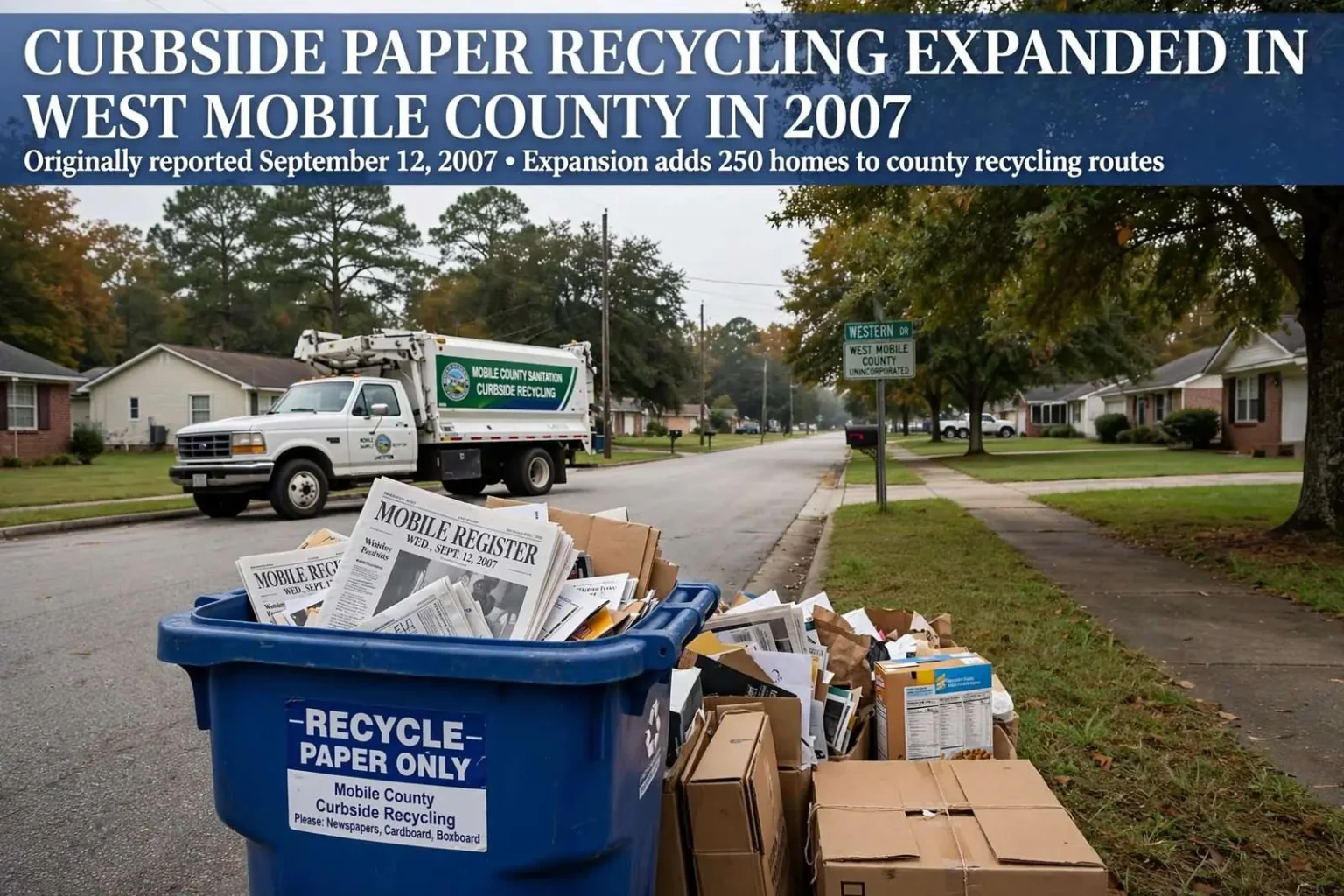
Originally reported September 12, 2007.
Curbside collection of post-consumer recyclable paper expanded to about 250 additional homes in western Mobile County in 2007, according to an archived local news report. The expansion was small in household terms but significant in what it signaled: the paper mill at the center of the county’s recycling economy was actively seeking more household paper, and the collection routes were growing to feed it. Mobile Paperboard Corporation general manager Chris Conrad said the company had increased its recycling activity significantly in the previous year or two. The factory recycled about 450 tons of paper daily, though only about 50 tons a week came from post-consumer waste — the paper residents put at the curb. Most of the recycled paper came from businesses, such as cardboard boxes collected after stores stocked their shelves. At the plant, paper was ground into paste, impurities were removed, and the material was strained and dried into nine-ply paper.
The gap between those two numbers — 450 tons a day recycled, and 50 tons a week from households — described the structure of paper recycling as it actually worked in Mobile County in 2007. Commercial recycling was the backbone: stores, warehouses, and offices generate paper and cardboard in steady, uniform, easily baled quantities, and businesses were used to handling it. Residential paper, by contrast, arrives in small amounts from each home — newspapers, cereal boxes, junk mail, corrugated packaging — and collecting it requires routes, bins, trucks, and the cooperation of hundreds of individual households to gather what a single store discards in a day. The 250-home expansion was an increment in building that residential side of the supply.
Western Mobile County was where the curbside program was growing, in the unincorporated communities and suburbs west and north of the city — areas where county services, rather than municipal departments, provide sanitation. Curbside recycling in Alabama in that era was not universal: it existed where a municipality or a private hauler offered it, and where a mill or broker stood ready to buy the collected material. The economics are unforgiving — collection is the expensive half of recycling, and it only pays when the recovered fiber has a buyer nearby. A working paper mill inside the county changes that equation, because the fiber collected on Monday can be at the mill on Tuesday, which is why the mill’s appetite for post-consumer paper and the reach of the curbside routes rose together.
Inside the Paper Mill
The mill process described in the report was the standard mechanical recycling loop for paperboard. Collected paper arrives at the plant, where it is sorted and fed into a pulper — the vat where paper is ground into paste, mixed with water and broken down into its fibers. From the pulp, impurities are removed: plastic tape from cardboard, staples, ink, glue, and the coatings that make some paper shiny. The cleaned material is strained to separate the usable fiber from the residue, and the slurry is then dried into new paper. The report specified the plant’s output as nine-ply paper — thick, laminated paperboard — which is the material of boxes, cartons, and industrial packaging.
Nine-ply paperboard is the reason a mill can absorb mixed recovered fiber. Multi-ply board is built up in layers, and not every layer needs virgin fiber of printing grade; the inner plies of a box can be made from shorter, grayish recycled fiber that would never do for a magazine page. Mills that produce packaging grades are therefore the natural destination for mixed residential paper, cardboard, and boxboard, since the quality bar for the product matches what the recycled stream can supply. The 450 tons a day the Mobile plant recycled went into this kind of product, turning the county’s discarded paper back into the packaging that carried goods to the same stores that had discarded the boxes.
That loop — box to store shelf to recycling route to mill to new box — is the commercial heart of paper recycling, and it was already mature in 2007. What was developing was the residential extension: getting households to sort their paper and getting routes to collect it. Post-consumer paper is messier and thinner in volume per stop, but it is also the stream that grows as participation widens, and every expansion of a few hundred homes adds capacity to it. Conrad’s remark that the company had significantly increased its recycling activity over the prior year or two placed the residential expansion inside a broader ramp-up at the mill.
What Recycling Meant Locally
For residents of the newly added routes, curbside paper recycling in 2007 worked on simple terms: set out newspapers, cardboard, and boxboard on the scheduled day, and the collection truck did the rest. The environmental arithmetic behind the program was the standard case for paper recycling — paper is biodegradable and heavy in the waste stream, and every ton recovered from the curb is a ton that neither fills a landfill nor requires a tree at the front end of the process. Recycling paper also uses less energy and water than making paper from raw wood, which is why paper recycling was among the earliest and most economically durable forms of recycling, predating the plastics programs that later dominated public attention.
The county’s waste picture in 2007 made the mill’s role concrete. Mobile County’s household waste went to landfills, and paper and cardboard were among the largest components of what residents threw away. A curbside program that reached only some homes, collecting only paper, could divert a meaningful volume without any of the sorting complexity that makes recycling other materials harder. The limit — 50 tons a week from post-consumer sources against the mill’s much larger daily throughput — showed how far the residential side still had to grow before it contributed substantially to the plant’s supply, and each expansion of a few hundred homes moved that number.
Participation was the variable that determined whether a route expansion succeeded. A route serving 250 homes collects paper only from the households that actually set it out, and programs of that era lived or died on the habits formed in the first months of service. Communities that recycled well did so because sorting paper became routine — a stack of newspapers by the door, flattened boxes beside the bin — and because residents could see the collection happen on schedule. Missed pickups and contaminated loads were the failure modes, which is why haulers and mills preferred simple, single-stream paper programs over complicated sorting schemes that residents abandoned.
The 2007 report survives as a record of that stage of Mobile County’s recycling development: a local mill running at 450 tons a day, drawing mostly on commercial cardboard, with a residential curbside program expanding by 250 homes in the western part of the county and a mill management actively pushing the increase. The details — Chris Conrad’s account of the company’s growing recycling activity, the plant’s process from paste to nine-ply paper — capture an economy that most residents saw only as a truck on collection day. Programs and facilities of that era may have changed in the years since; what the record preserves is the moment when household paper recycling in the county was small, growing, and anchored to a mill that could actually use what the routes collected.
The commercial half of the mill’s supply — the cardboard collected after stores stocked their shelves — deserves its own explanation, because it was the part of the business that paid the bills. Retail corrugated is the cleanest, most uniform recovered fiber available: it arrives at a store in predictable bales, free of the food residue and mixed materials that complicate household recycling, and stores generate it every day in the same quantities. Haulers run scheduled pickups, compact the cardboard, and sell it by the ton to mills like Mobile Paperboard. For a mill, commercial cardboard is the stable base load of supply, and residential paper is the variable addition — which is why the 450-ton daily figure could coexist with only 50 tons a week from the curb.
The mill’s place in the local economy ran beyond recycling itself. Paperboard mills are industrial employers in the communities where they operate, and the trucking that moves recovered paper and finished board adds jobs around the plant. The flip side of that presence is dependence on commodity markets: prices for recovered paper and for finished paperboard rise and fall with national demand, and a mill’s purchases from the recycling stream expand and contract accordingly. Conrad’s account of significantly increased recycling activity placed the company in an expansionary phase in 2007, buying more fiber and widening its collection network — the residential curbside expansion being one visible piece of that effort.