Witness Described Hopkins Family in 2008 Trial Testimony
A 2008 WKRG report covered testimony from a Jackson businessman during the Anthony Hopkins homicide case.
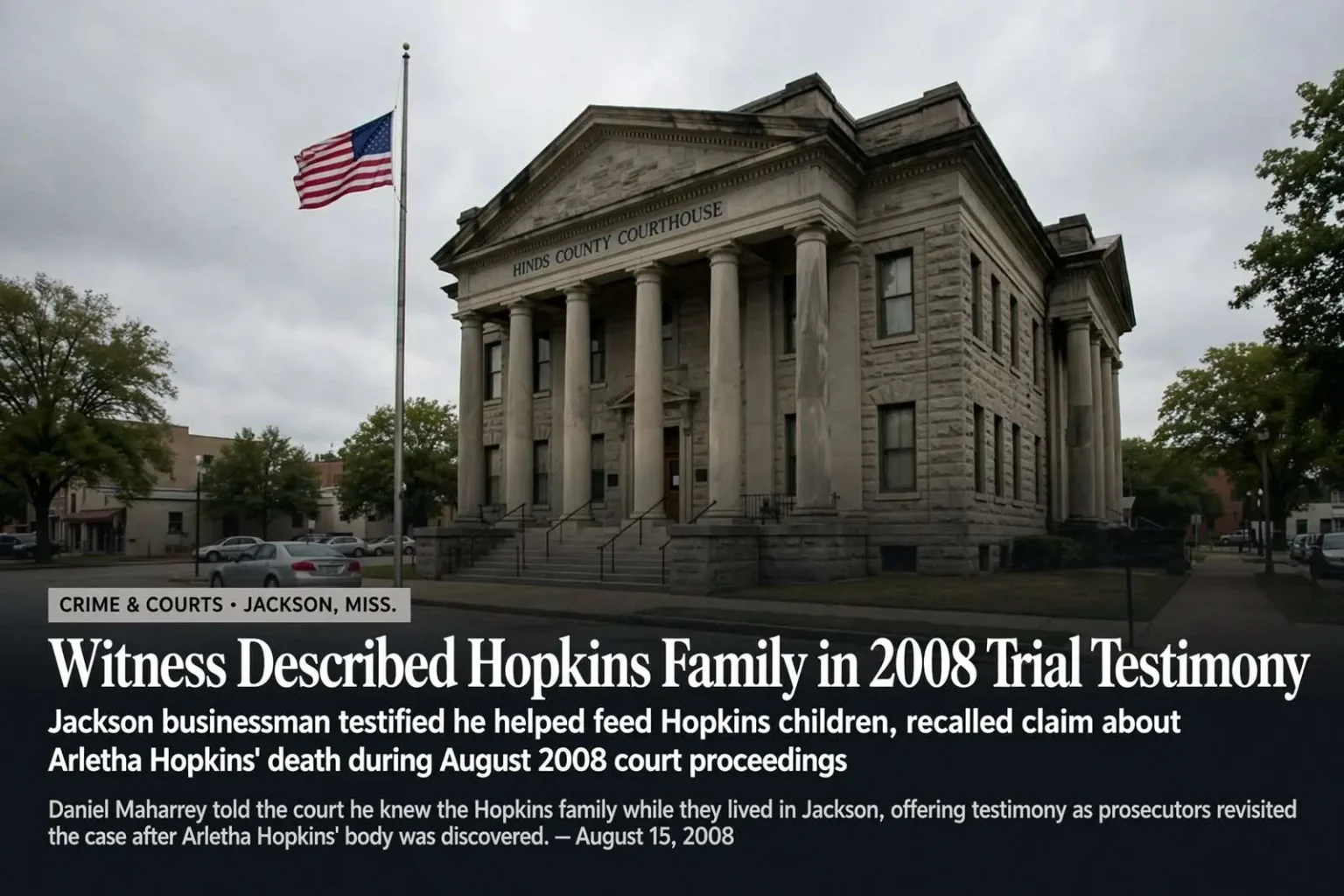
JACKSON, Miss. — During testimony in the Anthony Hopkins case in August 2008, a Jackson businessman described knowing Hopkins and his family when they lived in the city, adding a personal dimension to the proceedings as the case moved through court after Arletha Hopkins’ body was discovered. The testimony offered jurors and observers a glimpse into the family’s life years before the case brought it back into public view.
Daniel Maharrey said that he and his wife had helped feed the Hopkins children during the time the family lived in Jackson, describing an acquaintance with the family that went beyond a passing relationship. According to the testimony, Hopkins had told the Maharreys that his wife, Arletha Hopkins, had died — an assertion that would take on central significance in the case, given the circumstances under which the proceedings were occurring.
Maharrey’s testimony was reported as the case proceeded in court after Arletha Hopkins’ body was discovered. The discovery of the body years after her disappearance had reopened a chapter that many believed was closed, and the 2008 proceedings examined both the events surrounding her death and the years in which Hopkins had maintained that his wife was gone for an entirely different reason.
The August 2008 testimony reflected the nature of cases built on long timelines. When a death is discovered years after the fact, prosecutors must often reconstruct history through the recollections of neighbors, employers, family members and acquaintances — people whose ordinary memories of everyday interactions become pieces of a much larger puzzle. Maharrey’s account of the family’s time in Jackson, including the claim Hopkins made about his wife’s death, fit that pattern of testimony that helps establish the record of what was said and done during the years in question.
The significance of witness testimony in cold cases
Cases involving discoveries made long after the fact present particular challenges for prosecutors and investigators. Physical evidence degrades, memories fade, and the ordinary documentation of daily life becomes the connective tissue of the case. Witnesses like Maharrey — people who interacted with a family in ordinary ways, like helping feed children — occupy a specific role in such proceedings, offering context that investigators and jurors cannot obtain from any other source.
In proceedings of this kind, testimony about what a defendant said and did during the period in question can bear directly on the questions the court must resolve. Statements a defendant made about a spouse’s whereabouts or death, the family’s movements from place to place, and the day-to-day circumstances of their lives all become evidence subject to examination and cross-examination. The August 2008 proceedings reflected that structure, with witnesses from different periods and places contributing their portions of the historical record.
The report of Maharrey’s testimony came from a local station covering the proceedings, part of the media attention that accompanied the case as it developed. Cases of this kind draw significant public interest, both because of the length of time involved and because of the questions they raise about how a death could go undetected — and unprosecuted — for so long.
Context of the 2008 proceedings
The 2008 court proceedings came after the discovery of Arletha Hopkins’ body transformed what had been treated as a missing-person or abandonment situation into a homicide investigation. Once the remains were identified, investigators reopened the case, working to establish what happened to her and when, and prosecutors brought the matter before the court. The proceedings in August 2008 were part of that process, with testimony from witnesses who had known the family during the years the alleged events went unnoticed.
For the Jackson community, the testimony was a reminder of how ordinary encounters can become part of a criminal case years later. Maharrey’s account centered on everyday kindness — feeding children who needed a meal — and on a statement about a wife’s death that would be weighed against everything else the court heard. Witnesses in such cases are not asked to judge; they are asked to remember, and the court determines what the memories mean.
The case’s path through the courts also illustrates the persistence that cold-case investigations demand. Once a body is discovered and identified, investigators must trace backward through years of records, relocations and recollections to establish the facts a prosecution requires. Witness testimony gathered in 2008, more than a decade after the period being examined in some respects, demonstrates how long that arc can run and how many people can be touched by it — from the family members who lost someone, to the neighbors who remember the children, to the officers and prosecutors who assembled the case.
How the reporting framed the proceedings
Local coverage of the August 2008 testimony focused on what was said in court: who Maharrey was, what he and his wife had done for the Hopkins children, and what Hopkins had told them about his wife. The reporting carried the standard caution appropriate to any trial proceeding — that testimony represented what witnesses said under oath, and that the court would weigh it alongside all other evidence. That distinction matters in cases with long timelines, where the gap between what was reported, what was alleged, and what was proven can be significant.
The proceedings after the discovery of Arletha Hopkins’ body marked the resumption of legal attention to a case that had remained dormant for years. Her discovery gave investigators the physical evidence and the legal basis to pursue the matter in court, and the testimony of witnesses from her husband’s past became part of the record through which the court examined the family’s history. Maharrey’s account of the family’s years in Jackson was one piece of that record — a memory of children who were fed, and of a man who said his wife had died.
For the community watching the case develop, the August 2008 testimony underscored the human dimension of a case otherwise defined by its long timeline and its grim discovery. The Hopkins children, remembered by witnesses as kids who needed feeding, were part of a family whose story was being pieced together in court. Arletha Hopkins, whose body had been discovered years after her death, was at the center of proceedings that sought to establish what happened to her.
This report reflects testimony and allegations presented in the 2008 proceedings. It should be read as a historical account of what was reported in court at that time. Testimony in criminal proceedings represents evidence to be weighed, not findings of fact, and accounts published at the time reflect the record as it stood during the 2008 court process rather than any later developments in the case.
The role of civilian witnesses in homicide prosecutions deserves particular attention in cases like this one. Unlike law enforcement witnesses or expert witnesses, civilian witnesses speak to what they personally saw, heard and did. Their testimony is often the only direct evidence of events that took place far from any official record — inside homes, among neighbors, in the ordinary course of life. Courts treat such testimony with the full weight of the oath, and cross-examination tests it, but without it, prosecutions built on years-old events would be nearly impossible to construct.
Testimony about a defendant’s statements — like the statement Hopkins made to the Maharreys about his wife’s death — occupies a specific evidentiary category in criminal law. Statements attributed to a defendant can come before the court under specific rules governing admissibility, and their significance is weighed by the jury or judge alongside all other evidence. The reporting of such statements during the 2008 proceedings reflected their importance to the case’s narrative: what Hopkins said in the years when no one knew where Arletha was became directly relevant once her body was found.
Cold cases and reopened investigations
The Hopkins case belongs to a category that has grown more familiar in recent decades: prosecutions made possible by discoveries that come long after the fact. Advances in forensic science, including DNA analysis, have allowed investigators to reexamine evidence in cases that once stalled, and the discovery of remains has resolved dozens of missing-person cases across the country. Each such case requires investigators to reconstruct a timeline that may span years of moves, name changes and new relationships — work that depends on exactly the kind of witness testimony Maharrey provided in August 2008.
For families of victims in long-undiscovered cases, the resumption of legal proceedings brings a complicated mixture of grief and purpose. The discovery of a loved one’s remains answers the question of what became of them, but it also opens a process — investigation, testimony, trial — that requires the family to relive the loss publicly. Courts and victim advocates have developed services to support families through that process, recognizing the unique burden that delayed prosecutions impose.
The Jackson businessman’s August 2008 testimony, mundane in its details and extraordinary in its context, exemplifies the material from which such cases are built. A meal provided to hungry children, remembered years later under oath, became part of the historical record of a family at the center of one of the region’s most closely followed proceedings.
This report reflects testimony and allegations presented in the 2008 proceedings. It should be read as a historical account of what was reported in court at that time. It does not describe events proven at trial, nor does it reflect any developments that occurred after the August 2008 proceedings. Readers interested in the case’s full history should consult the public court record and contemporaneous reporting from the period.