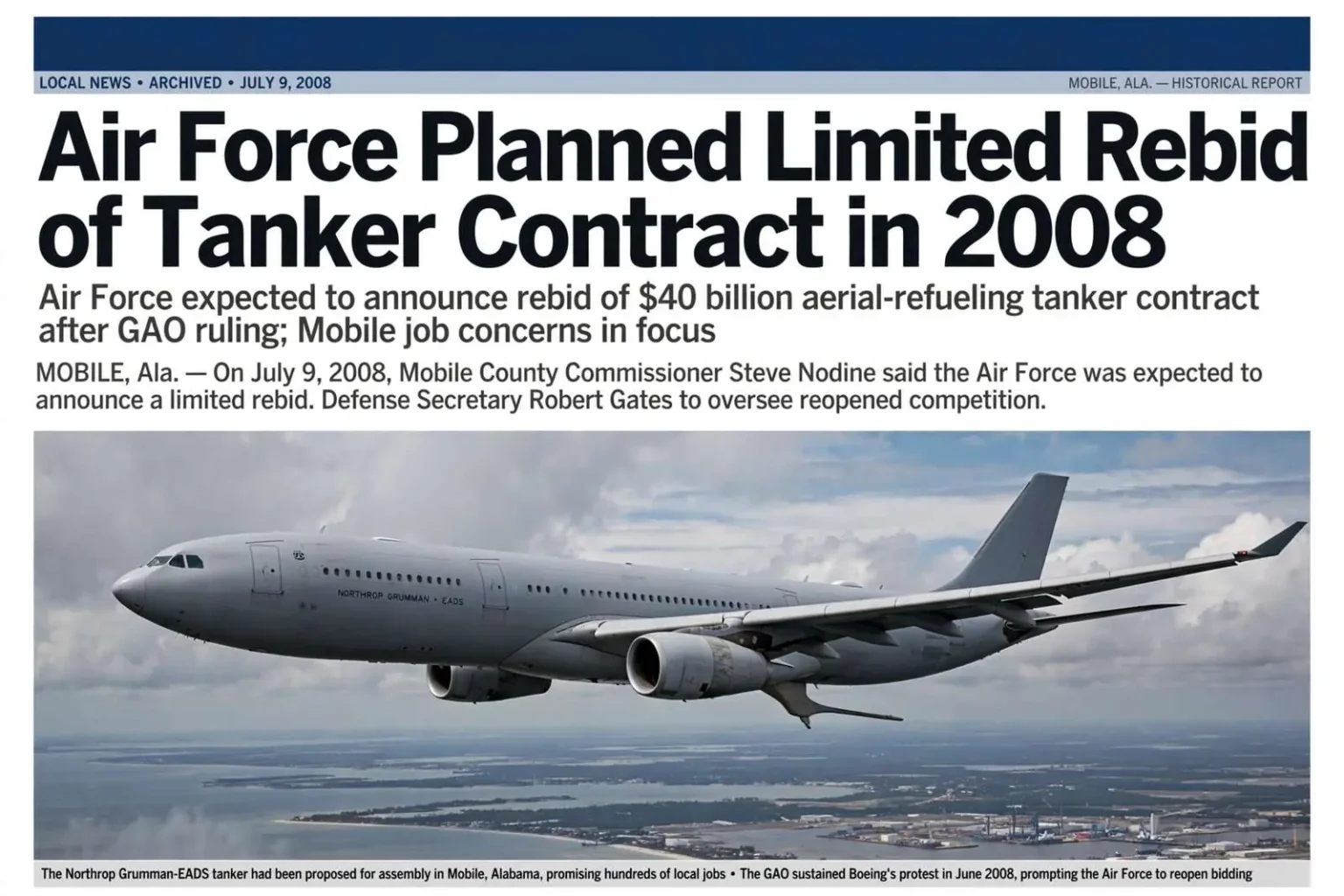
Aerial refueling aircraftAerial refueling aircraft.

Historical report, published from archived local news coverage.

MOBILE, Ala. — On July 9, 2008, Mobile County Commissioner Steve Nodine told the station that the Air Force was expected to announce a limited rebidding of its roughly $40 billion aerial-refueling tanker contract, the Pentagon procurement that had become the most closely watched defense award in the country and the center of Mobile’s economic hopes.

The contract had been closely watched in Mobile because of the potential role of Northrop Grumman and EADS and the possibility of aircraft work and jobs in the area. The partners had proposed assembling tankers in Mobile, and city and county leaders had staked considerable energy on winning the work for the Gulf Coast.

The station reported that official word was expected from Defense Secretary Robert Gates, whose department controlled the procurement and whose decision on how to proceed would shape the competition’s next chapter. An announcement of that kind, from the Pentagon’s top official, signaled how significant the program had become at the highest levels of government.

This historical report reflects the anticipated rebid announcement at that time. It does not describe the later procurement process or outcome, which unfolded over the years that followed through new rounds of bidding, protests and political debate.

Why the Tanker Contract Mattered to Mobile

The Air Force’s aerial-refueling tanker fleet, built around the aging KC-135, dated to the 1950s and had long been slated for replacement. The tanker recapitalization program, valued at tens of billions of dollars for the initial contract alone, represented one of the largest defense procurement opportunities in a generation, and wherever the work landed would gain thousands of jobs and an industrial foothold in aerospace.

Mobile’s bid to attract that work centered on the Brookley complex, the former Air Force base on Mobile Bay that the city had redeveloped into an industrial airfield. Local officials had spent years positioning Brookley as a site for aerospace manufacturing, and the tanker competition was the prize that could validate that strategy overnight.

Northrop Grumman and EADS, the parent of Airbus, had chosen Mobile as the site where their proposed tanker, based on an Airbus airframe, would be assembled if they won. The prospect of a European aerospace giant building American military tankers on the Gulf Coast generated both enthusiasm and controversy, drawing national attention to the city’s effort.

See also  Sharks Return to the Leaderboard as Alabama Deep Sea Fishing Rodeo Kicks Off 89th Year

For Mobile County’s elected officials, including Nodine, supporting the tanker bid was among the most visible economic development positions of the era. Commissioners, mayors and the area’s legislative delegation all worked to keep the project in play, courting company officials and touting the region’s port, workforce and industrial sites.

The estimated 40 billion dollar value of the contract covered only the first phase of what was expected to be a decades-long replacement of hundreds of tankers. The long-term opportunity, with follow-on orders and a supply chain of local vendors, was what made the competition transformative in the eyes of local planners.

The Competition That Gripped the Gulf Coast

The tanker contest primarily pitted the Northrop Grumman-EADS team against Boeing, which had built the existing tanker fleet and proposed a derivative of its 767 airliner. The rivalry between the two teams became one of the most contentious defense procurement battles in modern memory, fought through bid evaluations, congressional hearings and formal protests.

By the summer of 2008, the competition had already been through a full cycle: the Air Force had selected the Northrop-EADS tanker earlier that year, only to see the decision challenged and upheld on protest at the Government Accountability Office, which recommended reopening the bidding. That protest outcome set the stage for the limited rebid that officials anticipated in July.

A limited rebid, as discussed at the time, implied that the Air Force would adjust parts of its request rather than starting the competition completely over, a middle course between honoring the original evaluation and addressing the flaws the protest had identified. For Mobile, any path that kept the Northrop-EADS proposal alive was welcome news.

The stakes were understood in human terms across the region. Aerospace jobs pay well above regional averages, anchor supply chains that support thousands of additional positions, and signal to other manufacturers that a community can support high-tech industry. Local leaders spoke of the tanker work in generational terms, as an industry that could reshape Mobile’s economy the way shipbuilding and paper had in earlier eras.

The anticipation that summer was palpable in a city that had already lived through the ups and downs of the competition. Radio and television coverage tracked every development, and the possibility that the Secretary of Defense himself would announce the path forward told residents how much hung in the balance.

See also  Downtown Video of Bar Patrons Urinating, Vomiting Sparks Mobile Council Debate Over Nuisance Complaints

Mobile’s Aerospace Play: Brookley and Beyond

Mobile’s pursuit of the tanker work did not happen in a vacuum. The city’s economy had long rested on the Port of Mobile, shipbuilding at what is now Austal USA, chemical manufacturing and the forests and mills of south Alabama. Aerospace was the industry the city wanted next, and Brookley, with its long runways, bayfront acreage and aviation infrastructure, was the site that made the ambition credible.

The former Air Force base had closed in the base realignment rounds of the 1960s, and Mobile had spent decades converting the property into the Brookley Aeroplex, a civilian industrial airfield hosting maintenance, manufacturing and logistics firms. The tanker competition gave Brookley a flagship purpose, and the mere seriousness of the bid raised the site’s national profile.

EADS and Northrop Grumman had also weighed sites in other states, and Mobile’s selection as their proposed assembly location was itself a victory for the region’s recruiting effort. State and local incentives, training partnerships and the Port’s ability to move large aircraft sections by sea all factored into the case for the Gulf Coast.

County government’s role extended beyond cheerleading. Commissioners weighed incentive packages, infrastructure commitments and the long-term budget implications of landing a manufacturing complex, work that fell to officials like Nodine as the competition moved through its Washington stages.

The broader Gulf Coast aerospace cluster, stretching from the NASA facility at Stennis in Mississippi to shipbuilding and aviation firms along the coast, gave the region a credible story: a workforce already skilled in large-scale fabrication, with the ports and highways to support it. The tanker bid was the potential keystone of that story.

What a Rebid Meant for the Region

News that the Air Force was expected to announce a limited rebid carried mixed implications for the rival teams. A new competition meant renewed uncertainty, but for Mobile it also meant the Northrop-EADS proposal remained in the game, with the city’s assembly site still central to the bid.

Boeing, for its part, welcomed the reopening of the contest after its protest succeeded, arguing that the original request had been skewed toward a larger aircraft. The two companies’ competing airframes made the contest as much about the future shape of the tanker fleet as about where the jobs would go.

See also  Mobile Lands Bloomberg Grant to Build City Innovation Team

Congressional delegations from Alabama and Washington state took active roles, with members pressing the Air Force and the Defense Department on evaluation criteria. The politicization of the tanker contest became a defining feature of the program, and the anticipation of an announcement from Secretary Gates reflected the reality that decisions of that scale had moved to the Pentagon’s top echelon.

For workers and suppliers in Mobile, the cycle of announcements, protests and rebids was a lesson in defense procurement’s rhythms. Programs of that size rarely move in straight lines, and the summer of 2008 found the city seasoned in waiting for the next turn.

As officials awaited the expected announcement on July 9, 2008, the fundamentals had not changed: the Air Force needed new tankers, Mobile remained the proposed assembly site for one of the two contenders, and tens of billions of dollars in work, and thousands of jobs, waited on Washington’s next move.

Remembering the Tanker Era’s Local Impact

Whatever the eventual outcome, the tanker competition changed Mobile’s self-image and its economic trajectory. The city’s successful recruitment of major aerospace manufacturing in the years that followed built on the groundwork laid during the tanker fight, as site preparation, workforce training and international business connections made during the bid endured beyond the contest itself.

Archived reports like this one preserve the record of a period when a Pentagon contract dominated local conversation, when commissioners spoke of aircraft work in the same breath as the port and the shipyard, and when a $40 billion announcement was expected at any moment. The historical report reflects only what was known and anticipated on that July day, not the twists the procurement would take afterward.

For readers looking back, the episode remains a case study in how communities compete for transformative projects: the site, the incentives, the political advocacy and the patience to endure a competition that Washington would resolve on its own schedule.