Mobile County Investigated Reported Sexual Assault of Juvenile in 2008
An archived 2008 WKRG report said Mobile County deputies investigated a reported sexual assault of a juvenile in Wilmer and sought to question a man.
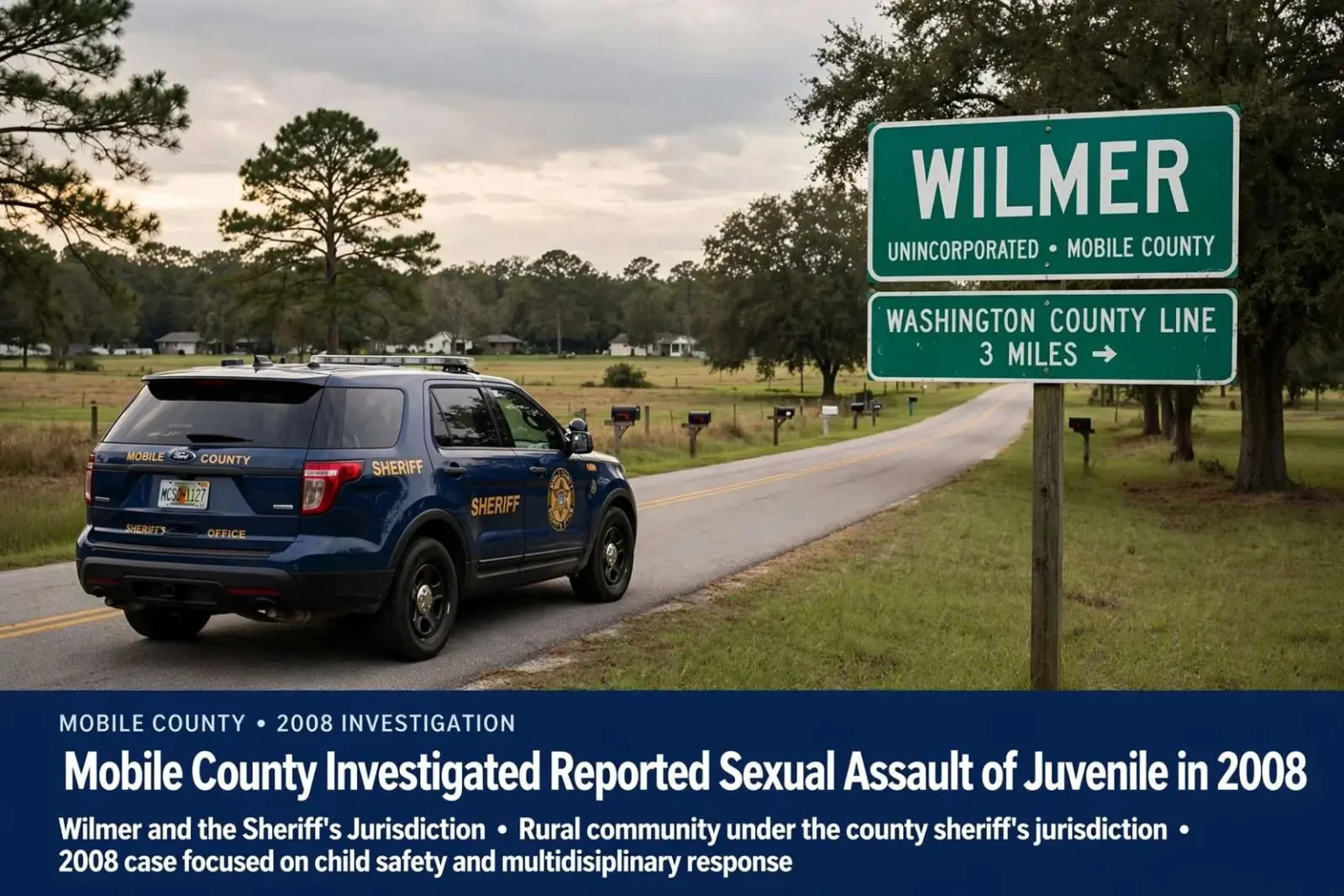
Wilmer and the Sheriff’s Jurisdiction
Wilmer is a rural community in the northwestern corner of Mobile County, near the Washington County line, where homes sit well back from two-lane roads and the nearest municipal police departments are a long drive away. Unincorporated communities like Wilmer fall under the primary jurisdiction of the Mobile County Sheriff’s Office, which fields patrol deputies across the county’s vast rural stretches and responds to 911 calls that would otherwise go unanswered for extended periods.
The Sheriff’s Office is the largest county law enforcement agency in Alabama, and its patrol, investigations, and special operations divisions cover everything from the city-adjacent suburbs of western Mobile County to the small settlements near the Mississippi line. For a reported crime against a child in Wilmer, the response in 2008 would have begun with patrol deputies securing the scene and speaking with the child’s family, before the case moved to the office’s investigators — detectives who handle crimes against persons, including the sensitive category of offenses involving juveniles.
Deputies responding to an allegation of this kind follow a protocol designed around the child’s welfare. The initial response focuses on the child’s immediate safety, medical needs, and separation from any suspected offender; forensic interviewing is typically conducted by specialists trained to question children without contaminating their accounts; and evidence collection proceeds under the understanding that cases involving juvenile victims may turn, months or years later, on the quality of that early work.
How Cases Involving Child Victims Are Handled
Alabama’s approach to reported child sexual abuse centers on a multidisciplinary model. Reports to law enforcement are generally coordinated with the county Department of Human Resources, which assesses the child’s living situation and safety, and with children’s advocacy centers — nonprofit facilities where forensic interviews, medical evaluation, victim advocacy, and therapy are delivered under one roof. The model exists to spare child victims the experience of repeating their account to a chain of strangers, a process that can retraumatize a young witness and degrade the evidence investigators depend on.
In Mobile County, that coordination draws on the region’s advocacy infrastructure and on prosecutors with the Mobile County District Attorney’s Office, who review investigative files to determine whether charges can be supported. Cases involving a child victim, an allegation made years after an event, or an offender known to the family present particular evidentiary challenges: there may be no witnesses beyond the child and the accused, physical evidence may be limited, and the defendant’s familiarity to the victim — which is common in these cases — can cut both ways, supporting testimony about opportunity while complicating questions of credibility.
These are among the reasons the outcomes of such investigations are often never public. An allegation reported to deputies does not automatically produce an arrest; an arrest does not automatically produce charges; and charges do not automatically produce a conviction. Between those stages sit the decisions of investigators, prosecutors, and, sometimes, grand juries — decisions that depend on evidence most of which is never described publicly, particularly when a minor’s privacy is at stake.
The response to a report like the one made in Wilmer also reaches beyond the criminal case itself. The child at the center of an allegation needs medical care, counseling, and a stable living arrangement while investigators work, and those needs fall to the family members, caseworkers, and advocates around the child rather than to the detectives building the file. Neighbors and extended family often carry much of that load quietly, which is one more reason accounts of such cases describe so little: most of what happens after the deputies leave is help, not headlines.
The 2008 case also illustrates the role that public appeals play in such investigations, and their limits. The original report included a contact request asking anyone with information to come forward — a standard tool when investigators believe witnesses or additional victims may exist. Such requests are necessarily time-limited, tied to an active investigative window, and they are not maintained as standing alerts afterward. That is why this preserved account does not reproduce the original contact information: it is no longer a valid or current channel, and its republication could mislead readers who encounter this article years later.
Why the Details Remain Omitted
The decision to omit identifying details is not cosmetic. Journalism and law enforcement practice both recognize that publishing specifics about cases involving child victims — names, exact locations, relationships, or descriptive details — can identify the child even when the child’s own name is withheld, and can impose lasting harm on a young person who already endured the crime and its investigation. Best practice is to report the category of the offense, the jurisdiction, and the response, while leaving out everything that serves only to satisfy curiosity at the victim’s expense.
The same restraint applies to the accused. The archived report described a man whom investigators sought to question but did not state that any charge was filed, and this account makes no claim about guilt, arrest, prosecution, or outcome. A person investigated but never charged has not been convicted of anything, and preserving that distinction matters both for the individual and for the accuracy of the historical record. Readers should understand the 2008 report for what it was: a snapshot of an allegation under investigation, published while investigators sought information — nothing more.
The Passage of Time and Older Cases
Reports from earlier decades carry their own context. Alabama law sets time limits — statutes of limitation — on prosecuting many offenses, and the limits for serious crimes against children have been repeatedly revised over the years, generally in the direction of longer windows as lawmakers and courts have come to understand how long child victims typically wait before disclosing abuse. Whether any particular older case can still be prosecuted depends on the offense, the dates involved, and the law in effect at the time, which is why an archived report cannot be read as a statement about anyone’s legal exposure today.
Time also changes the agencies and their capabilities. The Sheriff’s Office of 2008 operated before today’s widespread use of digital case management, expanded forensic interviewing standards, and the modern children’s advocacy center network that Alabama has since strengthened statewide. A case from that era was worked with the tools of its time, and readers judging it today should account for that distance.
The passage of years also reshapes what an archived story means to the place it describes. Wilmer today is a growing rural crossroads where new subdivisions have spread along the corridors toward Mobile, but it remains a community small enough that a report from 2008 can still be remembered by neighbors who lived there when deputies came. Reprinting the case without its identifying details honors both facts at once: the event was real, and the people involved — above all the child — are entitled to move past it without the archive pulling them back.
What Survivors and Families Can Do Now
The shift in how Alabama handles these reports since 2008 has been substantial, and it matters for anyone considering coming forward today. Mandatory reporting laws now reach a wide circle of professionals — teachers, healthcare workers, coaches, clergy in most circumstances — who are required by state law to report suspected child abuse to authorities, meaning a disclosure to almost any trusted adult in a school or clinic will set the system in motion. Children’s advocacy centers across the state coordinate the forensic interview, the medical check, and the family support from the first days of a report, and prosecutors increasingly build cases with the child’s experience in mind rather than requiring repeated tellings.
For anyone who experienced sexual abuse as a child — recently or long ago — the options available today are broader than they were in 2008. Reports can be made to local law enforcement, to the statewide child abuse hotline operated by the Alabama Department of Human Resources, or to the National Sexual Assault Hotline operated by RAINN, which connects callers to trained staff at a nearby crisis center and is available around the clock. Counseling and victim advocacy services across Mobile County serve survivors regardless of how long ago the abuse occurred, and advocacy centers accept adult survivors as well as children.
Reporting remains valuable even in cases that can no longer be prosecuted. Information held by survivors and witnesses has helped authorities identify patterns, protect other children, and close long-standing questions for families. And for the community reading an account like this one years later, the durable lesson of the 2008 Wilmer report is the one it was preserved to carry: an allegation was taken seriously, responded to, and investigated — and the privacy of the child at its center was treated as worth protecting, in 2008 and in every retelling since.