Historical report preserved from an archived 2008 local news story.
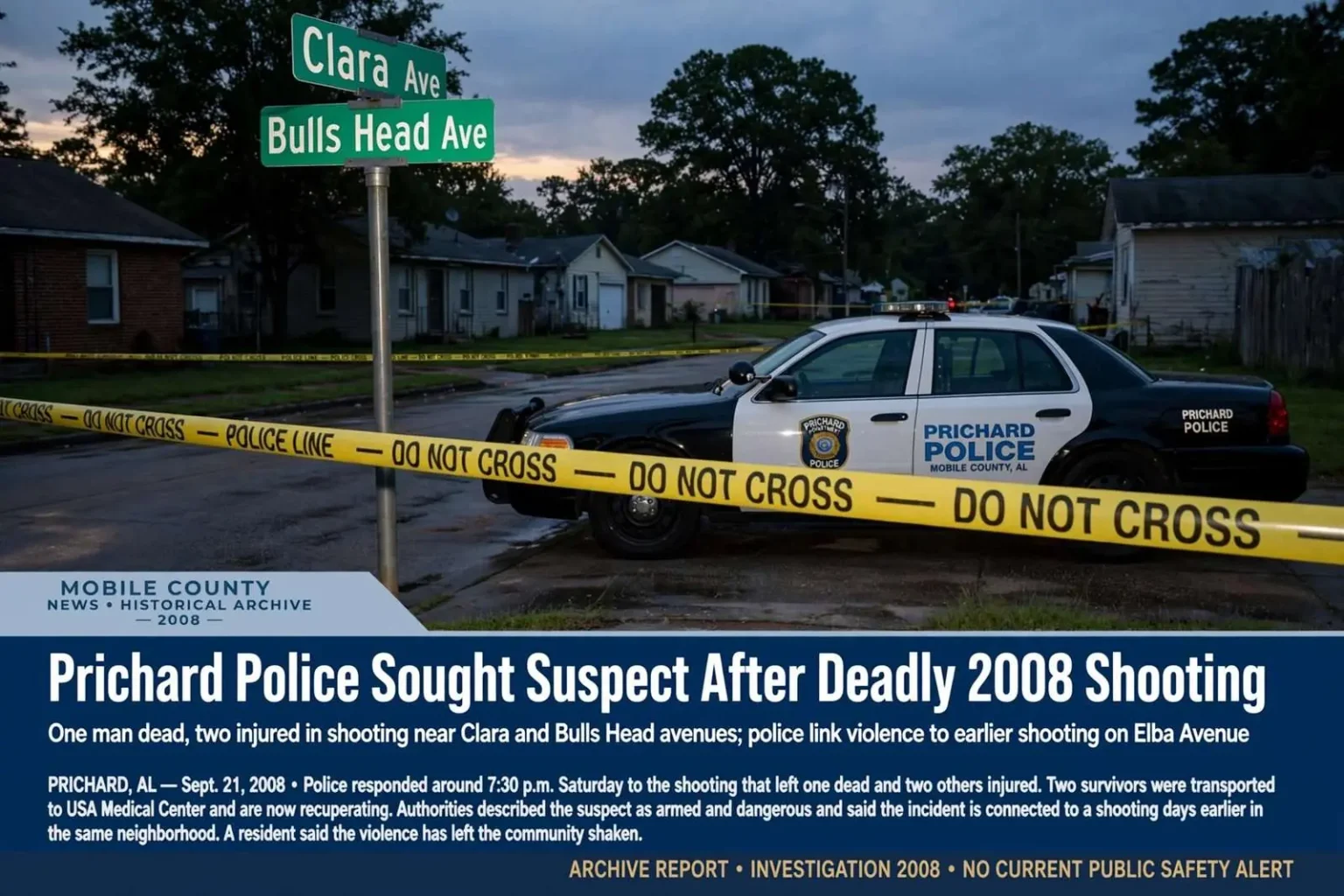
Prichard investigators said a shooting near Clara and Bulls Head avenues left one man dead and two others injured in 2008, a burst of violence in the Mobile County city that police quickly linked to another shooting days earlier in the same neighborhoods.
According to the archived report, police believed the shooting occurred around 7:30 p.m. on a Saturday along Clara Avenue and was connected to a previous shooting on Elba Avenue. The connection mattered to investigators: a pair of shootings in close succession and close proximity suggested a feud or retaliation cycle rather than random violence, and it shaped where police concentrated their search.
The two surviving victims were taken to USA Medical Center, and the victims’ names were not released in the report. The hospital, the teaching facility operated by the University of South Alabama, serves as the trauma center for the greater Mobile area, and victims of serious shootings from Prichard and the surrounding communities are routinely transported there for treatment.
The Scene on Clara Avenue
The intersection of Clara and Bulls Head avenues sits in the heart of Prichard’s residential grid, blocks of modest homes where gunfire on a Saturday evening draws neighbors onto porches and into the street within seconds. By the time officers arrived, the aftermath of the shooting had collected its audience: residents looking for the wounded, calling out information and, in many cases, deciding what they were willing to tell police.
A nearby resident said the violence had left her shaken. That reaction, fear settling over a block where a killing had just happened, is the residue investigators work against in the days after a homicide. Witnesses in dense neighborhoods often know who was involved and why, but saying so carries consequences, and cases in which names are not released and suspects remain at large reflect that tension between what police know and what the community will confirm on the record.
One injured victim, who asked not to be identified, told the station that he and another victim had left the hospital and were recuperating. The account offered a rare direct voice from inside the case, describing recovery rather than the events of the shooting itself, and its anonymity underscored the circumstances in which the survivors were speaking.
Prichard’s Context in 2008
Prichard, which wraps around the northern edge of Mobile, spent the 2000s wrestling with the fiscal and public safety strains that followed decades of industrial decline and population loss. Once a manufacturing and shipbuilding city that drew workers from across the Gulf Coast, Prichard entered the new century with a shrunken tax base, an aging housing stock and a police department working violent crime with limited resources. Shootings that would have mobilized a larger city’s full apparatus were, in Prichard, handled by a small detective division that depended heavily on regional cooperation.
The city’s neighborhoods, including the streets around Clara and Bulls Head avenues, are the kind of close-knit residential districts where violence lands hardest, in part because everyone knows everyone. A shooting connected to an earlier shooting on Elba Avenue, another residential street a short distance away, told residents the conflict was moving through their part of the city, and police urged anyone with knowledge of either incident to come forward.
The Search for a Suspect
Police said they were looking for a man in connection with the case and described him as armed and dangerous at the time. The warning served two purposes: it asked the public to report sightings rather than approach, and it told the community that investigators had developed a description, a sign that witnesses had begun talking despite the risks.
Homicide investigations in small departments lean on that cooperation. Detectives canvass door to door, re-interview witnesses and work with the Mobile County District Attorney’s office and neighboring agencies, and a suspect described as armed and dangerous is typically identified through some combination of witness accounts, physical evidence and the connections investigators had already drawn between the Clara Avenue and Elba Avenue shootings.
This historical account reflects the investigation and allegations reported then; it does not state any later case outcome or provide a current public-safety alert.
Retaliation Cycles and How Police Break Them
When investigators link two shootings, the linkage is not just descriptive; it drives the response. A connected pair of shootings means the risk of a third is elevated, and departments respond by increasing patrols in the affected neighborhoods, alerting patrol officers to watch for specific vehicles and people, and in some cases reaching out to people known to be close to the victims to head off retaliation before it happens. The archive’s report that police connected the Clara Avenue killing to the Elba Avenue shooting signals that detectives were working the case as a conflict with a history, not an isolated event.
That work happens fast. The first hours after a shooting produce the best information, shell casings that can be matched ballistically to other scenes, surveillance footage from nearby businesses and the initial statements of witnesses whose memories are freshest. A Saturday evening shooting on a residential avenue leaves a scene that officers document down to the positions of the wounded, and any tie to an earlier case turns two scenes into one investigation with shared evidence.
The victims’ silence, names unreleased and one survivor speaking only anonymously, is a familiar feature of these cases. Hospitalized victims and their families weigh cooperation against fear, and detectives respect the anonymity when they can, because a case built on forced disclosure rarely holds up in court and rarely wins the community trust that the next case will need.
USA Medical Center and the Region’s Trauma Pipeline
The transport of the two surviving victims to USA Medical Center reflects the geography of emergency medicine on the Gulf Coast. As the region’s trauma center, the hospital receives shooting victims from across Mobile County and beyond, and the survival of shooting victims often depends on the speed of that transport, how quickly EMS can reach the wounded, stabilize them and deliver them to surgical teams. Both survivors of the Clara Avenue shooting reached the hospital alive and, according to the survivor’s account, recovered enough to leave and continue their recuperation at home.
For police, the hospital is also an investigative post. Detectives interview surviving victims when their condition allows, and the accounts they give, or decline to give, become part of the record. The unnamed victim’s statement that he and another victim were recuperating told the public the men had survived their wounds; what it did not provide was an account of the shooter, a gap the department filled with its public description of a suspect considered armed and dangerous.
What the Archive Preserves
Preserved reports like this one serve a purpose beyond the original news cycle. They record, with dates and places, the events that shaped a community’s memory, the shooting near Clara and Bulls Head avenues, the connection to Elba Avenue, the search for an armed man, and the fear of the residents who lived through that Saturday evening. For researchers and residents looking back at Prichard’s history, the archive documents the city’s public safety struggles in the specific, human terms the original reporting captured.
This historical account reflects the investigation and allegations reported then; it does not state any later case outcome or provide a current public-safety alert.
Prichard’s Police Department Under Strain
The department working the Clara Avenue case in 2008 operated with a fraction of the resources of the neighboring Mobile Police Department, and the difference shaped how Prichard’s violent crime was handled. Detectives carried heavy caseloads, and the city’s budget pressures of the era, which included well-documented pension and fiscal troubles, limited overtime for investigations and the specialized units larger departments take for granted. Cooperation with the county sheriff’s office, Mobile’s detectives and federal partners filled some of the gap, and homicides in Prichard routinely drew assistance from across the county line.
Residents’ relationship with the department carried its own history. Trust built through solved cases and steady patrol presence, and eroded by the unsolved, is the currency a small department spends in a case like this one. The public appeal for help in identifying an armed and dangerous suspect, paired with the warning not to approach, was the department’s standard instrument: put the description out, give people a way to call in tips quietly and wait for the community’s help to arrive.
Saturday Night, Avenues and the Sound of Gunfire
The timing and setting of the shooting, a Saturday evening at the intersection of two residential avenues, put it at the hour when Prichard’s streets are busiest with family visits, porch gatherings and people coming and going between errands. Evening shootings on residential blocks leave the widest circle of potential witnesses: children in yards, drivers passing through the intersection, neighbors who heard the argument before the shots.
Investigators in such cases reconstruct the minutes around the gunfire from those fragments, and the archive’s report preserves the outline they assembled: a time, a location, a victim count and a suspected connection to a prior shooting on Elba Avenue. What the report could not capture, and what the neighborhood carried afterward, was the slower aftermath, the resident shaken on her block, the families of three victims, and the sense on surrounding streets that a conflict was moving through them.
Why the Details Stay Cautious
Every choice in the archived report reflects the caution of active investigations. Names withheld to protect the recovering victims. The suspect described only as an armed and dangerous man rather than by an unverified name. The connection between the two shootings stated as investigators’ belief rather than fact. These habits are how police and the reporters covering them write about cases whose conclusions had not yet been reached, and they are the reason the historical account ends with the disclaimer it carries.
This historical account reflects the investigation and allegations reported then; it does not state any later case outcome or provide a current public-safety alert.