Mobile Watched Possibility of a Split Tanker Contract in 2008
Archived WKRG coverage explored the possibility of a split Air Force tanker contract as Mobile awaited the 2008 decision.
Historical report, published from archived local news coverage. Days before the Air Force’s 2008 tanker decision, Mobile leaders were weighing the possibility that the contract could be divided between the Northrop Grumman/EADS team and Boeing, according to an archived local news report. The possibility of a split award loomed over one of the most consequential economic development contests in Gulf Coast history, with billions of dollars in work and thousands of jobs hanging on how the Pentagon structured the deal.
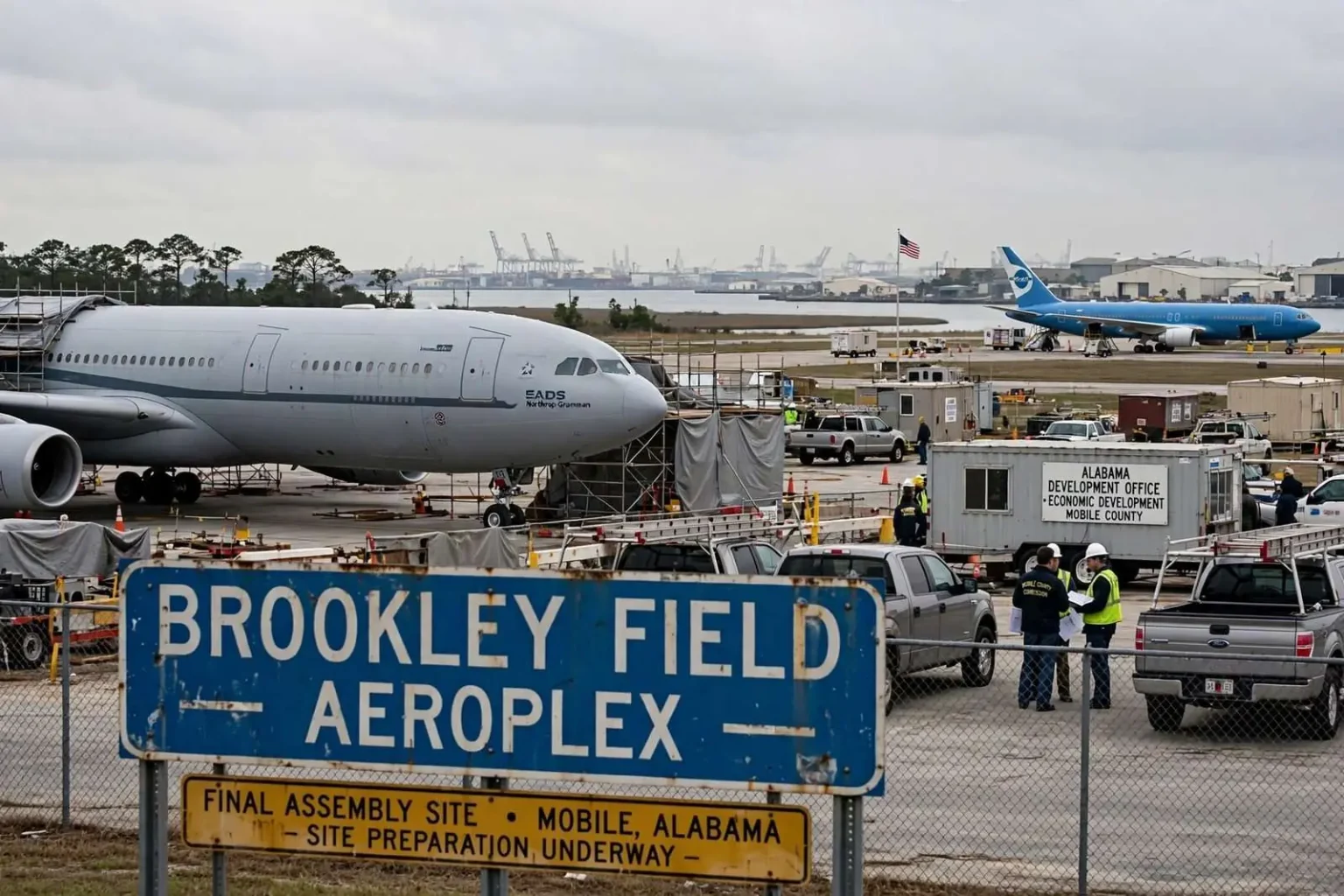
EADS and Northrop Grumman planned to build aircraft at Brookley Field in Mobile, while Boeing would build its planes in Washington state. The two teams had spent years competing for the award, and each had lined up political support, supply chains and workforce plans around the assumption that one winner would take all. A divided contract would have scrambled those preparations and forced both companies to think in terms of partial production and scaled-back facility plans rather than full programs.
Alabama Development Office Director Neal Wade said a split purchase had been discussed at an international air show, though he had also heard either company could win outright. His comments captured the uncertainty that gripped economic development officials in Mobile and across Alabama in the final days before the announcement. State and local leaders had invested years of courting in the Northrop Grumman/EADS bid, from recruitment visits to incentive packages, and they knew the difference between a full award, a partial award and a loss would shape the region’s aerospace ambitions for decades.
Political Calculations Around a Split
Mobile County Commissioner Steve Nodine said splitting the work might make political sense and could avoid a formal protest by the losing bidder. He noted that even a partial contract would still require facilities in Mobile. His observation reflected a belief shared by some local officials that any foothold in the program, however modest, would anchor an aerospace presence at Brookley Field that could grow over time through follow-on contracts, derivatives and commercial work.
The tanker competition had been contentious from the start. An earlier round of the contest had been awarded to Boeing, then overturned amid a procurement scandal that sent the contract back out for bid, opening the door for the Northrop Grumman/EADS team to propose its Mobile-based aircraft. The rebid drew intense scrutiny in Congress, where members from Washington state and Alabama each pressed the case for their favored team, and the prospect of a divided award was often floated as a compromise that could defuse the political fight and spare the Pentagon years of protest litigation.
The report said EADS had also announced plans to build commercial freight aircraft in Mobile if the city won the tanker contract. That pledge tied the military program to a broader industrial vision for Brookley Field, the former Air Force base that the city had been working to redevelop into an aeroplex since the base closed in the 1960s. Tanker assembly would have brought a military production line, while the freighter work would have added a commercial one, creating the kind of diversified aerospace manufacturing cluster that regions compete aggressively to attract.
What Was at Stake for Mobile
For Mobile, the stakes extended well beyond the factory floor. Officials projected that a winning tanker program would draw suppliers to the region, create thousands of direct and indirect jobs, and transform the city’s economic identity from a port and shipbuilding town into a broader aerospace hub. Community colleges and workforce programs were already beginning to align training with aerospace skills in anticipation of demand. The debate over a split contract was therefore not an abstract procurement argument; it was a discussion about how much of that future would arrive and how quickly.
The deliberations also illustrated how defense procurement decisions ripple far from the Pentagon. A decision made in Washington about aerial refueling tankers would determine land use at Brookley, hiring at Gulf Coast suppliers, school enrollment projections and real estate values in Mobile County. Local leaders followed every signal from the Air Force, from briefing schedules to congressional testimony, trying to read whether the award would be whole, split or delayed.
This is a historical account of options being discussed before the decision, not a report on the eventual outcome. The archived coverage preserves a snapshot of a community on the edge of a defining moment, when the mere possibility of a divided contract was enough to occupy the attention of the state’s top economic development officer and the county commission alike. It documents how Mobile’s leadership thought through contingencies at a time when the city’s aerospace future was anything but certain, and how even a partial win was viewed as a foundation worth having.
The tanker contest also exposed the tension at the heart of military procurement: the pull between buying the best-value aircraft and spreading the industrial benefit across congressional districts. Aerial refueling tankers are among the most heavily used aircraft in the Air Force inventory, supporting nearly every long-range mission, so the stakes of getting the replacement program right were high for the service as well as the bidders. Observers noted that a split award would carry its own costs, including duplicated training, maintenance and supply chains, which is why procurement professionals generally favored a clean single winner even as politicians weighed compromise.
Within Mobile, the anticipation was building at every level of the community. Business groups prepared expansion scenarios, workforce boards sized up training pipelines, and neighborhoods near Brookley Field watched for signs of construction. The airport-industrial complex at Brookley had long hosted aerospace tenants of modest scale, and the tanker program would have multiplied that activity many times over. Even leaders who counseled caution about rumors of a split acknowledged privately that any positive announcement, however structured, would change the trajectory of the region.
The archived report stands as a record of that waiting period, when the question was not simply whether Mobile would win, but what shape a win might take. It captures the pragmatic streak in the city’s leadership: Commissioner Nodine’s point that even partial work requires Mobile facilities, and Wade’s acknowledgment that either outcome he had heard about involved the city in some fashion, reflected officials ready to make the most of whatever the Air Force decided. That readiness, cultivated through years of chasing aerospace work, proved to be an asset in itself for a community determined to build an industrial future around its deepwater port, its airfield and its skilled workforce.
Understanding the 2008 deliberations requires a look at the aircraft themselves and the facilities each team proposed. The Northrop Grumman/EADS entry was based on a wide-body airframe that would have been assembled at a new final assembly line at Brookley Field, a site with runway access, deepwater port proximity and room to expand along Mobile Bay. The Boeing entry relied on a smaller, derived airframe built in Washington state, where the company’s commercial manufacturing base already stood. Each proposal carried different promises for Alabama: one put final assembly, supplier growth and a permanent industrial footprint inside the state; the other left Alabama with little more than the prospect of scattered subcontract work.
The Air Force’s earlier conduct in the competition had taught local leaders not to assume anything. The first award, handed to Boeing, was voided after federal investigators documented procurement misconduct, and the subsequent rebid rewrote the requirements and reopened the field. That history meant that even in the final days before the 2008 decision, officials like Wade and Nodine were hearing conflicting signals from Washington and from industry contacts at air shows and briefings. A split purchase, once considered a long-shot scenario, had become plausible enough that Mobile’s leadership actively war-gamed what it would mean for the city’s recruitment pitch and infrastructure plans.
For the broader Alabama economy, the tanker program represented the kind of anchor project that state recruiters had sought since the state landed its first major automotive assembly plants a generation earlier. Auto manufacturing had shown Alabama how a single flagship investment could pull an entire supplier network across state lines, and aerospace leaders hoped a tanker award would do the same for aviation, adding engineering, composites and systems integration capability to the state’s industrial mix. The possibility that the Air Force might split the award raised hard questions about whether a partial program would generate the same gravity, or whether suppliers would hold back until they knew a full production line would operate in Mobile for decades.
The uncertainty also rippled through Mobile’s civic conversation, from chamber of commerce gatherings to radio call-in shows, where residents debated the merits of each bid with the familiarity of people who had followed every twist of the competition. Newspaper archives from the period are filled with coverage of supply-chain prospects, wage estimates and site plans, a measure of how completely the tanker decision had come to define the city’s economic outlook. Whether the contract ultimately arrived whole, divided or not at all, the community had already organized itself around the pursuit of aerospace work, and that preparation shaped how Mobile approached every industrial opportunity that followed.