Confederate Flag Raised Along I-10 Near Grand Bay Sparks Public Backlash
A large Confederate flag raised along a roadside flagpole on Interstate 10 near Grand Bay has touched off a heated public dispute over heritage, race and free expression in Mobile County.
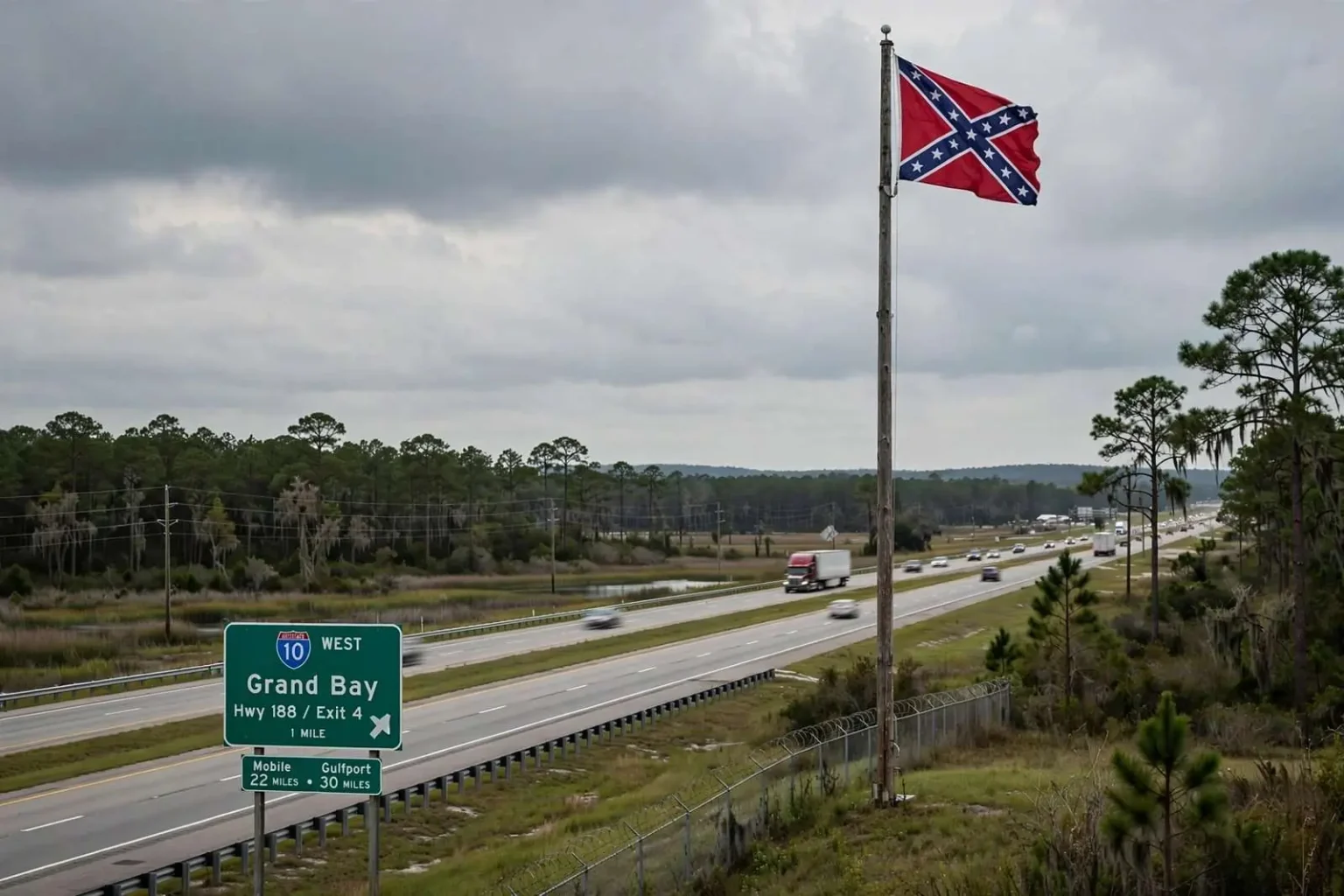
A large Confederate flag flying from a tall roadside flagpole along Interstate 10 near Grand Bay has become the center of an increasingly heated public dispute in Mobile County, with residents divided over whether the display honors Southern history or serves as a provocation along one of the region’s busiest highway corridors. The flag, visible to thousands of drivers passing through the southwest corner of the county each day, has turned a stretch of rural roadside into one of the most talked-about sites in the area.
The flag was put up by Dr. Ben George, joined by a group of supporters, according to accounts from those who have followed the dispute closely. George has defended the display as an effort to preserve Southern history and has pushed back hard against critics who argue the flag carries different, more troubling connotations for much of the public.
Why the Location Amplifies the Fight
Opponents of the display say its location along I-10, a highway traveled by thousands of motorists a day, transforms what supporters call a historical tribute into something closer to a statement aimed at provoking a reaction. Interstate 10 is the Gulf Coast’s main east-west artery, carrying commuters, commercial trucking and tourists between Mobile, the Mississippi state line and points beyond, and the corridor near Grand Bay is among the first stretches of Alabama many cross-border travelers see.
Critics argue the flag remains closely associated in the minds of many Americans with segregation and racial hostility, regardless of the intent behind flying it. In their view, a flag on private property far from public view is one thing; a banner hoisted where it cannot be avoided by anyone driving the highway is another, because it effectively broadcasts a message to every passerby without their consent.
The Dispute Turns Personal
The disagreement has grown personal at times. George has reportedly telephoned at least one vocal critic directly to defend the flag, at one point accusing detractors of being “cultural bigots.” He has also argued that if a young person wearing Confederate-themed clothing, such as a Dixie Outfitters shirt, were ever harmed because of it, responsibility for that violence would rest with people who publicly criticize the flag rather than with whoever committed the act.
That argument has drawn sharp pushback from opponents, who say any blame for hypothetical violence would fall solely on the person responsible for it, not on those raising objections to a roadside flag. They also describe the scenario George has raised as highly unlikely to ever occur. The exchange illustrates how far the debate has traveled from the flagpole itself, into arguments about blame, speech and who bears responsibility for how symbols are received.
Debates over Confederate symbols have followed this pattern across the South for years. Defenders generally frame the flag as heritage — a marker of ancestry, sacrifice and regional identity — while opponents point to its history: raised again during the civil rights era as a statement of resistance to desegregation, and adopted since by groups espousing racial hatred. Both framings cannot occupy the same flagpole at once, which is why disputes like Grand Bay’s rarely settle into quiet compromise.
Public Comment Runs in Both Directions
The dispute has generated a steady stream of reader mail and public comment running in both directions. Some writers have defended the flag as a matter of heritage and free expression, arguing residents have every right to display it on private property along the interstate. Others have denounced the display as unnecessary and inflammatory, saying it does little more than stir resentment.
The legal reality underlying those arguments is straightforward: a flag flown on private land, meeting ordinary zoning and safety rules, is generally protected expression, and opponents’ recourse is persuasion rather than prohibition. That gap between legal permission and public acceptance is precisely where the Grand Bay fight lives, with neither side contending the display is illegal, and each contending the other has misjudged what it means.
History Versus Highway: The Setting Argument
Several longtime observers of the debate say they have no objection to the Confederate flag appearing in a clearly historical setting, such as a museum exhibit or a cemetery marking Civil War dead. They argue a working flagpole along a major interstate is a different matter entirely, saying the display feeds outside perceptions of Alabama as resistant to putting its Civil War-era symbols in the past.
That distinction — context as the dividing line — has become the most common middle position in battles over Confederate iconography. A battle flag in a battlefield museum presents history; the same flag circling above a highway presents a claim, and viewers supply their own reading of what claim is being made. Mobile County’s economy depends heavily on tourism, port commerce and corporate investment, and some residents argue the region cannot afford imagery that gives visiting executives and prospective industries pause before they even reach the city limits.
Grand Bay itself is a small, close-knit community in southwest Mobile County, an unincorporated area shaped by farming, fishing and its position along the old coastal routes between Mobile and Mississippi. Residents there, like their neighbors across the county, have watched the flag become something larger than the pole it flies from — a local landmark that now carries meaning assigned to it by every motorist who passes.
A Familiar Fight in an Unfamiliar Place
Alabama has seen this argument repeatedly in recent decades, from legislative fights over historic flags at the state capitol to disputes over school mascots, monuments and license plates. What makes the Grand Bay case distinctive is its medium: a private flagpole, standing high enough to command the interstate right-of-way view, in an era when a single photograph can carry the image to an audience far beyond the drivers who see it in person.
Social media has amplified the dispute, as photos of the flag circulate alongside arguments rehearsed in comment sections across the state. What might once have remained a neighborhood disagreement becomes a regional referendum, with participants who have never driven the stretch of I-10 in question weighing in on both sides.
No Resolution in Sight
As of this writing, the flag remains standing along the I-10 corridor near Grand Bay, with no resolution in sight to a dispute that touches on some of the most sensitive fault lines in Alabama’s history: regional heritage, race relations and how the state is perceived by the rest of the country.
Neither side shows signs of backing down. George and his supporters regard the flag as a statement of identity that they are entitled to make, and the critics who have organized against it show no intention of letting the display pass without objection. The result is a standoff that has settled into the landscape, as fixed in its way as the flagpole itself.
What the Dispute Says About the Region
The fight near Grand Bay is, at bottom, an argument over audience. Supporters fly the flag primarily for those who share their reading of it; opponents measure it by the widest possible audience — every driver on I-10, including the many for whom the flag signals exclusion. Between those two definitions of who the flag is for lies most of the distance the two sides have proven unable to bridge.
Mobile County’s history gives the argument particular resonance. The region’s economy and identity were shaped by the cotton and timber trades, the port, shipbuilding and the civil rights struggles that followed, and its population today is more diverse than the imagery along its highways sometimes suggests. How the community resolves — or fails to resolve — the question of what belongs on that flagpole will say something about how it understands its own past and its own future.
For now, the flag flies, the letters and comments keep arriving, and the drivers keep passing beneath it. The dispute stands as a reminder that in south Alabama, history is not only preserved in museums and markers; it is contested in real time, along roadsides where anyone with a flagpole and conviction can raise the argument for all to see.
The Heritage Defense, and Its Limits
Defenders of the Grand Bay flag have leaned on arguments familiar from similar disputes across the South: the flag represents the courage of ancestors, regional identity and a refusal to let others define Southern memory. George’s framing as a defense of Southern history places him in that tradition, and his supporters argue that criticism of the flag amounts to an attempt to shame ordinary residents for their heritage.
Opponents respond that heritage claims do not settle the question of meaning, because symbols carry the history of how they have been used, not just how their current defenders wish them to be seen. A symbol reintroduced in the twentieth century as a banner of massive resistance carries that record with it, they argue, no matter the intent of the person raising it now.
The impasse is familiar: each side believes the other is arguing in bad faith, and the terms of the debate — heritage versus hate, history versus provocation — repeat themselves in comment threads and letters without moving either party. The Grand Bay flagpole has become, in effect, a standing staging ground for an argument the region has been having for generations.
Private Property, Public View
One thread of the debate concerns the relationship between private property and public space. Supporters note that the pole stands on private land and that the owner’s right to fly it is not seriously in dispute. Opponents concede the legal point but argue that visibility creates a public dimension no property line can contain: a message unseeable by choice, imposed on every driver, is functionally public speech whether or not it flies over public ground.
That tension is not unique to this dispute. Communities across the country wrestle with displays that are lawful but contested, and the usual resolution is neither law nor litigation but time, turnover and shifting public sentiment. Whether that process is underway along I-10 near Grand Bay is exactly what the two sides dispute.