Mobile County Landline 911 Fee Jumps Nearly 400 Percent, but Officials Call It Temporary
Mobile County landline customers will see their monthly 911 surcharge jump from $1.24 to $4.75 through September, a temporary increase county officials say is needed before the state takes over 911 fee collection statewide.
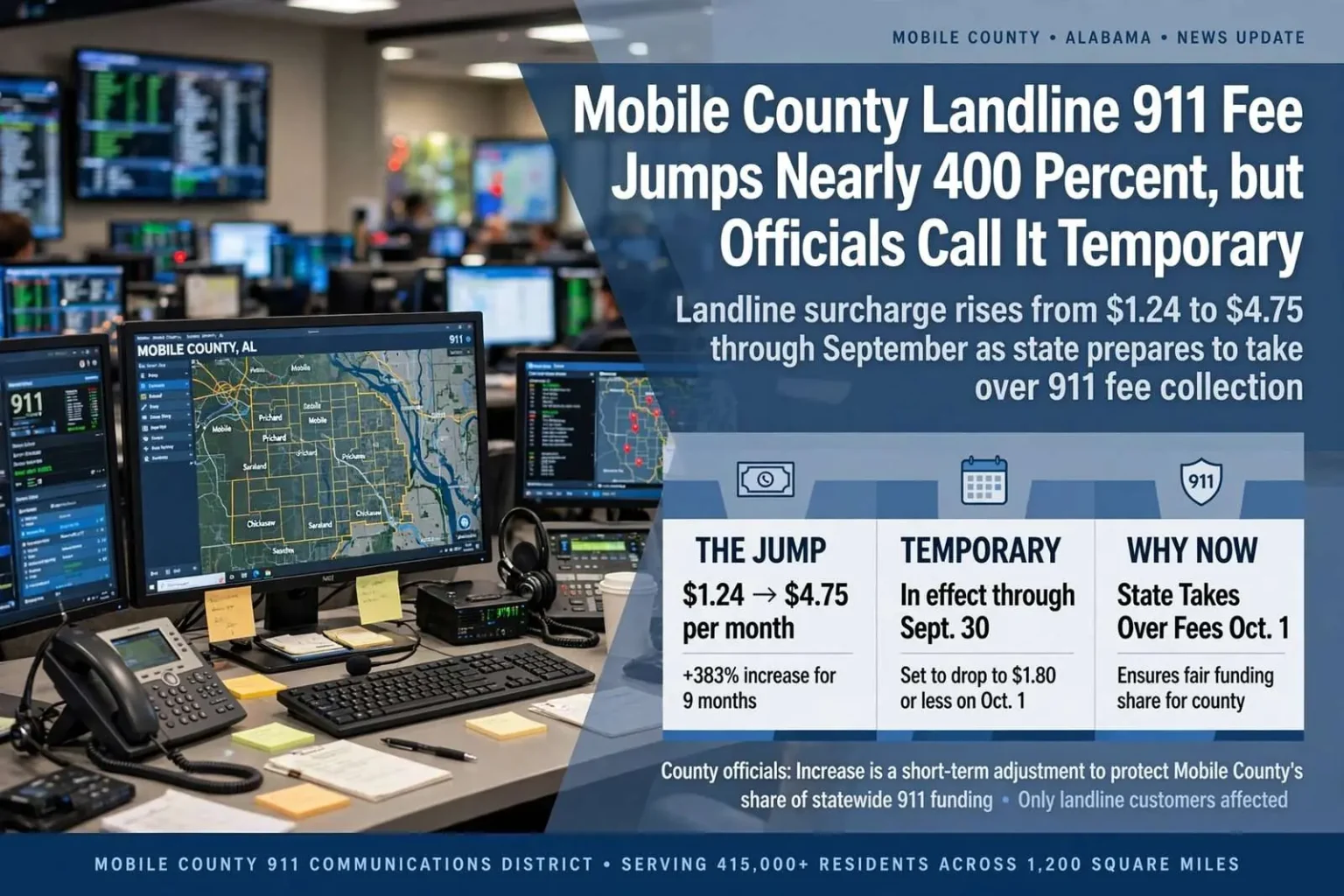
Landline customers across Mobile County are seeing a steep, if short-lived, jump in the 911 surcharge tacked onto their monthly phone bills. The monthly fee has climbed from $1.24 to $4.75, an increase of roughly 383 percent, as the state prepares to take over collection and distribution of 911 fees statewide.
Mobile County Communications District Director Gary Tanner said the spike is not a permanent rate hike but a one-time adjustment tied to the creation of a new state 911 Board, which is set to assume responsibility for collecting and disbursing 911 fees from local emergency communications districts across Alabama. The higher landline rate is scheduled to remain in place through the end of September before dropping back down.
Why a Bill Goes Up to Come Down
According to Tanner, the state plans to calculate each district’s future funding allocation based on how much money was collected locally in the nine months leading up to the takeover. Because of that formula, districts like Mobile County’s raised their local rates temporarily to establish what Tanner called a “base distribution amount,” ensuring the county continues to receive an appropriate share of state-administered 911 funding once the new system takes effect.
The mechanics are easier to understand with the outcome in mind. When a state authority assumes a funding stream, it needs a benchmark for how much each region was generating under the old system; without one, allocating the pool becomes a political fight. Alabama’s answer was to measure each district’s actual collections in the months before the switch, which created an unintended incentive: a district that left its old rate in place would lock in a base calculated on the lower figure. Mobile County’s board chose to pay the arithmetic — raising the local surcharge for nine months — rather than accept a permanently smaller share of the state’s distribution.
Once the state assumes control on Oct. 1, Tanner said, the surcharge on Mobile County landlines is expected to fall to $1.80 a month or less. Cell phone users, who were previously charged a flat 70-cent monthly 911 fee compared to the $1.24 landline rate, will eventually see rates unified under a single flat structure for both landlines and cell phones, though the exact figure won’t be finalized until the state Oversight Committee meets again on April 4.
The unification closes a gap that had grown untenable. The old structure charged wireless users less because, in the era when the fees were set, wireless service was a luxury and landlines carried the cost of the system. Decades later the relationship had inverted — most 911 calls now originate on mobile phones, and landline subscribers have dwindled to a base made up disproportionately of older and lower-income households. Charging the shrinking group more than the growing one was, as the consolidation debate acknowledged, a declining and regressive model.
The Oversight Committee’s April meeting is where those numbers harden into rates. Until then, customers see only the most visible part of the transition — the September spike — and county officials have been explaining the mechanics to anyone who calls about the bill.
A Decade-Long Push to Consolidate
Tanner said the push to consolidate 911 fee collection under a single state authority has been building since 2010, driven largely by concerns from smaller emergency communications districts that lacked the resources or consolidation of larger, more efficient operations like Mobile County’s. He said a Mobile-area legislative delegation resisted the change for several years before the measure was ultimately adopted.
“We have a great operation and everything was fine,” Tanner said. “As I understand it, the smaller emergency communications districts had some issues with the lack of consolidation. Some counties have two or three 911 centers, and there are some big players to subsidize. Jefferson County has 17 different operations centers.”
The contrast explains both the reform and the resistance. Alabama’s 911 districts were created one county at a time over decades, each with its own board, its own fee and its own arrangement with the telephone companies — a patchwork that worked adequately where local operations were strong and strained where they were not. A county running multiple centers for one population base divided dispatch authority, duplicated equipment and, in the view of reformers, wasted the fee revenue that ratepayers had been charged for a single public safety purpose.
The Mobile-area delegation’s resistance was, by Tanner’s account, a defense of local control. Districts that had managed their systems well — and Mobile County’s was routinely cited among them — had little to gain from ceding fee collection to Montgomery and something real to lose: the ability to set rates to local needs, hire to local standards, and spend on local priorities without a statewide formula in between. The eventual legislation preserved the districts as operating entities while transferring the money plumbing to the state, a compromise that left both camps with half the argument.
One Center for 1,200 Square Miles
By contrast, the Mobile County 911 Center operates as a single consolidated hub, handling dispatch for police, fire and EMS calls across the entire county and all of its municipalities. Tanner said the center serves an estimated 415,000 residents at any given time, along with as many as 150,000 additional people who may be passing through the county’s roughly 1,200 square miles on a given day.
Consolidated dispatch is the model most emergency communications professionals advocate, and Mobile County adopted it early. A single center means a cellular caller who dials 911 anywhere in the county reaches the same dispatchers regardless of whether the emergency falls inside Prichard, Saraland, Chickasaw or unincorporated territory — no transfer, no jurisdictional pause, no chance for a critical address to be lost between centers. It also means police, fire and medical responses are coordinated by one room rather than negotiated between three, which matters most on exactly the calls where seconds count.
The population figure Tanner cited understates the center’s true workload. A county that contains the port of Mobile, a major interstate junction, a regional airport and a tourist corridor carries a daytime population well above its census count, and every one of those additional people generates emergency calls that the local fee base pays to answer. Dispatch volume does not respect the boundary between residents and visitors; the funding has to cover both.
Running that operation on a 911 surcharge also illustrates what the fee actually buys. Call-takers and dispatchers work around the clock in shifts; the center’s technology — the mapping, radio consoles and computer-aided dispatch systems that translate a caller’s words into an ambulance’s destination — requires continuous maintenance and periodic replacement. The surcharge is the dedicated revenue that keeps that machinery staffed and current, which is why the county fought to protect its share of it.
What It Costs the Ratepayer
Tanner framed the temporary increase in practical terms for ratepayers. “It amounts to about 10 cents a day for nine months, but that number will be reimbursed each year for the next five years when we receive the funds from the state,” he said.
The reimbursement promise is the part of the arrangement most likely to be forgotten by the time it arrives. Because the district’s base amount was calculated on collections that included the elevated surcharge, the state’s formula will return the difference to Mobile County over the distribution years that follow — meaning the nine months of higher bills function, in the county’s telling, as a short-term loan to the transition rather than a permanent cost. Whether every ratepayer experiences it that way depends on the state board holding to the formula, which is precisely why district officials tracked the rulemaking so closely.
For customers, the practical guidance was simpler: check the September bill, expect the adjustment, and expect the lower — and, for landlines, still-higher-than-wireless — rate to appear in October. The jump from $1.24 to $4.75 drew the attention; the return to $1.80 or less was the point of the exercise.
What the State Board Inherits
The new state 911 Board takes on a task that is administrative in appearance and consequential underneath: collecting fees from carriers, distributing them by formula, and setting the standards that formerly varied from district to district. Centralization offers smaller districts an upgrade path — access to statewide purchasing power, consistent training standards, and interconnection between centers — while offering large districts, in theory, insulation from the fee erosion that occurs when wireless carriers’ reporting lags or fails.
Fee collection has, in fact, been the quiet problem beneath the consolidation debate. 911 surcharges are remitted by telephone companies, and the explosion of prepaid wireless plans — sold in cash at convenience stores, often without the surcharge being collected or passed through — has cost emergency communications systems across the country revenue that their funding formulas never anticipated. A statewide collection authority is better positioned than a county district to audit carriers and pursue uncollected fees, one of the less-advertised arguments for the switch.
County officials say residents should expect the higher rate to appear on landline bills only through the transition period, with the flat statewide rate structure taking hold once the state Oversight Committee finalizes its plans in the coming weeks.
When that happens, Alabama will have moved from one of the more fragmented 911 funding maps in the country to a single structure, and Mobile County — which entered the process with the kind of consolidated operation other counties were urged to emulate — will have traded a rate it controlled for a share of a pool it helped to size. The nine-month spike on the county’s landline bills is the visible transaction in that exchange: a temporary charge, by design, to protect a permanent investment in the system that answers when residents call for help.