Six Lakes, One Waterway: A Guide to the Black Warrior-Tombigbee River System
The Black Warrior-Tombigbee Project Office manages six lakes spanning roughly 457 miles from Birmingham to Mobile, offering navigation, hydropower and a wide range of outdoor recreation.
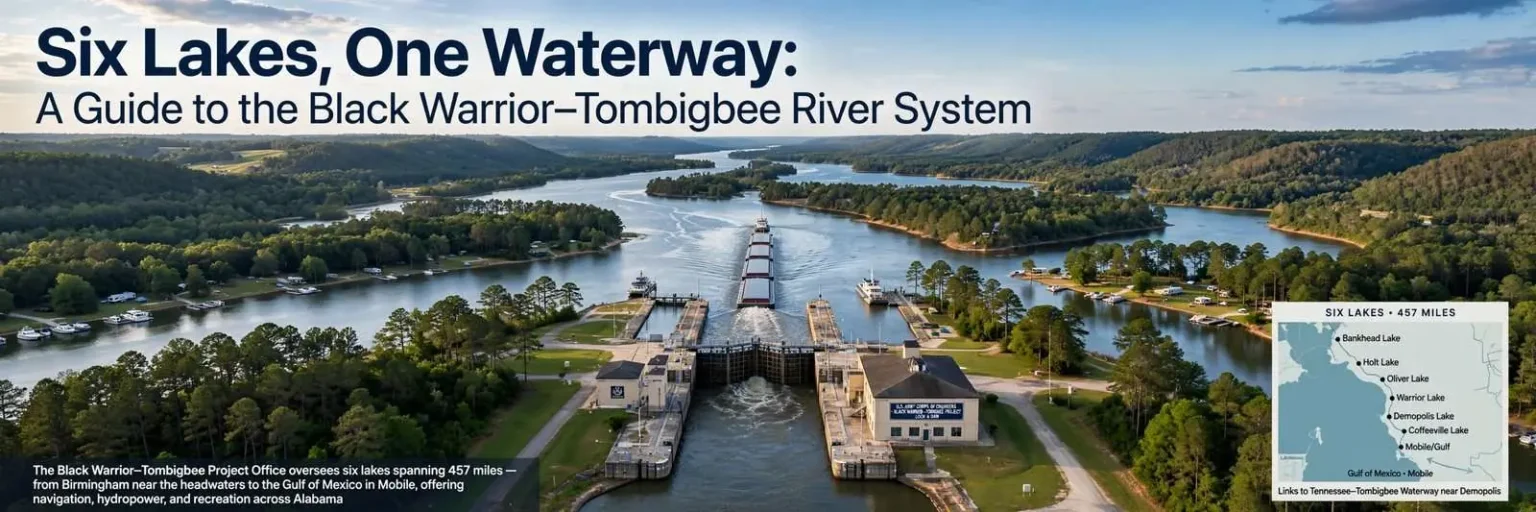
The Black Warrior-Tombigbee Project Office, part of the U.S. Army Corps of Engineers' Mobile District, oversees six lakes that together form one of the most extensive inland waterway systems in the Southeast. Bankhead, Holt, Oliver, Warrior, Demopolis and Coffeeville lakes stretch roughly 457 miles from the headwaters near Birmingham south through Tuscaloosa and Demopolis to the Mobile District's southernmost facility below Coffeeville, ultimately reaching a confluence with the Gulf of Mexico in Mobile.
Beyond their role in commercial navigation and hydropower, the lakes have become a hub for regional recreation, offering boating, fishing, camping, hunting, hiking and sightseeing across a system that spans hundreds of miles of Alabama.
A Waterway More Than a Century in the Making
The Black Warrior and Tombigbee rivers have shaped the development of the basins around them for generations. The Black Warrior basin sits amid some of the most heavily industrialized territory in the Southeast, while the Tombigbee basin has remained largely agricultural.
Long before locks and dams existed, explorers, traders and settlers used the rivers as natural highways, and the strategic location of Mobile as a port for the inland river system played a significant role in the city's early growth. The 19th-century boom in cotton cultivation, paired with the invention of the paddlewheel steamboat, further fueled trade along the rivers. Formal efforts to improve the waterway for navigation began in 1875, when the first improvement plans were approved.
Between 1895 and 1915, crews built a system of 17 locks and dams between Mobile and Birmingham using methods that would seem primitive by today's standards: dams built by hand from stone and mortar, locks walled with stone-filled timber cribs, and mule power used for hauling. Those original structures created a six-foot-deep channel, enough for the steam-powered tow boats and packets of the era. The system underwent a major modernization starting in 1937, when the Corps of Engineers replaced the 17 low-lift locks with six high-lift locks engineered to handle modern towboats and barges.
Depending on location, those locks can raise or lower vessels anywhere from 22 to 69 feet, and the nine-foot-deep navigation channel is maintained at a width of 200 feet, wide enough to accommodate tows of up to eight standard barges. Today, the waterway runs approximately 457 miles, and every original lock and dam has since been replaced with one exception: the John Hollis Bankhead Dam on the Black Warrior near Birmingham, which has itself been modernized and fitted with a new lock to bring it in line with the rest of the system.
Six Lakes, Six Different Characters
Coffeeville Lake, the system's third largest, covers 8,800 acres and stretches 97 miles. A modern campground sits at Service Park just west of the town of Coffeeville, and the Corps has licensed about 4,000 acres of the lake to the U.S. Fish and Wildlife Service for the Choctaw National Wildlife Refuge, which is managed primarily for migratory waterfowl. Several day-use areas are also located on Coffeeville Lake.
Demopolis Lake, located at the confluence of the Black Warrior and Tombigbee rivers near Demopolis, is the largest in the system at 10,000 acres, extending 48 miles up the Black Warrior and 53 miles up the Tombigbee. It offers two modern campgrounds, numerous day-use facilities, primitive camping areas and a full-service marina.
Warrior Lake sits six miles from Eutaw and covers 7,800 acres across 77 miles. It was formed by the Armistead I. Selden Lock and Dam, completed in 1962, and the Corps manages seven day-use parks along its shoreline that provide public access to the water.
Oliver Lake, created by the William Bacon Oliver Lock and Dam, is smaller and more compact — nine miles long with about 1,000 surface acres — with recreational development limited to boat launches and day-use areas located within the Tuscaloosa city limits and managed by the Tuscaloosa County Park and Recreation Authority.
Holt Lake, a narrow, winding 18-mile lake with 3,200 surface acres, lies six miles northeast of Tuscaloosa and was formed when the Black Warrior River was dammed in 1966. It offers camping options ranging from primitive to fully developed, complete with park attendants for security and information, water and electric hookups, and a camper washhouse.
Bankhead Lake, the system's northernmost project, stretches 65 miles and covers 9,100 surface acres, including the Locust and Mulberry forks up to the head of navigation. Unlike the other lakes, development around Bankhead is entirely private or commercial, with several marinas and fish camps offering boat docking and storage, fueling facilities, boat repairs, launching ramps, food and supplies. The Corps of Engineers does not operate developed recreation areas at Bankhead Lake.
A Note for Visitors
All Black Warrior-Tombigbee campgrounds are transitioning to cashless payment systems, according to the Black Warrior-Tombigbee Project Office. Information is currently available covering the southern section of the waterway system, with additional details about the northern section expected to be released soon.
Connection to the Tenn-Tom
The Black Warrior-Tombigbee system also links to the Tennessee-Tombigbee Waterway, the 234-mile Corps of Engineers navigation channel that opened in 1985 and meets the Tombigbee near Demopolis. That junction gives barge traffic a route between the Port of Mobile and the Tennessee River, and from there to the wider inland waterway network.