Brookley Groundbreaking Was Planned as 2008 Tanker Protest Continued
Archived WKRG coverage described planned 2008 Brookley construction milestones while the Air Force tanker award remained under review.
Historical report, published from archived local news coverage. This article describes plans and timelines as they stood in 2008, not the project’s later outcome.
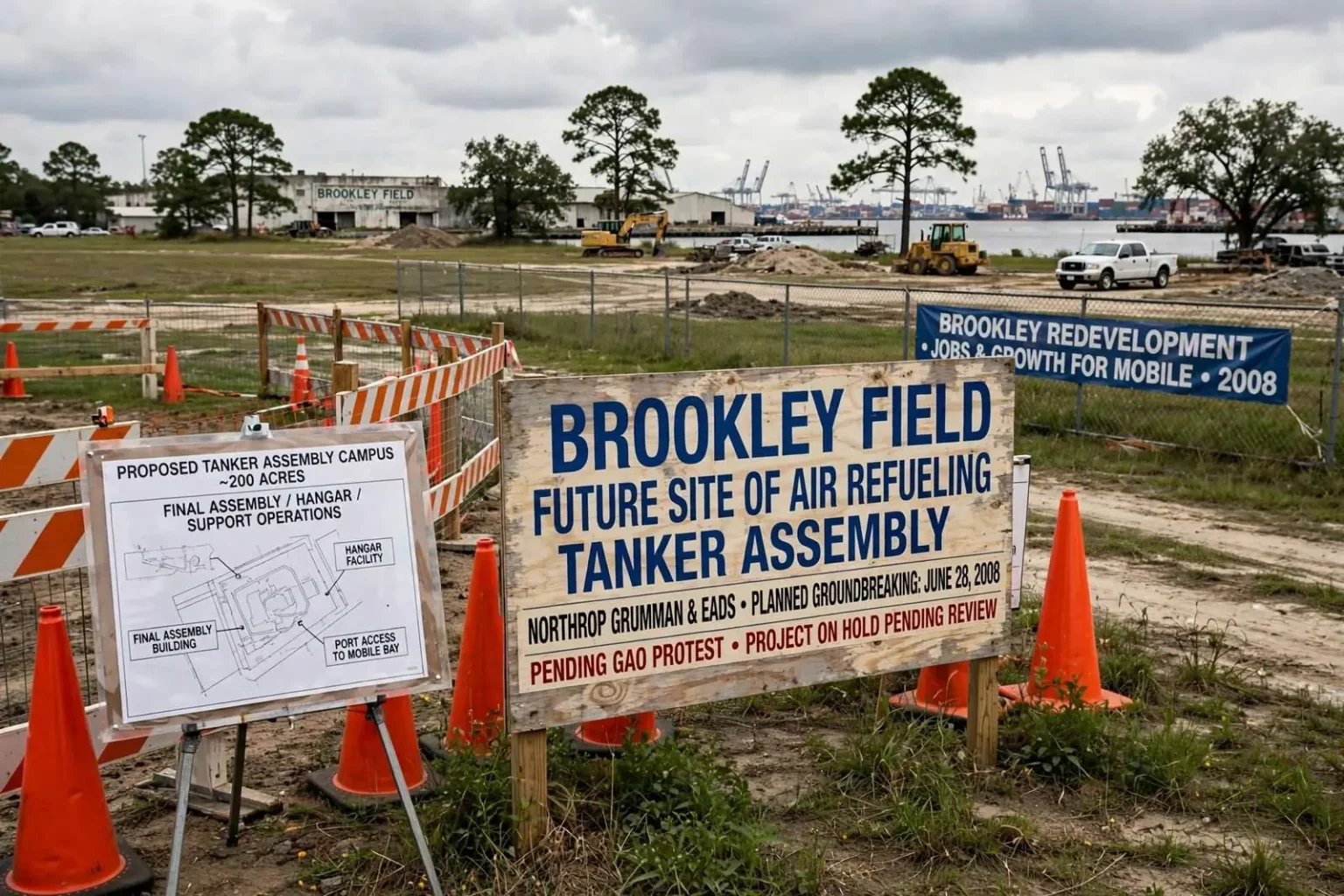
MOBILE, Ala. — In May 2008, Northrop Grumman and EADS were moving ahead with plans for a June 28 groundbreaking at Mobile’s Brookley Field, according to an archived report from a local television station, even as the Air Force tanker award that made those plans possible sat under formal protest at the Government Accountability Office. The two companies had been selected for the Air Force’s air-refueling tanker program earlier that year and had chosen Brookley as the site where the aircraft would be assembled. The June date on the calendar reflected a strong current of optimism in Mobile’s industrial and economic development community, but everyone following the competition understood that the ceremony would only take place if the pending protest did not stand in the way.
The archived report described the scope of what the companies intended to build on the Mobile waterfront property. Northrop Grumman and EADS expected to assemble air-refueling aircraft at Brookley on nearly 200 acres, an area large enough to accommodate final assembly lines, hangar space and the range of support operations that a major aerospace manufacturing site requires. For a city that had spent decades working to bring new industry and jobs back to the former Air Force base, the tanker program represented the largest single opportunity the Brookley property had ever been offered.
Boeing, which had lost the tanker competition, had formally protested the award, and that protest put the entire project on hold while the Government Accountability Office reviewed how the competition had been conducted. The GAO’s role in federal procurement disputes is well established: when a losing bidder files a protest, the agency examines whether the contract award followed federal acquisition rules and issues an opinion on the merits of the challenge. The planned June 28 groundbreaking depended directly on the review’s expected June 19 opinion, a timeline that gave Mobile’s business and civic leadership a short and anxious window as spring turned to summer in 2008.
The selection that set the plans in motion
By the time the May report was published, the Northrop Grumman-EADS team had already made Mobile the center of its proposal for the Air Force tanker program. The companies planned a two-part approach to production, with EADS expected to carry out work on the airframe in Europe before shipping major sections to Mobile for final assembly. Northrop Grumman, serving as the prime contractor, was to lead the effort to turn the delivered components into completed air-refueling aircraft ready for military service. The division of labor reflected the strengths each partner brought to the competition and gave Mobile a role at the most visible stage of the manufacturing process.
The choice of Brookley Field was not a casual one. The site offered an airport environment with existing runways and apron space, direct access to Mobile Bay and the Port of Mobile, and a stretch of flat industrial land inside the city limits that could support the kind of large-scale construction the program would require. Nearly 200 acres was a substantial footprint by any standard, and the companies made clear in the period after their selection that they intended to build facilities designed for long-term aircraft production rather than a short-term project office.
Local officials who had pursued aerospace work for years viewed the tanker program as a potential turning point for the area. Mobile’s economy had long been anchored by shipping, paper manufacturing and chemical production, and civic leaders had made the recruitment of aviation and shipbuilding work a priority in their planning. The prospect of a tanker assembly operation at Brookley tied together several threads of that strategy at once: reuse of a historic military airfield, growth of a skilled industrial workforce, and a place on the national map for Gulf Coast aerospace manufacturing.
A campus on the bay
According to the archived report, the companies outlined separate but complementary construction plans at Brookley. Northrop Grumman said its hangar could be completed in 18 months, a timeline that would have put a finished structure on the property well before the end of the decade if the program had proceeded on schedule. EADS, for its part, expected its facility to be operating by summer 2010, a target that reflected the company’s plan to establish its own presence on the site in parallel with the prime contractor’s work.
Facilities of that kind are more than simple buildings. A tanker assembly operation requires hangars with clear-span space large enough to house wide sections of aircraft, climate-controlled production floors, paint and testing areas, and offices for engineering and program management staff. Bringing such a campus to Brookley would have involved years of construction activity, hundreds of skilled trades jobs during the building phase, and the infrastructure improvements needed to move large aircraft components from the port to the assembly site. The 18-month and summer 2010 timelines gave the public the first concrete sense of when that activity might begin and how quickly the site could be transformed.
Brookley’s long road back
The plan described in the 2008 report carried added weight because of the history of the property itself. Brookley Field began as an Army Air Corps airfield in the years before World War II and grew into one of the largest Air Force supply and modification facilities in the country during the war years. For decades, the base was a cornerstone of Mobile’s economy, employing thousands of civilian workers alongside military personnel and anchoring neighborhoods that grew up around its gates.
That era ended in the late 1960s, when the federal government closed the base as part of a broader restructuring of military installations. The closure stripped Mobile of one of its principal employers almost overnight, and the city spent the following decades working to redevelop the sprawling site. Over time the property became an industrial airport serving cargo carriers, maintenance firms and manufacturing tenants, and it gradually built a new identity as a working airfield with land available for large projects. The tanker proposal was exactly the kind of reuse local planners had pointed to for years when they described Brookley’s potential.
The airfield’s advantages went beyond open land. Its location placed it within a short drive of downtown Mobile and connected it to the region’s highway network, while the nearby State Docks meant that oversized cargo arriving by ship could move to the site without crossing long distances by road. For a program that planned to bring major aircraft sections across the Atlantic from European production lines, that combination of a deepwater port and an airfield with room to build was difficult for competing sites to match.
How the protest process worked
The protest that hung over the June 28 plans followed a path familiar to anyone who watches federal contracting. After the Air Force selected the Northrop Grumman-EADS team, Boeing exercised its right under federal procurement law to challenge the award, and the case moved to the Government Accountability Office, the congressional watchdog that hears bid protests. The GAO’s process sets deadlines for the parties to submit legal arguments and evidence, and it aims to decide most protests within roughly 100 days. The expected June 19 opinion fit that rhythm, coming a matter of weeks after the formal submissions in the case.
A protest of this kind can produce several outcomes. The GAO may deny the protest and allow the award to stand, sustain it in whole or in part and recommend corrective action, or dismiss it on procedural grounds. An airman at the agency does not replace the contract; a sustaining opinion typically directs the Air Force to revisit its evaluation or document its reasoning, and the affected agencies decide how to respond. Until the opinion arrived, though, the companies’ ability to proceed with site work at Brookley was effectively frozen, which is why the reported June 28 groundbreaking was tied so tightly to the June 19 date.
The Alabama congressional delegation and local officials watched the calendar closely during those weeks. Federal contract awards of this size draw sustained attention from lawmakers, whose offices track protest timelines and press for the program to move forward on behalf of constituents who stand to benefit from the work. In Mobile, the debate played out against a backdrop of years in which the city had competed hard for aerospace projects and had learned that national competitions of this kind rarely end on the day the winner is announced.
What the plans meant for Mobile
The significance of the tanker program to the Gulf Coast went well beyond the acreage and the buildings. Aerospace assembly work brings with it a supply chain of machine shops, tooling firms, logistics providers and technical services that cluster around a manufacturing site. Communities that host such operations typically see related businesses open nearby and workforce training programs expand at area colleges to feed the demand for skilled labor. For Mobile, the prospect of becoming one of the few places in the country where large military aircraft were assembled carried a symbolic value that local leaders frequently cited alongside the direct employment numbers.
The region had already invested in the building blocks for that kind of growth. Community colleges along the Gulf Coast had developed aviation maintenance and industrial skills programs, and the area’s shipbuilding industry had cultivated a deep pool of workers experienced in precise fabrication and systems installation. State economic development officials had spent years marketing Alabama’s manufacturing base to national and international companies. The tanker plan, as described in the May 2008 report, fit neatly into that existing framework and promised to give it a marquee anchor at Brookley.
For residents of the neighborhoods surrounding the airfield, the reported timelines offered a picture of what change might look like close to home. Construction traffic, new hangars rising on land that had sat vacant for decades, and a steady stream of workers and suppliers were the practical signs residents watched for. City officials in that period emphasized the long-term nature of the proposal, noting that an assembly operation of the scale described would unfold over years rather than months and that the June 28 ceremony, if it occurred, would mark a beginning rather than a finish line.
A plan awaiting an answer
As late May turned to June in 2008, the situation at Brookley was one of careful waiting. The companies continued to describe their intentions for the site and their confidence in the program, while the Government Accountability Office worked toward its expected June 19 opinion. The archived station report captured that moment of suspension: groundbreaking planned for June 28, assembly projected on nearly 200 acres, a hangar expected within 18 months, an EADS facility targeted for summer 2010, and all of it dependent on how the protest review concluded.
Reports of that period preserved the distinction that matters for anyone reading the coverage today. The dates and commitments described were plans and expectations as they existed at the time, announced while the award remained under protest. The Government Accountability Office review, the companies’ construction schedules and the Air Force program all remained subject to change, and the record of that spring documents what Mobile hoped for rather than what ultimately transpired. What the archived report does show clearly is the scale of the ambition attached to Brookley Field in 2008: a former Air Force base poised, its backers believed, to become the home of tanker assembly for the United States Air Force, with a city watching a June calendar to see whether that future would get its official start.