Mobile County Schools Watched State Budget Debate in 2008
In May 2008, Mobile County Public Schools officials said the state education budget debate could lead to additional local cuts after more than $30 million had already been removed.
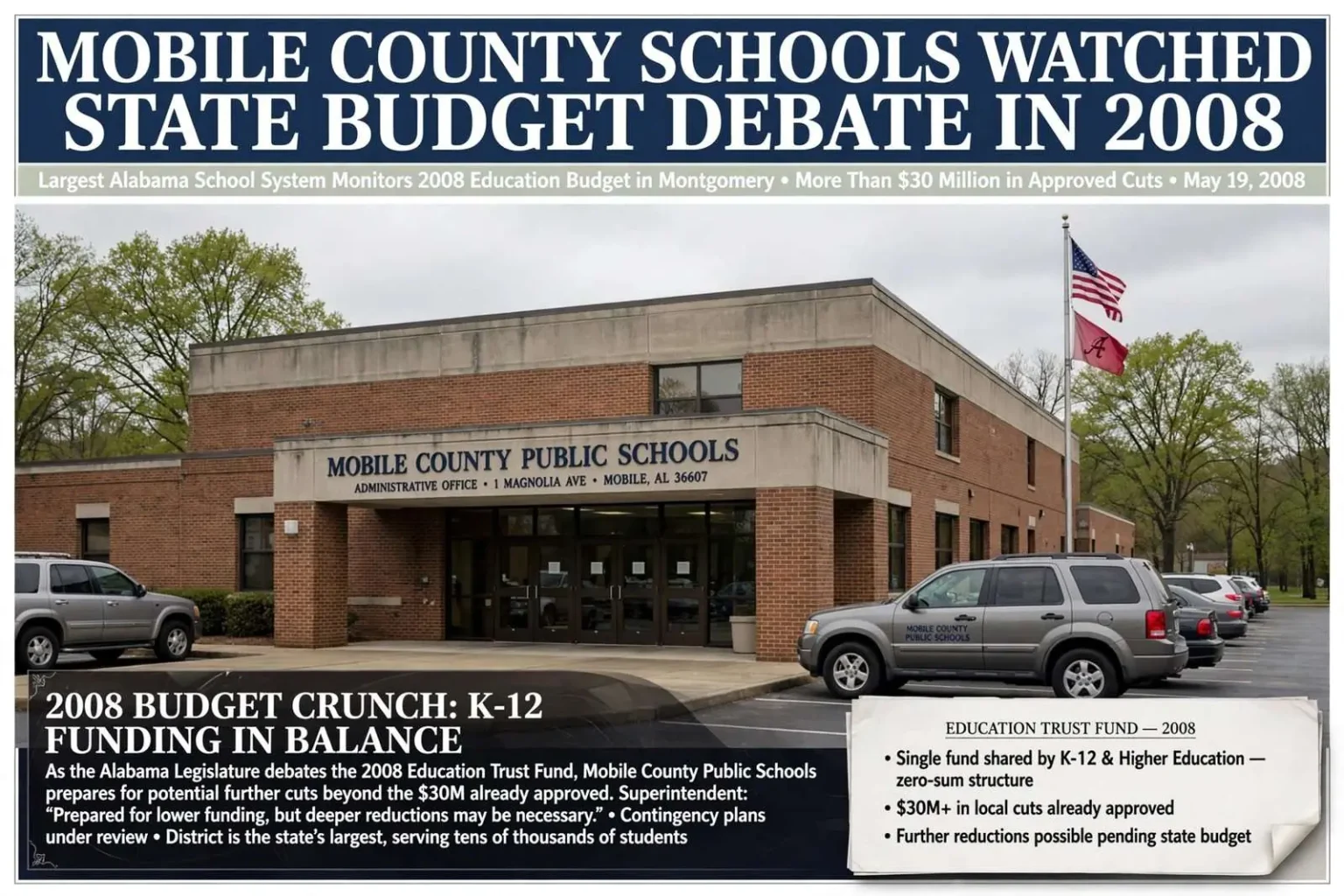
Originally reported May 19, 2008. Mobile County Public Schools officials were watching the state education budget debate closely in May 2008 because changes in funding could have affected local school operations across Alabama’s largest school system. The outcome of the legislative budget process in Montgomery, superintendents across the state understood, would flow directly into the staffing and program decisions each district had to make before the next school year.
Superintendent Dr. Roy Nichols said that additional funding for higher education could mean less money for kindergarten through 12th-grade schools, framing the budget debate in the zero-sum terms that have long governed Alabama school finance. The state’s education budget is a single fund shared by K-12 schools, colleges and universities, and every dollar directed to one side of that ledger is a dollar not available to the other — a structural tension that surfaces in Montgomery nearly every legislative session.
Nichols said the district was prepared for lower funding, but that further reductions might be needed beyond what the system had already absorbed. The Mobile County Public School System had already approved more than $30 million in local budget cuts, according to the report, a figure that put the district’s planning well past trimming and into the territory of program and position eliminations.
The district making the calculations
Mobile County Public Schools was — and remains — the largest school system in Alabama, serving tens of thousands of students across the city of Mobile, the county’s suburbs and its rural communities. Scale changes how budget cuts land: a reduction that a small district absorbs by leaving a vacancy unfilled can force a large system to eliminate whole categories of positions, and the district’s more than $30 million in approved cuts reflected that arithmetic.
Dr. Roy Nichols led the system through that period, and his public framing of the budget debate — that higher education’s gains could come at K-12’s expense — tracked the legislative dynamics of 2008. In May of that year, Alabama legislators were working through the education budget amid signals of a slowing economy, and school superintendents statewide were pressing for K-12’s share while universities lobbied for their own growth.
The district’s contingency planning followed a standard sequence. Systems facing state funding reductions typically protect classroom instruction first, then cut centrally managed programs, administrative positions and non-instructional spending — and only when reductions grow deep enough do they reach into teaching positions, course offerings and the support services that surround the classroom.
Why the state budget dominates local decisions
Alabama’s Foundation Program — the state funding formula that pays for the basic operation of public schools — ties each district’s revenue to the education budget the Legislature passes each session. When that budget grows, districts gain flexibility; when it stalls or shrinks, districts face the prospect of reductions in state support that local tax bases, in systems like Mobile County’s, can only partially offset.
The structural tension Nichols described is built into Alabama’s arrangement: K-12 schools, community colleges and universities all draw from the same Education Trust Fund, and the distribution among them is the product of legislative negotiation each session. Superintendents’ groups and university systems each retain lobbyists and make their cases in Montgomery, and the outcome shapes hiring calendars, program plans and class sizes across the state’s school systems.
For Mobile County in 2008, the stakes were concrete. The district had already approved more than $30 million in cuts, and the question posed in May was whether the budget the Legislature would pass would force a second round. Nichols’s statement — prepared for lower funding, but warning of further reductions — was the public face of that uncertainty.
What the $30 million in cuts represented
More than $30 million in approved local budget cuts, as the report described, placed Mobile County among the Alabama systems that had moved earliest and deepest as the 2008 economic picture dimmed. Cuts of that scale in a system of Mobile County’s size typically touch every level of the operation: central office positions, deferred maintenance, reduced supply budgets, scaled-back programs, and hiring freezes that shrink the workforce through attrition before layoffs are considered.
Superintendents making such reductions describe a triage logic. Personnel costs dominate school budgets — salaries and benefits account for the large majority of most districts’ spending — so meaningful cuts eventually reach positions, but districts work through everything else first because every position eliminated is a service a student no longer receives. By May 2008, Mobile County’s already-approved reductions signaled that the district had worked well past the easy choices.
The timing compounded the strain. Districts build their budgets on the state allocation approved in the spring session, and hiring for the following school year happens in the weeks after the budget is set. Uncertainty in May — the month when Mobile County officials were watching the debate — sits directly on top of that hiring calendar, forcing superintendents to plan for ranges of outcomes rather than a single number.
The 2008 context: a budget year on the edge
The spring of 2008 arrived amid the early tremors of what would become a national recession, and state budgets across the country were already reflecting the slowdown. Alabama’s education revenues, drawn from income and sales taxes, are among the most economically sensitive in the nation, so forecasts for the Education Trust Fund had begun pointing down just as the Legislature weighed the year’s education budget.
In that environment, the contest Nichols described — additional funding for higher education potentially meaning less for K-12 — played out against a shrinking or flat total. Advocates for both sectors argued their cases with the same revenue picture in view, and K-12 superintendents argued that years of relative advantage for higher education had left school systems vulnerable to exactly the kind of downturn 2008 was shaping into.
Mobile County’s watchfulness was shared by systems across Alabama. Statewide organizations of school boards and superintendents tracked the budget deliberations closely, and local districts like Mobile County translated the legislative maneuvering into their own planning — the $30 million in cuts already approved, and the further reductions Nichols warned might follow if the final budget fell short.
What was at stake in local school operations
For parents and teachers in Mobile County, the budget debate in Montgomery was not an abstraction. State funding levels determine staffing ratios, course offerings, transportation, and the support programs — from reading specialists to career-technical education — that operate on state dollars. A budget that forced further reductions would reach those elements of school operations in the following year.
Nichols’s comment that the district was prepared for lower funding reflected preparation already underway: the approved cuts were the contingency, and the open question was whether they would be sufficient. The report preserved his framing without predicting the outcome — the budget debate was still live when the account was published in May 2008.
This article reflects the budget concerns reported in 2008 and is not a statement about current school funding. It preserves the record of a specific moment: Alabama’s largest school system, more than $30 million in cuts already approved, and a superintendent warning that further reductions might be needed while the Legislature debated how to divide the state’s education dollars between K-12 schools and higher education.
How budget cuts reach the classroom
The sequence of a school system’s cuts follows a pattern that Mobile County’s more than $30 million in reductions would have traced. Districts typically begin with positions vacated through retirement and resignation — leaving them unfilled spreads the reduction across the workforce without individual layoffs. Central office administration, travel, contracts and materials come next, followed by the program decisions that require board action: course eliminations, reduced staffing formulas, and scaled services.
Each step along that sequence changes what a student experiences. Larger class sizes follow staffing reductions; fewer electives follow course cuts; older textbooks and deferred repairs follow capital and materials reductions. When superintendents like Nichols testified about the stakes of the state budget in May 2008, those downstream effects were the concrete reality behind the percentages being negotiated in Montgomery.
For the Mobile County system, the scale of the district meant the effects reached tens of thousands of students at once. Decisions made in the superintendent’s budget office — which vacancies to fill, which programs to preserve — repeated themselves across the system’s dozens of schools, from the city of Mobile’s campuses to the county’s suburban and rural schools, as the district worked through what lower state funding would mean building by building.
Dr. Roy Nichols and the district’s leadership
Dr. Roy Nichols led Mobile County Public Schools as superintendent through the period, and his role in the budget debate was that of the system’s chief advocate and planner. Superintendents in Alabama spend much of each legislative session on the state budget — monitoring the Education Trust Fund’s outlook, briefing board members, and pressing the county’s legislative delegation for K-12’s share — and Nichols’s public comments in May 2008 reflected that standing responsibility.
His statement carried two messages at once: reassurance that the district was prepared, and a warning that prepared had limits. That pairing was the standard posture of Alabama school leaders in lean budget years, designed to keep the local community informed without alarm while signaling to Montgomery that further cuts would have consequences the district could not absorb quietly.
The archived report, originally published May 19, 2008, preserves that moment in the district’s history: the largest school system in Alabama watching Montgomery, a superintendent explaining the zero-sum structure of the state’s education budget, more than $30 million in local cuts already on the books, and a school year’s planning hanging on the final form of the state budget. This article reflects the budget concerns reported in 2008 and is not a statement about current school funding.