2008 Ranking Placed Mobile Low on Women’s Heart-Health Measures
A 2008 ranking assessed Mobile's heart-health environment for women using factors including smoking, obesity, exercise and access to care.
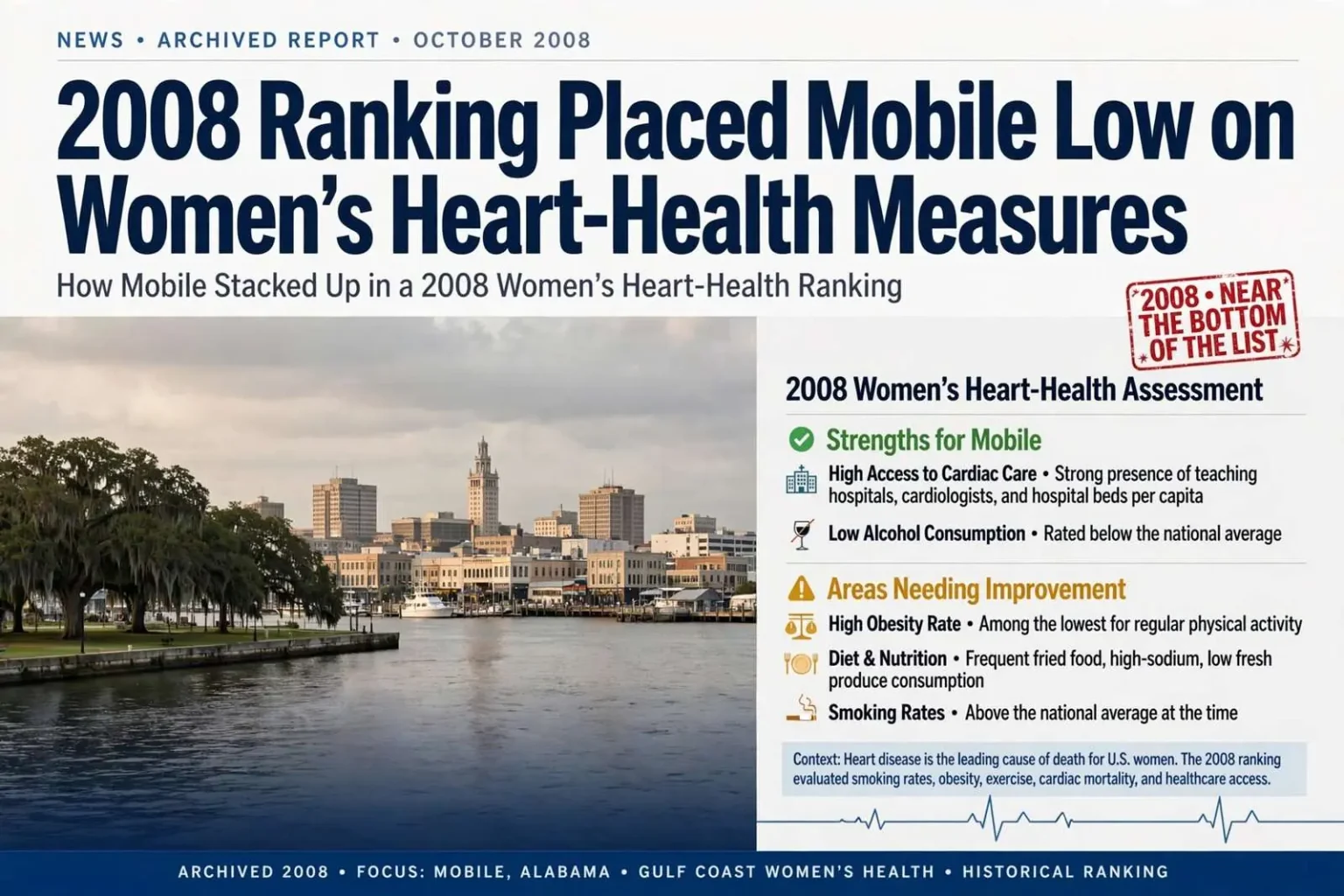
How Mobile Stacked Up in a 2008 Women’s Heart-Health Ranking
More than a decade ago, a national ranking examined how well American cities supported the heart health of women, and Mobile landed near the bottom of the list. The 2008 assessment scored communities on a set of measurable factors, including smoking rates, obesity levels, cardiac mortality and the share of women who reported exercising regularly. The report preserved here from an archived 2008 local news story recorded the city’s placement and the specific strengths and weaknesses that drove it.
For women in Mobile and across the Gulf Coast, the findings of that era matter as a historical marker. Heart disease has long been the leading cause of death for women in the United States, and it can present differently in women than in men. Rankings like this one were designed to draw attention to the everyday environment a city provides — medical access, recreational spaces and prevailing habits — rather than to judge individuals.
The 2008 report gave Mobile credit in several important categories. The city ranked well for low alcohol consumption among its residents, a factor tied in public health research to better long-term cardiac outcomes. It also performed well on access to cardiac care, counting strong numbers of practicing cardiologists, hospital beds and teaching hospitals per capita. That combination of measures reflected the density of medical infrastructure in the Mobile metropolitan area, which serves as a referral center for residents of surrounding counties in southwest Alabama and the Mississippi Gulf Coast.
The Medical Infrastructure Behind the Ranking
Teaching hospitals occupy a distinctive place in any city’s health landscape. Because they combine patient care with physician training and clinical research, communities with teaching institutions tend to have broader access to specialists and newer treatments. Mobile’s standing in that category in 2008 was a meaningful asset, since a teaching hospital environment typically supports round-the-clock emergency cardiac services, catheterization labs and cardiology fellowship programs.
Hospital beds per capita is another measure that health analysts watch closely. In a cardiac emergency, time is the decisive variable, and a city with ample bed capacity and nearby interventional cardiology is better positioned to deliver the rapid treatment that heart attacks demand. The 2008 report’s recognition of Mobile on that front indicated that residents did not face the access barriers seen in more rural parts of Alabama, where a heart patient may need to travel a significant distance for advanced care.
Cardiologists per capita rounded out the access picture. A healthy supply of heart specialists means shorter waits for appointments, more available expertise in preventive cardiology and more capacity for managing chronic conditions such as hypertension, atrial fibrillation and heart failure — conditions that affect women at rates that have historically been underrecognized.
Where Mobile Needed Improvement
The same 2008 report, however, identified obesity, lack of regular exercise and poor eating habits as the areas where Mobile needed the most improvement. Those three findings were interconnected, and they mirrored the pattern seen across much of the Deep South during that period. Southern states consistently posted some of the highest adult obesity rates in the country in the mid-2000s, and Alabama was regularly listed among the leaders.
Regular physical activity is one of the most protective habits for cardiovascular health, lowering blood pressure, improving cholesterol profiles and helping with weight control. A city’s ranking on that measure often reflects practical realities: the walkability of neighborhoods, the availability of parks and recreation centers, summer heat and humidity that discourage outdoor exercise, and the safety of sidewalks and streets. In the Mobile of 2008, the report suggested, too many women were not getting the regular activity their hearts needed.
Eating habits formed the third area of concern. Diets heavy in fried foods, sweetened beverages and high-sodium restaurant fare — staples of Gulf Coast cuisine — have been repeatedly linked to elevated rates of hypertension and heart disease. Public health campaigns in the years after reports like this one pushed for greater access to fresh produce, nutrition education and community wellness programs.
Why City-Level Heart Rankings Mattered for Women
Rankings that focused specifically on women filled an important gap. For much of the twentieth century, cardiovascular research treated male patients as the default subject, and women’s heart attacks were frequently misdiagnosed or dismissed because their symptoms can differ — nausea, fatigue, shortness of breath or jaw pain rather than the classic crushing chest pressure. By the 2000s, national organizations had launched sustained efforts to close that awareness gap, and city-by-city scoring became a common way to focus public attention on the problem.
Smoking was one of the core factors Mobile was scored on in 2008. Tobacco use accelerates the artery damage that leads to heart attacks and strokes, and it carries particular risk for women who also take hormonal birth control. During that era, Alabama’s adult smoking rate ran above the national average, and the state’s clean indoor air rules were less restrictive than in many other parts of the country. How a city performed on smoking therefore reflected both individual behavior and the policy environment surrounding it.
Cardiac mortality, another scoring factor, captures the end result of everything else: how many residents actually die of heart disease. A city can score well on access to care yet poorly on mortality if prevention fails upstream. The 2008 Mobile report placed these numbers side by side, giving a rounded picture of a community whose medical resources were strong but whose daily habits were working against its residents.
Obesity deserves particular attention because of its downstream effects. Excess weight raises the risk of type 2 diabetes, high blood pressure and elevated cholesterol — the trio that cardiologists identify as the most common precursors of heart disease. When the 2008 report flagged obesity as an area needing improvement in Mobile, it was effectively predicting the health challenges the community would face for years afterward unless patterns changed.
What the Ranking Meant for Local Residents
For Mobile women reading such a report in 2008, the practical takeaway was twofold. First, the city’s medical foundation was solid: residents did not lack for heart specialists, hospital capacity or teaching-level care. Anyone experiencing warning signs could reach sophisticated treatment within the metropolitan area. Second, the burden of prevention sat largely in daily choices and community conditions — the foods available in local stores, opportunities for safe exercise and the prevalence of smoking.
Community organizations in the years surrounding that report began responding with initiatives familiar to Gulf Coast cities: walking groups, church-based health programs, blood pressure screenings at community events and school wellness efforts aimed at breaking the cycle in the next generation. Hospitals and physician groups used their cardiac care capacity not only for treatment but for education, offering screening events and nutrition counseling.
The value of a historical ranking lies in the comparison it invites. Mobile in 2008 was a city with strong cardiac infrastructure per capita and persistent lifestyle-related risk factors — a combination that, repeated across the South, helped explain regional disparities in heart disease that persist in public health statistics. Whether and how the city’s numbers moved in later years would depend on sustained attention to exactly the weaknesses the report named: obesity, exercise and diet.
A Note on This Article
This article records a historical ranking published in 2008 and preserved from an archived local news story. It does not represent current health data, and nothing here should be read as medical advice. Health statistics change over time, and anyone with questions about heart health should consult a qualified health care provider rather than rely on an archived ranking.
The Broader Southern Context of 2008
Mobile’s mixed report card in 2008 was not an isolated result. Cities across Alabama, Mississippi, Louisiana and neighboring states routinely appeared near the bottom of national health rankings during that period, burdened by the same combination the report identified: high rates of smoking and obesity, diets with limited fresh produce, and levels of regular exercise that lagged behind national benchmarks. At the same time, the region’s larger cities often scored surprisingly well on medical capacity, because they had absorbed generations of investment in hospitals and specialist care.
That split — strong infrastructure, weak prevention — has been a defining feature of Gulf Coast public health. It helps explain why residents of the region may face long odds of avoiding a heart problem yet short distances to advanced treatment once one occurs. Public health researchers have argued that closing the gap requires changing the environment itself: safer streets for walking, better food access in underserved neighborhoods, and steady messaging about the warning signs of heart attacks in women.
For the women of Mobile, the 2008 ranking also carried a message about advocacy. National heart-health campaigns of that era urged women to know their numbers — blood pressure, cholesterol, blood sugar and weight — and to press for thorough evaluation when symptoms appeared. A city with abundant cardiologists and teaching hospitals gave residents the means to act on that advice; the ranking’s weak spots gave them the reasons.
Archived reports like this one serve another purpose for local readers: they document what a community knew about itself at a moment in time. Mobile in 2008 could point to real strengths in cardiac care and real weaknesses in daily habits, laid out side by side. The years that followed would test whether awareness translated into improvement, and later rankings offered new snapshots for comparison. What this article preserves is the starting point — a clear, specific account of where the city stood on women’s heart health when the 2008 assessment was published, and the factors — smoking, obesity, cardiac mortality, exercise, alcohol consumption and access to cardiologists, hospital beds and teaching hospitals — that produced its score.