Mobile County Schools Considered Student Drug-Testing Program in 2008
Archived WKRG coverage reported that Mobile County school and community leaders considered a student drug-testing program in 2008.
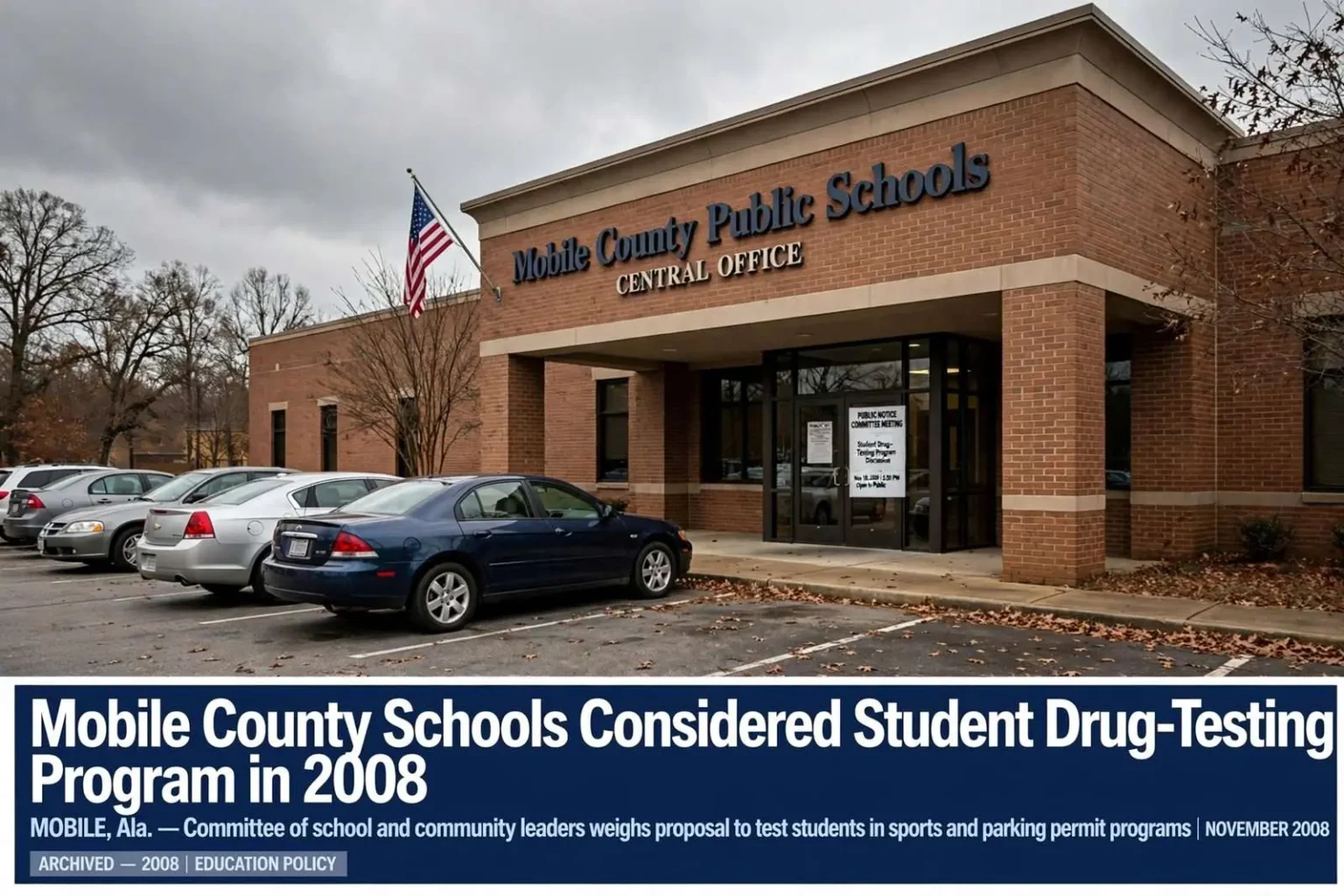
MOBILE, Ala. — In 2008, Mobile County Public Schools was actively weighing one of the most debated questions in American public education: whether to drug-test its high school students. According to an archived report from a local television station, the idea had advanced far enough that a committee of school and community leaders was meeting regularly to discuss whether such a program should be adopted and, if so, exactly how it might work.
The committee’s task was twofold. Members had to decide whether a testing program was worth adopting at all, and then work through the practical mechanics — which students would fall under it, how tests would be scheduled and administered, and what would happen after a positive result. Those details are what typically determine the fate of school drug-testing proposals, because the legal and logistical terrain is narrower than many parents assume when the idea is first raised.
At the time, the district was led by Superintendent Roy Nichols, the longtime head of Alabama’s largest school system. The deliberations in Mobile County came as school districts across the country were rethinking how to address substance use among teenagers, moving beyond punishment alone and toward tools that could identify students early and connect them with help before their behavior escalated into suspension, expulsion or worse.
A Model Just Across the Bay
Any serious discussion of drug testing in Alabama schools in that era inevitably turned to Baldwin County, and the Mobile County committee was no exception. Nichols said the neighboring district’s program could serve as a model for what Mobile County might build. Baldwin County Public Schools, which spans the fast-growing eastern shore communities from Daphne to Gulf Shores, had already put a testing program in place and had worked through many of the questions Mobile County’s committee was just beginning to ask.
Programs like Baldwin County’s generally share a common design. Rather than testing an entire student body — which courts have not permitted — they apply random testing to students who volunteer for or participate in extracurricular activities, and to those who drive to school and park on campus. The logic is straightforward: participation in athletics, clubs or a parking privilege is treated as a choice, and agreeing to the possibility of a test becomes a condition of that choice.
Testing drivers in particular has long been considered one of the highest-value applications of such policies. A teenager who arrives at school under the influence of marijuana or another controlled substance is not only a danger to himself but to every motorist and pedestrian around the campus. Parking lots are also a common point of transfer for drugs moving into a school, which is why parking permits are so often tied to consent agreements in districts that test.
Who Would Have Been Covered
In Mobile County, the proposal under discussion could have applied to students involved in activities such as sports and to those who drove and parked on campus. That framing matched the standard model and stayed within the boundaries set by federal case law. The U.S. Supreme Court upheld suspicionless testing of student athletes in Vernonia v. Acton in 1995, and in 2002 it extended that reasoning in Board of Education v. Earls to students in competitive extracurricular activities generally.
Those rulings are why drug-testing programs across the country look the way they do. The court has never allowed schools to test students at random across the entire population, but it has accepted that students who raise their hands for a team, a band, a club or a parking spot occupy a different position, and that schools have a legitimate interest in protecting the safety and integrity of those programs. Alabama districts that adopted testing in the 2000s built their policies directly on that foundation.
A Statistic That Framed the Debate
The archived report included a number that gave the committee’s work its urgency. The station reported that 249 Mobile County students had been suspended that school year for bringing marijuana or another controlled substance onto campus. In a district of Mobile County’s size, the figure reflected a steady, recurring problem rather than an isolated cluster of incidents — and each of those suspensions represented a student who had reached the point of being removed from school before anyone intervened.
Advocates of testing programs argue that this is precisely the gap such policies are meant to close. A random test cannot catch a student who brings a substance to school on a given morning, but over the course of a semester it changes the calculation for students who participate in activities or drive, making them accountable on an ongoing basis rather than only when something goes visibly wrong. Critics counter that the programs can push at-risk students away from the very activities that benefit them most, and that money spent on testing kits might be better directed toward counselors and treatment referrals.
That tension — between deterrence and support, between enforcement and trust — is what committee members were being asked to weigh. The 249 suspensions were the case for acting; the questions of cost, consent and fairness were the case for care.
Consent Was Central to the Plan
Nichols emphasized that any program the district adopted would require parent and student agreements. That requirement was not merely a courtesy; it was the legal backbone of the entire approach. Because the program would reach students only through voluntary activities and driving privileges, each family would be asked to sign off in advance, acknowledging the testing policy and accepting its consequences as a condition of participating.
Consent-based structures also shape how the results are handled. In most Alabama programs of that era, a first positive result did not trigger expulsion or automatic suspension from school. Instead, it typically led to a meeting with parents, a notification to the activity sponsor or a loss of parking privileges, with escalation only if the behavior continued. The stated goal in district after district was the same: to give families an early, concrete reason to have a conversation they might otherwise never have had.
For a district the size of Mobile County’s — which drew students from downtown Mobile, the western communities along the Mississippi line, and everything in between — the administrative lift was significant. Consent forms, testing windows, chain-of-custody procedures and result notifications all had to be designed, budgeted and communicated to tens of thousands of families. The committee’s deliberations reflected that reality; nothing about the program was going to be simple to stand up.
No Final Decision Had Been Made
As of the time of the archived report, no final adoption decision had been made. The committee was still meeting, the proposal was still a proposal, and the district had not committed to putting the program in place. That state of uncertainty was common for policies of this kind, which often spend months or years in study before either being adopted, modified or quietly set aside.
What the episode documents is a snapshot of a large urban-suburban Alabama district taking a serious, structured look at drug testing at the height of the national debate over such programs. The committee included school administrators and community leaders, the superintendent pointed to a neighboring county’s working program as a template, and the conversation was anchored in real data from the district’s own discipline reports.
How Mobile County Fits Into the Regional Picture
Mobile County’s situation in 2008 mirrored what districts along the Gulf Coast were confronting at the same time. The county blends a dense urban core with sprawling suburban and rural school zones, and its high schools serve communities with sharply different profiles. Any testing policy would have had to work as well at a large city high school as at a smaller school in the county’s western reaches, which is one reason the committee resisted rushing to a conclusion.
The proposal also arrived amid a broader national conversation about student privacy, federal funding conditions and the appropriate limits of school authority. Districts that adopted programs in those years frequently revised them after the first year, adjusting the list of covered activities, the frequency of testing or the consequences attached to results. Committee members studying Baldwin County’s experience had the advantage of learning from those adjustments rather than repeating them.
Whether the district ultimately moved forward in that form, reshaped the idea or tabled it, the record of the deliberation remains part of the history of education policy in south Alabama — and a reminder of how much care even a single policy question can demand in a system responsible for tens of thousands of students.
This is a historical account of a policy discussion from 2008, based on archived local news coverage. It is not a statement of current Mobile County Public Schools policy.