Mobile County Schools Considered Student Drug Testing in 2008
A 2008 WKRG report covered Mobile County Public Schools' discussion of a possible high-school student drug-testing program.
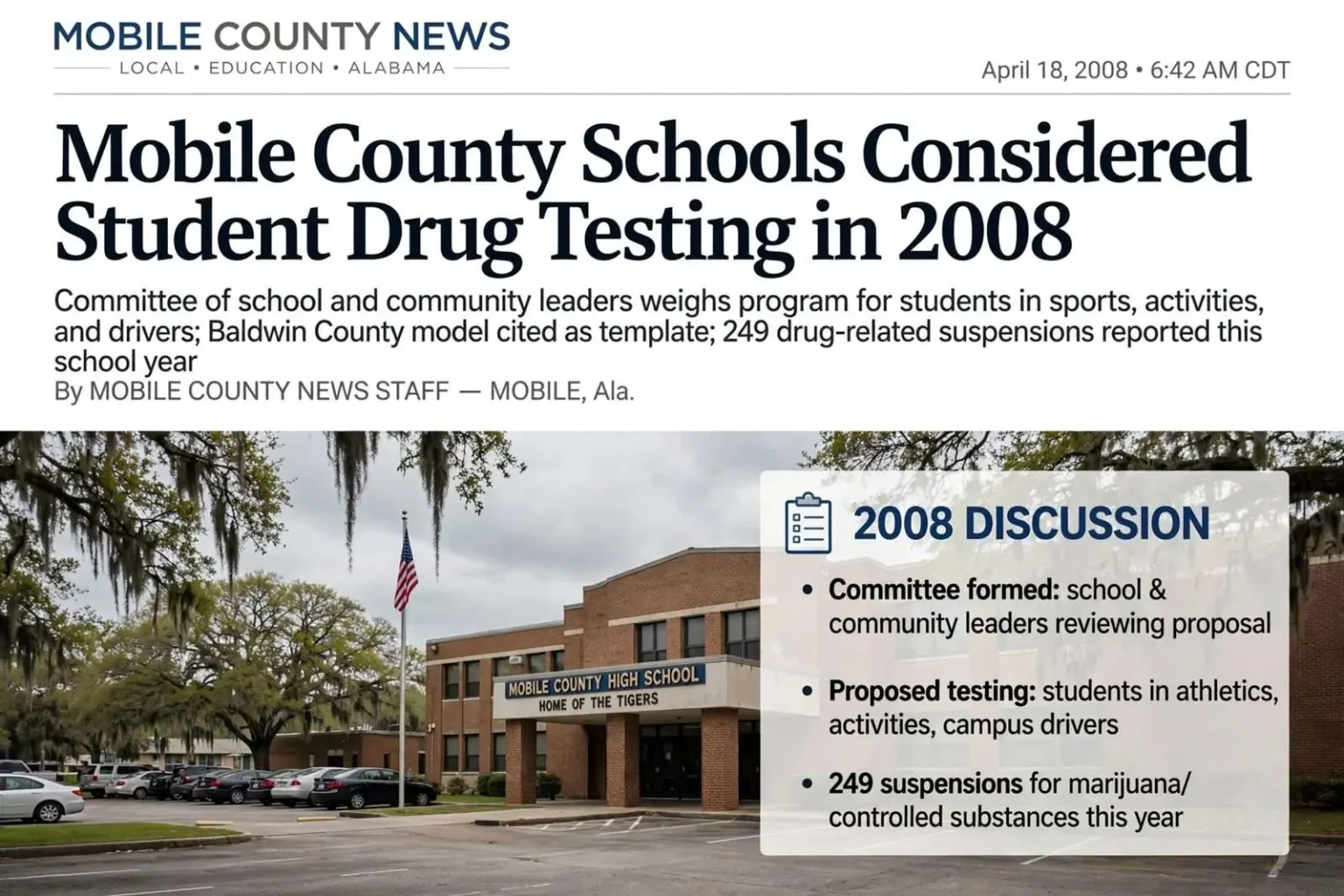
Mobile County Public Schools considered a drug-testing program for some high-school students in April 2008, according to a local station. A committee of school and community leaders was discussing whether to adopt the idea and how it would work, in a conversation that touched on one of the most debated questions in American public education: when, and on whom, a school system may demand a urine sample.
The discussions were at an early stage. The committee, made up of school system and community representatives, was weighing whether to adopt a testing program at all and, if so, how it would be structured. No proposal had been presented as a final policy decision, and the matter remained an idea under study rather than an adopted rule of the system.
Superintendent Roy Nichols said the system could model a Baldwin County program. Baldwin County, just across Mobile Bay, had put in place a drug-testing program aimed at students who participated in certain school activities, and its experience supplied the nearest working example of how such a policy functions in an Alabama school system of comparable size and character.
Under the model being discussed, testing would potentially apply to students who participated in activities such as sports, or who drove and parked on campus. That structure follows the general shape of student drug-testing policies around the country, which concentrate on students who take on privileges or roles beyond ordinary classroom attendance rather than testing the entire student body.
The numbers behind the discussion
The station reported that 249 students had been suspended that school year for bringing marijuana or controlled substances onto campus. That figure — a single school year’s suspensions in a single system — gave the committee’s discussion a concrete anchor and illustrated why school leaders were examining the problem at all.
Suspensions for drugs on campus represent the cases schools catch and act on. They are the visible tip of a problem that is harder to measure: possession that goes undetected, use that occurs off campus, and the slower erosion of school climate that drug problems can produce. It was against that backdrop that 249 suspensions became part of the public case for considering a testing program.
Mobile County Public Schools is the largest school system in Alabama, serving students across the city of Mobile and the surrounding county — a sprawling district encompassing urban neighborhoods, suburban communities and rural stretches of the county. Its high schools range from large urban campuses to small county schools, and any policy the system adopts touches tens of thousands of families.
Scale matters in a policy discussion like this one. A testing program in a small district involves hundreds of students and a modest administrative apparatus; in a system the size of Mobile County’s, the same idea involves thousands of students, meaningful costs for collection and laboratory work, and a communications challenge in explaining the policy to parents across the county. The committee’s work on “how it would work” was, in practice, a question of how a program of that scale would be designed and paid for.
Nichols said parents and students would sign agreements before testing could occur. That consent-based feature, common to student testing programs, acknowledges the legal and practical reality that schools operate in partnership with families, and it frames the program as a condition of participation rather than a blanket mandate.
The Baldwin County model
The program Nichols cited was Baldwin County’s. Baldwin County Public Schools, the system across the bay, had adopted drug testing for students participating in extracurricular activities and for student drivers — the two groups most commonly included in such programs nationally. Students who wanted to play sports, take part in other sanctioned activities, or park a car on campus would be subject to testing as a condition of those privileges.
The logic of that design has been argued by school boards across the country. Students in athletics and activities serve as visible representatives of the school, and student drivers carry responsibilities — and pose risks — that extend beyond their own classroom performance. Testing those groups, supporters argue, gives students a face-saving reason to refuse drugs (“I might be tested”) while avoiding a dragnet that sweeps in every student in the system.
For Mobile County leaders, Baldwin County’s program offered a template that had already been adapted to Alabama law, Alabama school culture, and the practicalities of an Alabama district: which activities trigger testing, how students are selected for tests during the year, what happens on a positive result, and how confidentiality is handled. Modeling a new program on an existing one shortens the design process and supplies an answer to the first question every board member asks — is this being done anywhere nearby?
It also supplied a realistic preview of the friction. Testing programs generate objections from students and parents, questions about cost, and ongoing administrative work to keep the process fair and consistent. Baldwin County’s experience, whatever its details, demonstrated that such a program could operate in a large Alabama county system over time.
The legal landscape
Any discussion of school drug testing in the United States takes place in the shadow of the Supreme Court’s decisions on the question. The Court first upheld student-athlete drug testing in the mid-1990s, ruling that a school district’s policy of testing athletes was constitutional in light of schools’ custodial responsibility and the decreased expectation of privacy in public school settings.
A few years later the Court went further, upholding testing for students in all competitive extracurricular activities, not just athletics. Together, those decisions established the legal space in which programs like the one Mobile County was considering operate: schools may test students who participate in voluntary activities or accept special privileges, but the decisions do not authorize testing of the entire student body at large.
That is why the structure described in the 2008 discussion — testing tied to activities such as sports, or to driving and parking on campus — is not an arbitrary design. It is the shape the case law permits. A program aimed at every student would face serious constitutional obstacles; a program aimed at participants in activities and student drivers fits within the recognized exceptions.
Consent agreements, the feature Nichols described, add a further layer. By having parents and students sign agreements before testing occurs, the school system documents that families understand the program and accept its conditions as part of participation. In practice, the signing ceremony is also where the policy is explained: what substances are screened, how samples are collected, who sees the results, and what consequences follow.
How the committee’s work fit the process
The committee structure said something about how the school system approached the question. Rather than presenting the board with a finished policy, the system convened school and community leaders to discuss whether the idea should be adopted and how it would work — the kind of study process large districts use for proposals that touch families directly and carry legal, financial and community dimensions. Community representation extends that fact-gathering beyond the schoolhouse, bringing in the perspectives of families, employers and civic institutions that would live with the policy’s effects.
April 2008 placed the discussion on the school calendar in a particular way. A spring study would, if it led anywhere, produce recommendations for a later year — budget requests, board votes, policy drafting and parent notification all take longer than a semester. The station’s reporting made the status clear at both ends: this was a historical summary of a 2008 policy discussion, and the proposal was not presented as a final policy decision. Readers were being told about an idea under consideration in the largest school system in Alabama, with a named superintendent, a named model program next door, and a concrete number — 249 suspensions — behind it.
Why systems consider testing at all
The national conversation Mobile County entered in 2008 had been building for more than a decade. Federal drug-control policy in the late 1990s and 2000s encouraged school-based testing programs, funding was made available for them, and districts across the country adopted policies aimed at athletes, drivers and activity participants.
The arguments for testing are the ones school boards hear most often. A testing program creates a concrete, ongoing reason for a student to say no when offered drugs — a reason that can be repeated at home without accusation. It identifies students who are using early, at a stage when intervention is easier. And it signals that a system takes the problem seriously enough to build machinery around it.
The arguments against are equally familiar. Critics note that participation-based programs by design exempt students not in activities or not driving, and that a student who wants to avoid testing can simply avoid the trigger. They raise concerns about privacy, screening reliability and cost — every sample collected, transported and analyzed carries a price that recurs for as long as the program runs. Large systems weigh another factor: consistency across campuses. A district as varied as Mobile County’s must apply any such policy the same way at every high school, which means uniform procedures, trained staff and clear documentation — and that is why the “how it would work” half of the committee’s question was as heavy as the “whether” half.
The consent agreements Nichols described answer part of both critiques. A signed agreement makes the program’s terms explicit to every family before a sample is ever collected, and it gives parents a role in the decision — a student participates in testing the way he or she participates in football: knowingly, and with a parent’s signature.
What the 2008 discussion means in retrospect
Because the account of the April 2008 discussion is a historical summary, its significance today is what it documents rather than what it announced. It records that the largest school system in Alabama was seriously examining a student drug-testing program in 2008; that its superintendent pointed to Baldwin County’s program as a possible model; that the contemplated structure covered students in activities such as sports and students who drove and parked on campus; and that 249 suspensions that year for marijuana or controlled substances formed part of the case under discussion. It also records the mechanism Nichols described: parents and students would sign agreements before testing could occur.
For readers tracing the history of school drug policy on the Alabama Gulf Coast, the 2008 discussion is a data point in a longer regional story. Baldwin County’s program gave Mobile County a working example across the bay, and the exchange of policy ideas between neighboring systems is a familiar pattern in Alabama education, where county systems of similar size and demographics often borrow structures from one another.
The context behind the numbers
The figure that anchored the 2008 reporting deserves its own context. Suspensions for bringing marijuana or controlled substances onto campus are the disciplinary endpoint of a chain of events: an observation or report, a search or discovery, an administrative decision, and a penalty. Each of the 249 suspensions represented one of those chains completed — and none represented use or possession that went undetected.
School years generate discipline figures like this across every large district, and they move with enforcement intensity as much as with student behavior. A system that searches more or screens more will record more cases than one that does not, even if underlying use is identical — one reason single-year figures are best read as a snapshot rather than a trend.
The campus dimension focused the discussion on the school environment rather than on student conduct generally. A testing program aimed at activity participants and student drivers addresses what students bring to campus and what they do under the school’s watch, not what they do at home. As a historical record, the account preserves the essentials as reported in April 2008: a committee of school and community leaders studying a drug-testing idea; a superintendent citing Baldwin County as a model; testing potentially aimed at students in activities such as sports or those who drove and parked on campus; 249 suspensions that school year; consent agreements to be signed before testing; and no final policy decision presented — a documented moment in the public life of Alabama’s largest school system.