Baldwin County Therapists Used Wii Games for Rehabilitation in 2008
Mercy Medical therapists in Baldwin County used Nintendo Wii games in 2008 to help patients with weakness, brain injuries and spinal conditions.
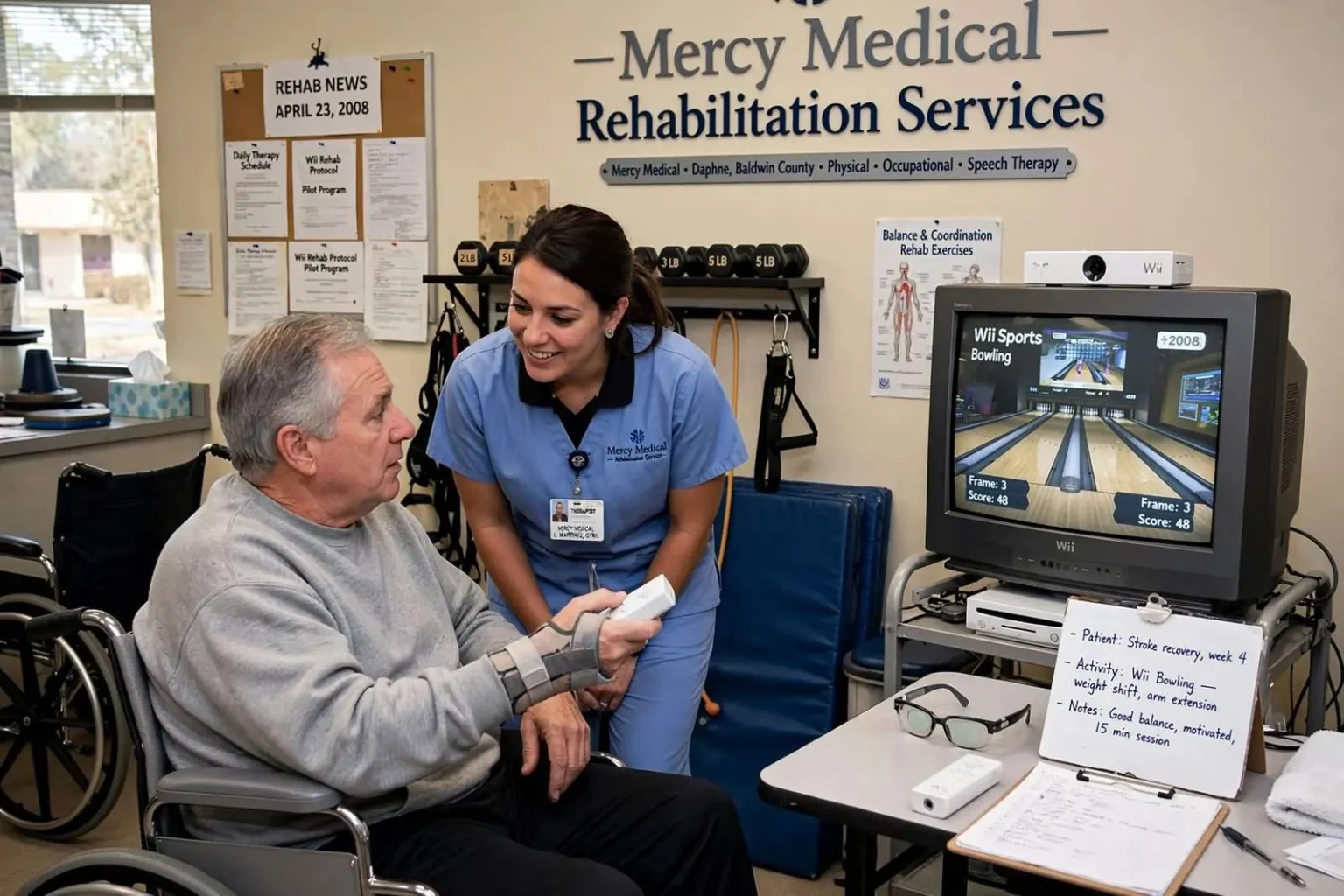
Therapists in Baldwin County were using Nintendo Wii games as a rehabilitation tool in 2008, according to an archived local news report originally published April 23, 2008. Mercy Medical staff used interactive tennis, bowling and golf games in therapy for people with impairments, weakness, brain injuries and spinal conditions. Therapists also used equipment such as wheelchairs, weights and vision-simulation glasses while learning how the games could support treatment.
The approach reflected a moment when consumer video game technology crossed over into clinical practice. The Nintendo Wii, released in late 2006, had quickly become known for its motion-sensitive controller, which required players to swing, push and gesture rather than simply press buttons. Rehabilitation specialists around the country noticed that the same movements demanded by the games mirrored exercises patients were already being asked to perform — reaching, gripping, shifting weight, tracking objects with their eyes — and that patients who balked at repetitive drills would happily play a round of virtual tennis for thirty minutes at a stretch.
Why motion-controlled games fit therapy
Rehabilitation medicine depends on repetition. A patient recovering strength after a stroke, relearning coordination after a brain injury, or rebuilding endurance following a spinal condition must perform the same movements over and over, and progress is gradual. The hard part for therapists is rarely designing the exercise; it is motivating the patient to keep doing it. Games answered that problem. The on-screen feedback of a bowling ball rolling down a virtual lane or a tennis racket connecting with a ball turned an abstract exercise into a goal with visible results.
The Wii’s controller also allowed therapists to adjust the intensity and range of a patient’s movements. A gentle swing could produce a full game of tennis, so a patient with limited shoulder mobility could participate without being pushed past safe limits. Therapists could observe balance, weight shifting and coordination during play, gathering a picture of a patient’s abilities in a setting far more engaging than a standard clinical test.
Mercy Medical’s program
Mercy Medical, a health care organization serving the Gulf Coast from its Daphne campus in Baldwin County, offered rehabilitation services including physical, occupational and speech therapy. In 2008, staff there incorporated the Wii’s tennis, bowling and golf games into treatment for patients dealing with impairments, general weakness, brain injuries and spinal conditions. The games gave therapists another tool in a field that had always borrowed from whatever worked — household objects, playground equipment, everyday tasks repurposed as therapeutic exercise.
Training accompanied the new equipment. Staff used wheelchairs, weights and vision-simulation glasses while learning how the games could support treatment, an approach that let therapists experience what their patients experienced. Vision-simulation glasses in particular allowed a therapist with healthy eyes to understand the visual limitations faced by patients recovering from brain injuries or dealing with age-related vision loss, which shaped how they framed the games’ demands for those patients.
A wider trend in 2008
Baldwin County’s therapists were part of a nationwide wave. Through 2008 and the years that followed, rehabilitation centers, nursing homes and veterans’ facilities across the United States adopted the Wii and similar systems for balance training, upper-limb therapy and endurance work. Researchers began studying the outcomes formally, and the field that came to be known as serious gaming — using game technology for health and education — took root in that era.
The enthusiasm was tempered by practical realities. Consumer games were not designed as medical devices, so therapists had to adapt them, and progress had to be documented through conventional clinical measures rather than game scores. Insurance reimbursement followed the therapy provided, not the equipment used. But as a complement to hands-on treatment, the games earned a lasting place: they got patients moving, kept them engaged, and turned portions of a difficult recovery into something closer to play.
What the games demanded of patients
Each of the three games Mercy Medical staff used exercised a different set of abilities. Virtual tennis called for lateral movement, arm extension and timed swings, making it useful for patients rebuilding reach and rotational control. Bowling emphasized a smooth forward motion, release timing and balance during a simulated throw, which translated well to gait and stability work. Golf required controlled range of motion through a swing arc, grip strength and sustained attention across a full round of holes.
Beyond the physical demands, the games exercised cognition. Players tracked moving objects, judged distances, made quick decisions and kept score — mental work that mattered for patients recovering from brain injuries. Speech and social interaction often followed naturally, since games played side by side invited conversation and light competition between patients, family members and therapists. For people whose injuries had isolated them, that social dimension was itself therapeutic.
Rehabilitation on the Eastern Shore
Baldwin County’s population grew quickly through the 2000s, and with it came demand for rehabilitation services closer to home than the large medical centers across Mobile Bay. Facilities on the Eastern Shore, including Mercy Medical in Daphne, served patients recovering from strokes, surgeries, injuries and progressive conditions without requiring a drive across the Interstate 10 Bayway. The addition of game-based therapy fit the profile of a facility working to offer current techniques in a community setting.
The April 2008 report captured the program at an early stage of that experiment. Therapists were still learning how the games fit into treatment plans, testing them alongside conventional equipment — wheelchairs for mobility patients, weights for strength work, vision-simulation glasses to understand impaired sight. That experimental posture was typical of the period, when clinicians across the country were writing the first informal rules for using consumer technology in a medical setting.
From novelty to standard practice
In the years after 2008, the technology matured. Dedicated rehabilitation systems with clinical software and adjustable difficulty followed the consumer wave, and virtual reality-based therapy became a recognized specialty within physical and occupational therapy. The core insight demonstrated by therapists using the Wii — that engagement drives repetition, and repetition drives recovery — became foundational to the field.
For the patients who played virtual tennis and bowling in Baldwin County therapy sessions in 2008, the technology offered something simple and valuable: a reason to push through one more rep. For the therapists, it was a reminder that treatment works best when the patient wants to participate. The 2008 experiment at Mercy Medical sits in that history as an early Gulf Coast example of a practice that later spread throughout rehabilitation medicine.
The patients behind the practice
The people served by game-based therapy in 2008 spanned a wide range of circumstances. A middle-aged patient recovering from a stroke might work on weight shifting and arm control through bowling. An older adult fighting general weakness could build endurance through repeated rounds of tennis without the joint stress of a real court. A young person recovering from a brain injury might use the games’ visual tracking demands to rebuild attention and processing speed. Patients with spinal conditions, whose mobility and strength were limited in different ways, found that the seated and adjustable nature of many game tasks let them participate fully.
What united them was the challenge of staying motivated through months of outpatient or inpatient therapy. Recovery timelines in rehabilitation medicine are measured in weeks and months, and progress comes in small increments. Any tool that makes a patient look forward to a session — rather than dreading the repetition — measurably changes how much work gets done, and that was the quiet achievement of the Wii era in clinics like Mercy Medical’s.
Training the therapists, not just the patients
The emphasis in the 2008 report on staff training deserves note. Rather than simply wheeling a console into a therapy room, Mercy Medical had its staff practice with the same equipment their patients used: sitting in wheelchairs to play, wearing weights to feel restricted movement, and putting on vision-simulation glasses to experience impaired sight. That kind of empathy-based training helped therapists calibrate expectations, spot frustration early, and modify the games to fit each patient’s real abilities.
It also reflected a broader truth about rehabilitation work: the therapist’s understanding of the patient’s experience is as important a clinical tool as any machine. A therapist who knows firsthand how disorienting tunnel vision can be will design a safer, more effective game session for a patient with that limitation than one who reads about it in a chart.
A 2008 snapshot with a long legacy
The April 23, 2008 report preserved a moment when a Baldwin County rehabilitation team joined a national experiment, using the year’s most popular game console to coax patients through exercises they might otherwise have resisted. The article reflects a 2008 rehabilitation practice and is not medical advice or a description of current therapy options — modern rehabilitation has moved well past the technology of that era, toward dedicated clinical systems and individually calibrated programs.
Yet the principles visible in that 2008 program remain the same ones rehabilitation therapists work from today: meet patients where they are, make repetition bearable, and never underestimate the power of a little competition to get a weakened arm to reach a little farther. The therapists of Baldwin County who rolled virtual bowling balls in 2008 were practicing, in their own way, the future of their profession.