Mobile Schools Considered Cutting 259 Teaching Positions in 2008
A 2008 WKRG report detailed potential Mobile County school-system cuts, including teaching positions and education initiatives.
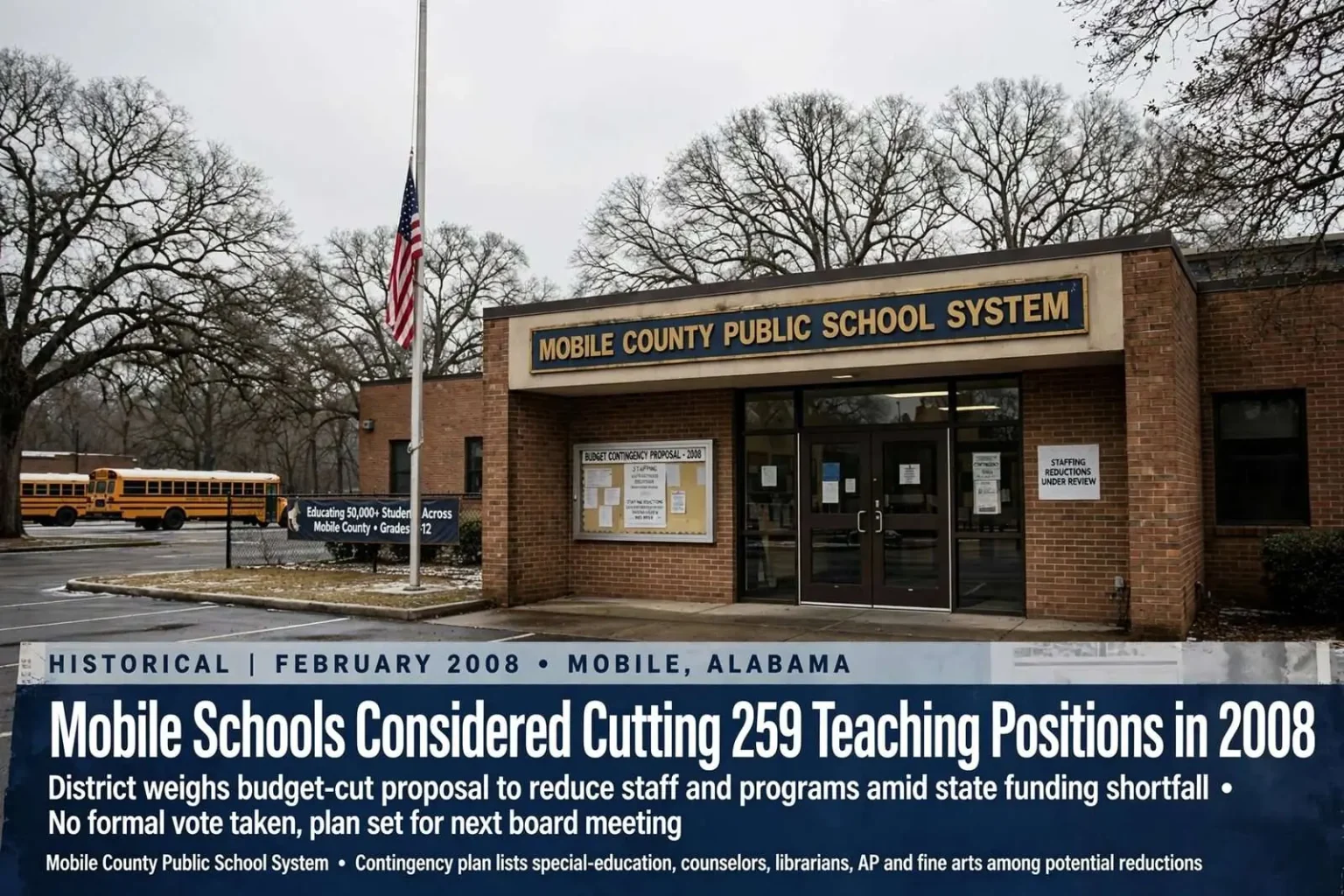
Mobile County school officials considered a budget-cut proposal in 2008 that could eliminate 259 teaching positions and reduce or end multiple programs, according to a local station’s report at the time. The proposal listed reductions in locally funded and state-funded teacher positions, special-education staff, assistant principals, counselors, librarians and a principal-training program. It also identified potential cuts to initiatives including math, advanced placement, professional development, middle-school reform, fine arts, partnerships and truancy work. The report said board members had not yet taken formal votes and were expected to consider the proposal at their next regular meeting. This is a historical summary of a proposed 2008 budget action, not a final decision — and the distinction matters, because budget-cut proposals of this kind are routinely reshaped, scaled back, or replaced before a board acts on them.
The scale of the proposal reflected the fiscal position in which the Mobile County Public School System found itself in 2008. The system is the largest school district in Alabama, operating more than a hundred schools and programs across the county from the city of Mobile to Citronelle, Grand Bay, and the communities in between, with an enrollment measured in the tens of thousands. A district that size employs thousands of teachers, and a list of 259 positions represented a substantial share of its instructional workforce. Each line on the proposal’s list — teachers funded from local money, teachers funded from state money, special-education staff, assistant principals, counselors, librarians — corresponded to a different revenue stream and a different set of state rules, which is why school-budget reductions are itemized in this fashion rather than stated as a single number.
The year mattered as much as the numbers. Alabama’s public school system is funded primarily through the Education Trust Fund, which draws on state sales tax and income tax revenue, making education budgets the state’s most economically sensitive spending. When the national economy weakened in 2008, state education revenue weakened with it, and the state superintendent’s office began warning districts of potential proration — the across-the-board percentage cuts Alabama law applies when revenue falls short of budgeted amounts. School systems across the state responded by building lists of positions and programs that could be cut, so that if the reductions came, they would come from a plan rather than a scramble. The Mobile County proposal was that kind of document: a contingency plan for a budget year that had turned hostile.
What the Proposal Listed
The personnel cuts spanned every category of school staffing beyond the classroom teacher. Special-education staff, assistant principals, counselors, and librarians are positions state funding formulas treat differently from base classroom units, and many districts staff them with local money or a blend of sources. Cutting them has consequences that differ from cutting a classroom teacher: fewer counselors means larger student loads for the remaining staff and less attention to the college applications, scheduling conflicts, and personal crises that counselors handle; fewer librarians means libraries with reduced hours or media centers without certified staff; fewer assistant principals means discipline and safety work concentrated on a smaller administrative team.
The proposed program reductions reached into the academic initiatives the district had built over prior years: math programs, advanced placement courses, professional development for teachers, middle-school reform, fine arts, partnerships with outside organizations, and truancy work. Advanced placement cuts are felt first by college-bound students, since AP courses offer college credit that reduces later tuition costs. Truancy programs affect attendance enforcement — the work of keeping students in school, which in Alabama carries legal consequences for both students and parents. Professional development cuts affect the training teachers receive during the year, and fine arts reductions land on band, choir, art, and theater programs whose costs are real but whose value is hardest to quantify. Each of these initiatives had been the product of years of board investment, and the proposal treated them as available for reduction if the budget required it.
The principal-training program named in the proposal deserves particular note, because such programs are how a district builds its own future administrators. A large urban district like Mobile County’s needs a steady supply of principals and assistant principals, and training programs recruit strong teachers, mentor them, and prepare them for school leadership. Cutting the pipeline does not show its effect for years, but it eventually leaves a district hiring administrators from outside, or promoting without preparation, when retirements and departures thin the ranks.
The Board’s Position
The report was careful on one point: no vote had been taken. Board members of the Mobile County Board of School Commissioners — the elected five-member board that governs the system — had not formally acted on the proposal, and the plan was expected to be considered at the board’s next regular meeting. That sequencing is standard in school budgeting: the superintendent’s administration develops a list of potential reductions, presents it to the board as a planning document, and the board weighs it in public session before anything is final. The gap between a staff proposal and a board decision is where public comment, community pressure, and revised revenue estimates all operate.
The political reality facing the board in a case like this is that every line on a cut list has a constituency. Parents of special-education students watch the special-education lines; teachers watch the position counts; band parents and arts advocates watch the fine arts lines; the business and civic partners engaged in district programs watch the partnership items. A board considering 259 positions and a dozen program areas receives the concerns of all of them, and the public meeting where the proposal is considered becomes the forum where those interests are aired. This is by design: Alabama’s open-meetings requirements put board deliberations in public, and budget decisions — the most consequential a board makes — are where that transparency matters most.
For district employees, a proposal like the 2008 list creates months of uncertainty. Teachers and staff whose positions appear on a potential-cut list face the possibility of transfer, non-renewal, or a scramble for other openings, and in a district the size of Mobile County’s, the personnel machinery of reductions — seniority rules, certification requirements, recall rights — is complex. State law and local policy govern the order in which employees are laid off or reassigned, and a reduction that eliminates a position does not always eliminate the employee, since a displaced teacher may fill a vacancy elsewhere in the system. That complexity is one reason boards act on such lists early in the budget calendar, to give the personnel office time to sort the effects before the new school year.
The deeper context of 2008 is that Alabama’s education funding structure makes bad years structural, not incidental. The Education Trust Fund’s dependence on sales and income taxes means that a recession — with its drop in consumer spending and employment — arrives in school budgets with a lag, and proration can be declared mid-year, forcing districts to cut from budgets they are already spending against. Districts respond with hiring freezes, larger class sizes, deferred maintenance, and cuts to the non-core programs that make a school system whole. The Mobile County proposal, with its list of positions and initiatives, was the district’s map of what those options looked like at its scale.
Reading the Proposal Today
As a historical record, the 2008 proposal documents what a large district considered when revenue turned down — and what it considered too valuable to propose cutting outright. The list is a kind of inventory of the district’s commitments circa 2008: advanced placement, middle-school reform, fine arts, truancy enforcement, principal training, and the staffing categories that support instruction. The fact that these items appeared on a cut list does not mean they were ended; contingency proposals routinely exceed what boards will actually cut, precisely so that the board has room to choose. The report itself framed the proposal as something the board had not yet taken up formally, and as a summary of a proposed action rather than a final decision.
The pattern the proposal represents continued across Alabama education long after 2008. Districts across the state built similar lists during the proration years that followed, and the state’s education budget recovered only slowly through the 2010s. Mobile County, like other large systems, faced repeated rounds of budget tightening in which position counts, program offerings, and staffing ratios were revisited year after year. Each round produced its own list, its own public meetings, and its own board decisions, and the cumulative effect showed up gradually — in class sizes, in program availability, in the staffing of school libraries and counseling offices.
What the 2008 record preserves is a snapshot of one round of that process at its start — the administration’s proposal, presented before any board action, listing 259 teaching positions and a set of programs the district might reduce or end. The board had not voted; the meeting at which members would consider the proposal was still ahead. For anyone reading the record now, it stands as documentation of the choices a large Alabama school system weighed when the economy turned, of the programs it had built and the positions it employed, and of the point in the process at which the public — parents, teachers, and residents of Mobile County — could still affect the outcome before the board’s vote made it final.