Mobile County School Board Elected New Leaders in 2007
The Mobile County school board elected new officers in November 2007 as incoming superintendent Dr. Roy Nichols began visiting local schools.
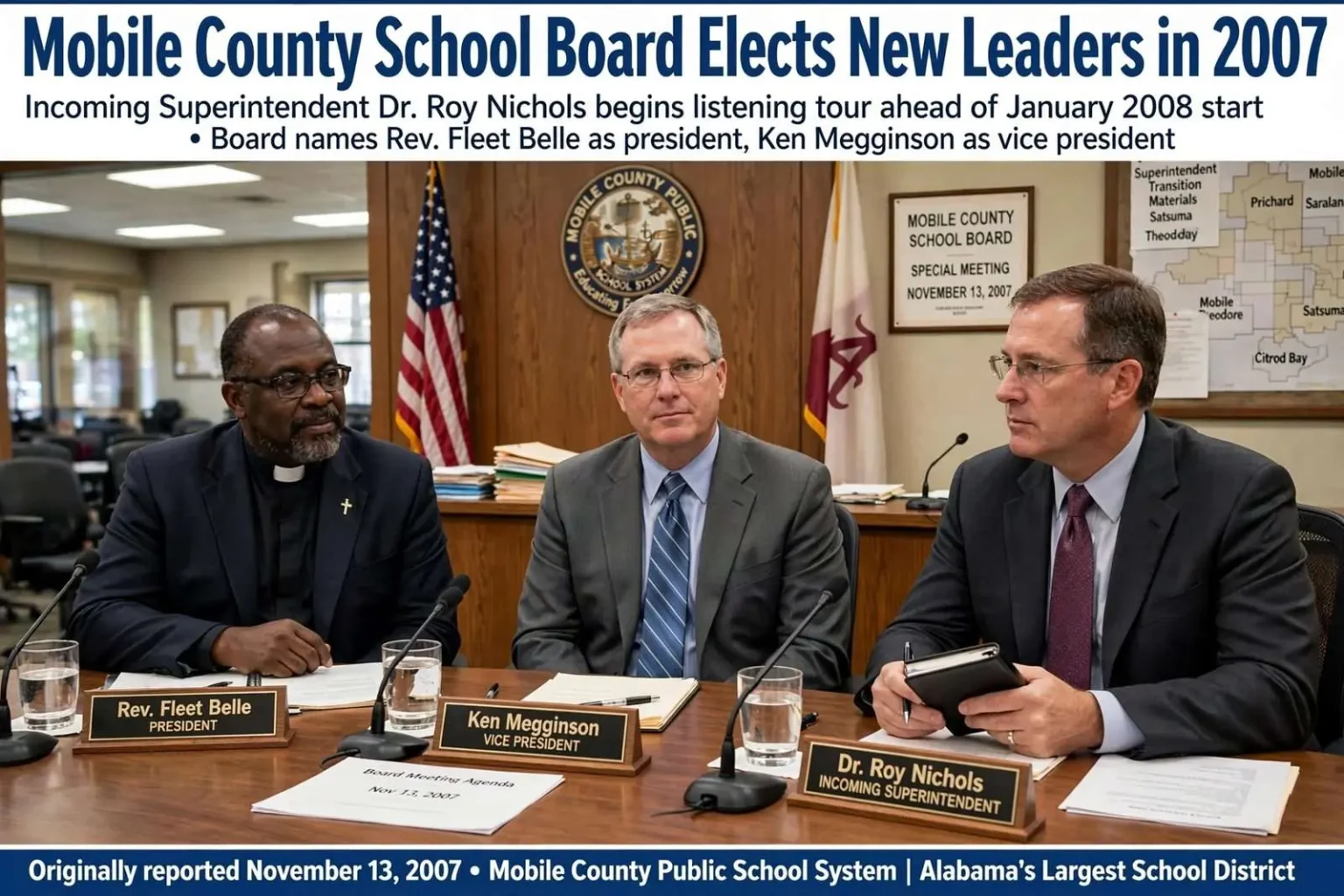
Originally reported November 13, 2007. The Mobile County school board elected new officers in November 2007 while incoming superintendent Dr. Roy Nichols began familiarizing himself with the school system before his official start date. The changes at the top came as the system prepared for a new era of leadership, with a superintendent arriving from outside the district and a board adjusting to a new set of officers at the dais.
Nichols attended his first school board meeting and visited two schools that morning, with plans to visit more. The early visits were part of a deliberate effort to learn the system from the ground up before taking office. He said he wanted to see every school, meet employees and hear from teachers and principals through an online survey.
The survey asked employees to share something they were proud of, identify what needed improvement and suggest what he could do to help the system succeed. The three-part format was designed to capture both institutional pride and candid criticism from the people who work in classrooms and school offices every day. Results of the survey were to be compiled as Nichols prepared his transition into the superintendent’s office.
Board members elected the Rev. Fleet Belle as president, replacing Judy Stout, and chose Ken Megginson as vice president. Belle said supporting Nichols while avoiding micromanagement would be among his priorities. Nichols was scheduled to begin as superintendent on Jan. 1, 2008.
Leading Alabama’s largest school system
The Mobile County Public School System is the largest school district in Alabama, serving tens of thousands of students across the city of Mobile, the surrounding suburbs and the county’s rural communities. Its campuses stretch from the urban core of Mobile out to communities such as Prichard, Saraland, Satsuma, Theodore, Grand Bay and Citronelle. Managing a system of that size makes the superintendent’s job one of the most prominent public positions in southwest Alabama.
The superintendent answers to an elected school board, whose members represent districts across the county. The board sets policy, approves budgets and hires the superintendent, while the superintendent runs day-to-day operations, recommends staff appointments and oversees instruction. How well that relationship works often shapes how much a system can accomplish, which is why Belle’s pledge to support Nichols without micromanaging him drew attention from observers of the district.
Nichols arrived with a career in education that prepared him for the scale of the Mobile County job. New superintendents in Alabama systems typically spend their first months learning budgets, personnel matters and the political landscape that surrounds a large urban district. His decision to begin with school visits and an employee survey reflected a management style focused on listening before making changes. The approach also buys time: an administrator who spends the fall listening enters the budget season with a clearer picture of where the community wants its resources to go, and employees who feel heard in the transition are more likely to give a new administration the benefit of the doubt when difficult choices arrive.
New officers take the gavel
The election of Fleet Belle as board president handed the leadership role to a Mobile pastor with long ties to the community. Board presidents in Mobile County set meeting agendas, preside over sessions and serve as the public face of the board between meetings. The position carries influence over how the board communicates with the superintendent and how disputes among members are worked out in public.
Belle replaced Judy Stout, who had held the president’s chair and continued to serve on the board after handing off the office. Rotating leadership among board members is a common practice in large Alabama districts, giving different members experience chairing meetings and keeping any single member from dominating the panel. Outgoing presidents typically remain active voices on the board, and Stout’s continued presence meant the incoming officers could still draw on her institutional knowledge.
Ken Megginson’s election as vice president gave the board a second officer positioned to step in when the president is unavailable. The vice president also often takes on assignments the president delegates, from committee work to public events. Together, the two officers were charged with keeping board meetings orderly and productive during a period of transition at the top of the administration.
Board service in a district of this size is a demanding, often thankless job. Members field calls from parents about everything from bus routes to bullying, sit through hours of meetings on budgets and personnel, and make decisions that affect tens of thousands of children. The officer positions add to that load, requiring extra coordination with the superintendent’s office and the district’s legal and finance staff.
Belle’s stated priority of supporting Nichols while avoiding micromanagement touched on one of the most persistent tensions in public education. Boards that involve themselves in personnel and operational decisions can undermine a superintendent, while boards that engage too little can lose sight of community concerns. Finding that balance would be a running theme as Nichols settled into the job in the new year.
Why the transition mattered
The November 2007 officer elections came at a pivotal moment for the district. Large urban systems across Alabama in that era faced pressures including tightening budgets, aging school buildings, competition from private schools and the steady work of raising student achievement. Mobile County’s size meant that any initiative — from curriculum changes to facility plans — operated at a scale few other districts in the state had to match.
Nichols’ plan to visit every school was more than ceremonial. Superintendents who make the rounds early build relationships with principals, teachers and support staff, and they see firsthand the condition of classrooms, cafeterias and athletic facilities that budget documents can only describe. The visits also signaled to school communities that the incoming administration intended to be visible across the county, not just in downtown Mobile.
The online survey extended that outreach to employees who might not otherwise meet the superintendent until after he took office. Asking employees what they were proud of gave staff a chance to highlight programs and people that deserved recognition, while the improvement question opened the door to frank talk about problems that had accumulated over the years. The final question — what Nichols could do to help — framed the incoming superintendent as a partner rather than a distant administrator.
Looking toward January
With a Jan. 1, 2008 start date on the calendar, Nichols’ pre-start weeks were a window into the system he would soon lead. Sitting in on his first board meeting allowed him to watch the board’s dynamics before he became the central figure at the table. The timing also meant the new board officers and the new superintendent would take office within weeks of each other, giving both sides a natural starting point for the working relationship Belle had described.
Transitions of this kind are closely watched in Mobile County because the school system touches so many households. The district is among the county’s largest employers, and its decisions on staffing, school closures and construction ripple through neighborhoods from Wilmer to Dauphin Island Parkway. Parents, teachers and business leaders alike follow changes at the superintendent’s office for signs of what will be prioritized in the years ahead.
The period between a superintendent’s hiring and start date is also when a district’s expectations take shape. Board members who elected Nichols, along with the new officers, had the chance to outline their hopes for the administration before day one. Belle’s emphasis on support rather than interference suggested a board ready to let its new chief executive establish his own approach, provided the system moved in the right direction.
Nichols’ listening tour and survey results were expected to inform his early decisions once he took office. Superintendents often use input gathered during transitions to structure their first budget recommendations, staff realignments and community meetings. For Mobile County employees who responded to the survey, the answers they gave about pride, problems and priorities had a direct line to the incoming administration’s agenda.
As November 2007 closed, the pieces of a new administration were in place: a president and vice president elected by their colleagues, an incoming superintendent making his rounds, and a start date that would put all of them to work in the new year. What followed would be measured the way large school systems always are — in test scores, budgets, construction projects and the confidence of the families the district serves.
The story of that November week remains a snapshot of a school system in motion, capturing the moment leadership passed to a new generation of administrators and board officers. For the teachers, principals and employees who filled out the survey, and for the parents watching the transition, it marked the beginning of a chapter that would shape Mobile County classrooms for years to come.